
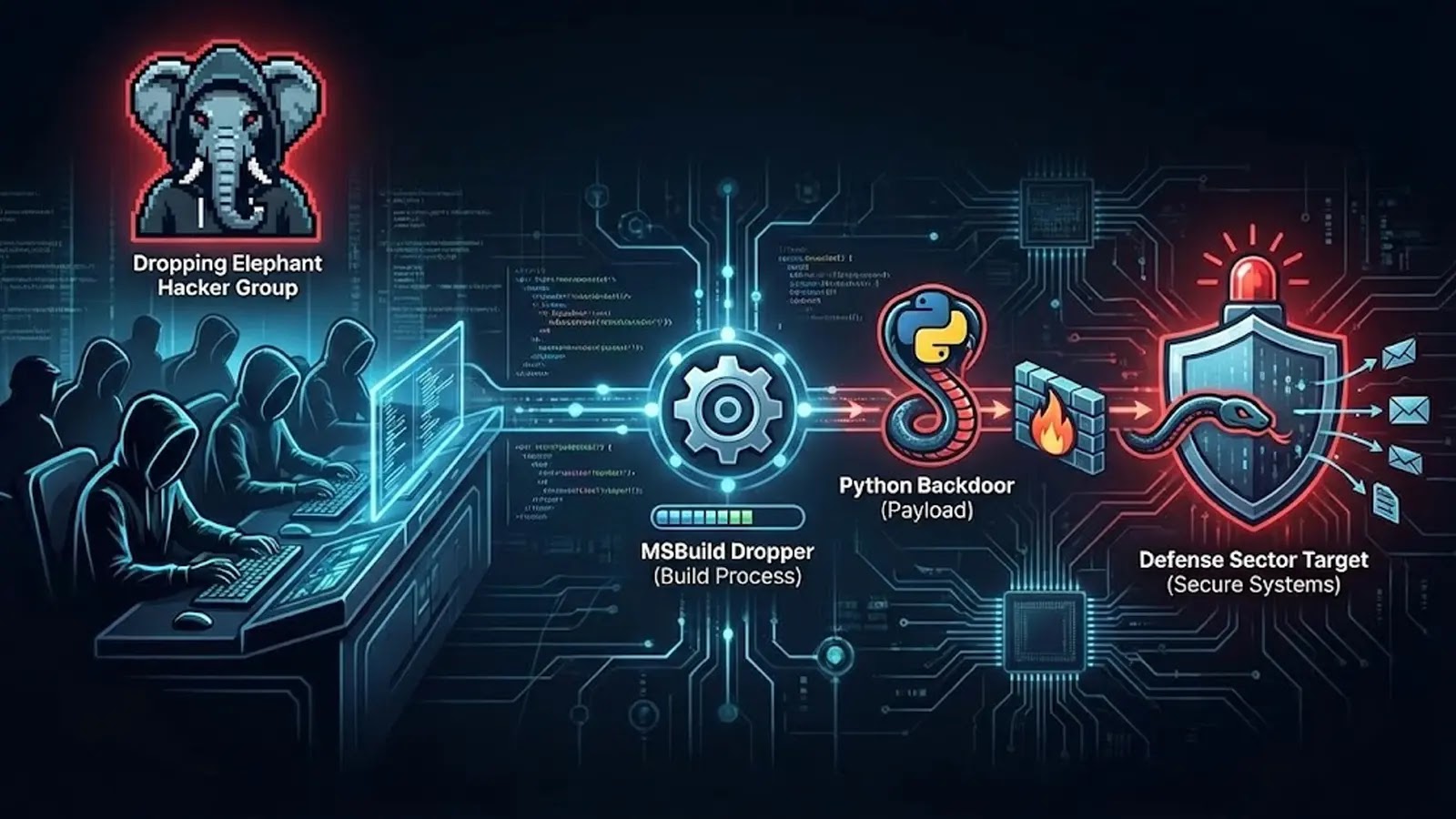
Dropping Elephant Hacker Group Attacks Defense Sector Using Python Backdoor via MSBuild Dropper
Cyber warfare is a relentless, shadow conflict, and the recent activities of the “Dropping Elephant” threat group underscore its escalating sophistication. This India-aligned adversary has unveiled a complex multi-stage cyberattack, specifically targeting Pakistan’s vital defense sector. What makes this campaign particularly chilling is its ingenious use of a Python-based remote access Trojan (RAT) cleverly disguised and deployed through an MSBuild dropper.
Understanding the Dropping Elephant Threat Group
The “Dropping Elephant” hacker group, also known by other monikers in the intelligence community, is an advanced persistent threat (APT) actor with suspected ties to India. Their operations typically involve espionage and intelligence gathering, primarily focusing on geopolitical rivals. This latest campaign against Pakistani defense targets perfectly aligns with their established modus operandi. They are known for their patience, persistence, and ability to adapt their tactics to bypass conventional security measures.
The Multi-Stage Attack Chain: A Closer Look
This sophisticated attack against Pakistan’s defense sector is not a single-shot exploit but a carefully orchestrated multi-stage process designed for maximum stealth and persistence. It begins with highly targeted spear-phishing attempts, leveraging fake defense-related lures to entice victims within military research and development units and procurement facilities. These initial footholds are crucial for establishing a presence within the networks linked to entities like Pakistan’s National Radio and Telecommunication Corporation (NRTC).
Once a victim is engaged, the attack chain unfolds:
- Phishing Lures: Adversaries employ convincing, defense-themed email lures designed to appear legitimate. These emails often contain malicious attachments or links that initiate the infection process.
- MSBuild Dropper: The initial compromise often involves an MSBuild dropper. MSBuild (Microsoft Build Engine) is a powerful platform for building applications. Threat actors abuse its legitimate functionality to execute malicious code, making detection difficult as it blends with normal system activity. This technique allows the attacker to execute arbitrary commands or scripts on the compromised system without directly dropping an executable.
- Python-based Remote Access Trojan (RAT): The ultimate payload is a custom Python-based RAT. Python’s versatility and cross-platform compatibility make it an attractive choice for malware developers. This RAT provides the attackers with extensive control over the compromised machine, enabling data exfiltration, further reconnaissance, and command execution. Its fileless or script-based nature also makes it harder for traditional endpoint detection and response (EDR) solutions to identify.
Why the MSBuild Dropper and Python RAT Combo is Effective
The combination of an MSBuild dropper and a Python RAT presents several advantages for the Dropping Elephant group:
- Evasion: MSBuild is a trusted Windows component, making its malicious use harder to detect by traditional signature-based antiviruses. The execution often appears as a legitimate system process.
- Obfuscation: Python scripts can be easily obfuscated to hide their true intent, and their execution doesn’t necessarily leave typical executable footprints on disk.
- Flexibility: Python RATs are highly customizable, allowing attackers to tailor their capabilities based on their objectives and the target environment.
- Low Footprint: Leveraging built-in tools (living off the land) and scripting languages reduces the necessity of introducing new, potentially detectable binaries onto the system.
Remediation Actions and Defense Strategies
Defending against sophisticated attacks like those perpetrated by Dropping Elephant requires a multi-layered, proactive approach, especially for critical infrastructure and defense organizations.
- Enhanced Email Security: Implement advanced email gateway solutions with sandboxing and URL rewriting capabilities to detect and block phishing attempts. Educate users on identifying spear-phishing attacks.
- Endpoint Detection and Response (EDR): Deploy robust EDR solutions that can monitor process behavior, detect anomalous MSBuild activity, and identify suspicious script execution.
- Network Segmentation: Segment networks to limit lateral movement if a compromise occurs. Critical assets should reside in highly protected zones.
- Principle of Least Privilege: Enforce the principle of least privilege for all users and applications, minimizing the potential impact of a successful compromise.
- Security Awareness Training: Conduct regular and interactive security awareness training sessions for all personnel, focusing on social engineering tactics and phishing detection.
- Regular Patching and Updates: Ensure all operating systems, applications, and security software are routinely patched and updated to address known vulnerabilities. While no specific CVE has been publicly associated with this particular MSBuild abuse, staying updated is crucial against general exploitation.
- Threat Intelligence: Subscribe to and act upon relevant threat intelligence feeds to understand the current tactics, techniques, and procedures (TTPs) of APT groups like Dropping Elephant.
- Advanced Threat Protection (ATP): Implement ATP solutions that use behavioral analysis and machine learning to detect unknown threats, including advanced RATs.
- Monitoring and Logging: Implement comprehensive logging across endpoints, networks, and applications. Regularly review logs for suspicious activities, especially those related to PowerShell, MSBuild, and Python execution.
- Incident Response Plan: Develop and regularly test a thorough incident response plan to ensure rapid detection, containment, eradication, and recovery from attacks.
Relevant Tools for Detection and Mitigation
| Tool Name | Purpose | Link |
|---|---|---|
| Microsoft Defender for Endpoint | Advanced EDR capabilities, behavioral analysis, and threat hunting for Windows environments. | https://www.microsoft.com/en-us/security/business/endpoint-security/microsoft-defender-endpoint |
| Elastic Security (SIEM/XDR) | Unified security analytics for endpoint, network, and cloud data; threat hunting and incident response. | https://www.elastic.co/security/ |
| Proofpoint / Mimecast | Advanced email security gateways for phishing and malware protection. | https://www.proofpoint.com/ / https://www.mimecast.com/ |
| Sysmon (System Monitor) | Free Windows system service and device driver that logs detailed information about process creations, network connections, and file modifications. | https://learn.microsoft.com/en-us/sysinternals/downloads/sysmon |
| Snort / Suricata | Open-source intrusion detection/prevention systems (IDS/IPS) for network traffic analysis and signature-based detection. | https://www.snort.org/ / https://suricata.io/ |
Key Takeaways for Cybersecurity Professionals
The Dropping Elephant campaign is a stark reminder that state-sponsored groups continue to refine their offensive capabilities. Their adoption of common tools like MSBuild for droppers and Python for RATs highlights a shift towards “living off the land” techniques, which are inherently more challenging to detect. Defense organizations and entities involved in critical national infrastructure must move beyond signature-based defenses and adopt behavioral analytics, comprehensive logging, and robust EDR solutions. Constant vigilance, coupled with well-trained personnel and a proactive threat intelligence strategy, remains the strongest defense against such persistent and sophisticated adversaries.




