
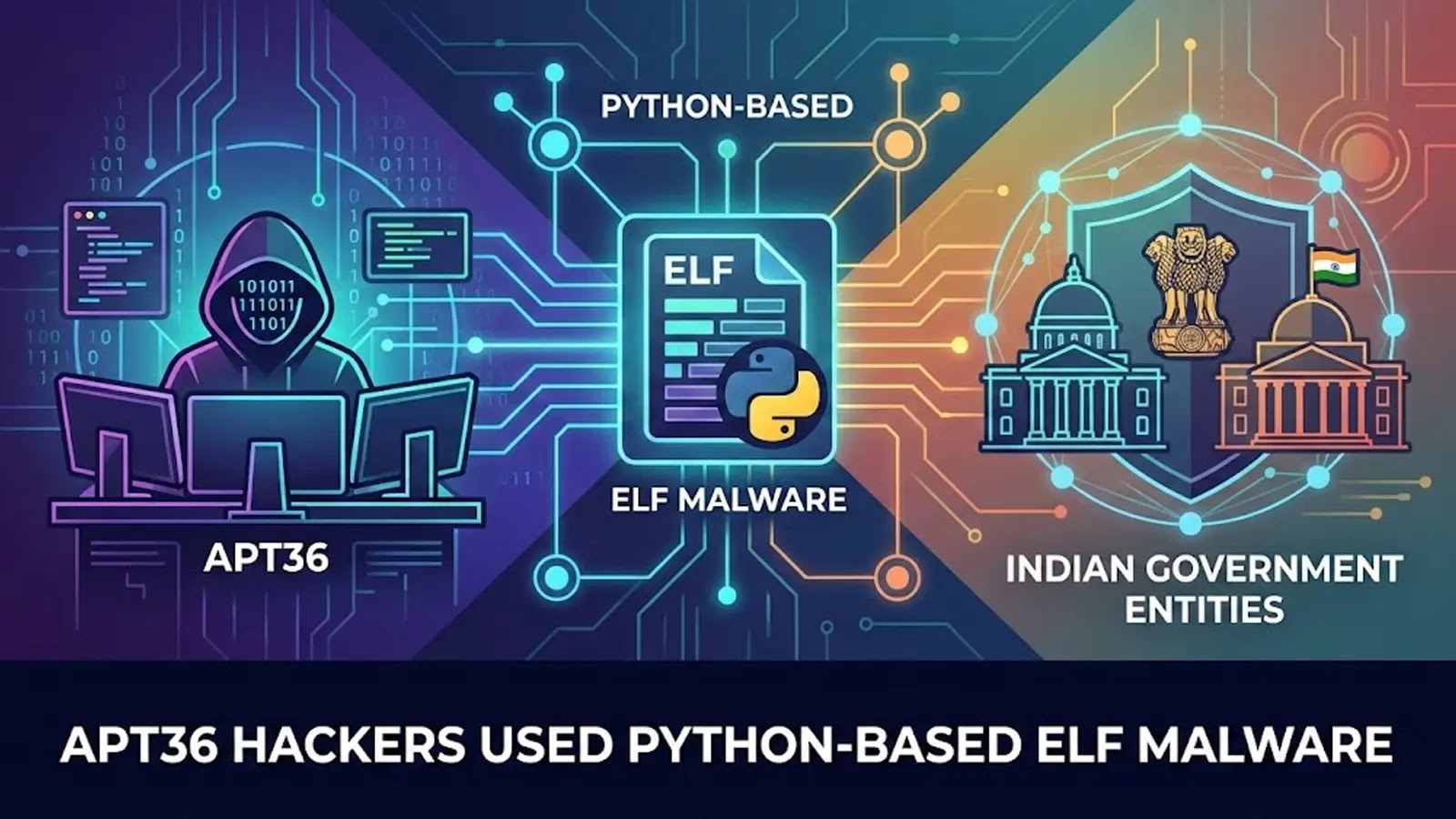
APT36 Hackers Used Python-Based ELF Malware to Target Indian Government Entities
A New Threat: APT36’s Python-Based ELF Malware Targets Indian Government
The digital battlefield is constantly evolving, and nation-state threat actors are at the forefront of this arms race. A recent report sheds light on a significant escalation in tactics by the Pakistan-based threat group APT36, also known as Transparent Tribe. This formidable adversary has deployed a newly developed, Python-based ELF (Executable and Linkable Format) malware in a sophisticated cyber-espionage campaign directly targeting Indian government institutions. This development signals a concerning shift in their capabilities and a sharpened focus on compromising Linux-based systems.
Understanding APT36 (Transparent Tribe)
APT36, or Transparent Tribe, has a well-documented history of engaging in cyber-espionage, primarily against government and military entities in the Indian subcontinent. Their modus operandi typically involves highly targeted spear-phishing campaigns designed to compromise sensitive systems and exfiltrate confidential data. Their previous campaigns often utilized custom-built Windows malware, but this new development indicates a strategic expansion into Linux environments, reflecting a broader trend of threat actors diversifying their attack vectors.
The Evolution of the Threat: Python-Based ELF Malware
The core of this new campaign is a novel Python-based ELF malware. The choice of Python is particularly notable due to its cross-platform compatibility and the relative ease with which developers can create complex functionalities. When compiled into an ELF executable, this malware can run natively on Linux systems, making it a potent tool for breaching and maintaining persistence within Linux-centric infrastructures commonly found in government and enterprise environments.
- Cross-Platform Advantage: Python’s versatility allows for rapid development and adaptation across different operating systems.
- Stealth and Evasion: Python-based malware can sometimes be more difficult to detect by traditional signature-based antivirus solutions, especially if obfuscated or packed.
- ELF Format: The use of the ELF format ensures direct execution on Linux systems, bypassing compatibility layers.
Spear-Phishing: The Initial Attack Vector
As with many advanced persistent threats, the ingress point for this campaign is spear-phishing. These highly personalized emails are crafted to appear legitimate, often impersonating trusted contacts or governmental communications. The emails contain weaponized attachments or malicious links designed to entice recipients into executing the Python-based ELF malware. Once executed, the malware establishes a foothold, enabling further reconnaissance, lateral movement, and data exfiltration.
- Social Engineering: Spear-phishing relies heavily on manipulating human psychology to bypass security controls.
- Weaponized Attachments: Malicious documents (e.g., PDFs, Office files) or archives containing the ELF executable are common payloads.
- Credential Harvesting: Phishing attempts often aim to steal credentials that can then be used to access further systems.
Why Linux? Shifting Attack Surfaces
The pivot towards Linux-based malware by APT36 highlights a crucial shift in the threat landscape. Linux servers and workstations are integral to the infrastructure of many government organizations and critical institutions. Historically, Windows systems were the primary target for many APT groups, but as organizations harden their Windows defenses, adversaries are increasingly looking towards less saturated attack surfaces. Linux’s prevalence in cloud environments and critical infrastructure makes it an attractive target for cyber-espionage.
- Server Dominance: Linux powers a vast majority of web servers and cloud infrastructure.
- Development Environments: Many developers and IT professionals utilize Linux, making it a gateway to sensitive data and systems.
- Evasive Potential: Fewer security tools are sometimes deployed or configured as robustly on Linux endpoints compared to Windows.
Remediation Actions and Proactive Defense
Defending against sophisticated threats like APT36 requires a multi-layered and dynamic security strategy. Indian government entities, and indeed any organization with critical Linux infrastructure, must immediately review and enhance their cybersecurity posture.
- Enhanced Email Security: Implement advanced email filtering solutions that scrutinize attachments, links, and sender authenticity. Educate users on identifying spear-phishing attempts.
- Endpoint Detection and Response (EDR) for Linux: Deploy EDR solutions specifically designed for Linux environments to detect and respond to suspicious activities, including new process creation, file modifications, and network connections.
- Network Segmentation: Isolate critical systems and networks to minimize the impact of a breach and restrict lateral movement.
- Regular Patch Management: Ensure all operating systems, applications, and frameworks (including Python interpreters) are kept up-to-date with the latest security patches. This helps mitigate known vulnerabilities. For instance, specific Python vulnerabilities might be tracked, although none are directly associated with this ELF malware variant itself. Generic vulnerabilities like those in underlying libraries (e.g., OpenSSL CVE-2023-0464, CVE-2023-0466) could indirectly affect interpreter security if not patched.
- Security Awareness Training: Continuously train employees, especially those with access to sensitive information, on the latest phishing techniques and social engineering tactics.
- Principle of Least Privilege: Grant users and processes only the minimum necessary permissions to perform their tasks.
- Behavioral Analytics: Monitor system and network behavior for anomalies that may indicate compromise, rather than relying solely on signature-based detection.
- Threat Intelligence: Stay informed about the latest tactics, techniques, and procedures (TTPs) used by APT groups like APT36.
Here’s a table of tools that can assist in detection and mitigation:
| Tool Name | Purpose | Link |
|---|---|---|
| Osquery | Endpoint visibility and host intrusion detection | https://osquery.io/ |
| Falco | Runtime security for containers and Linux | https://falco.org/ |
| YARA | Pattern matching for malware identification | https://virustotal.github.io/yara/ |
| Snort/Suricata | Network Intrusion Detection/Prevention Systems (NIDS/NIPS) | https://www.snort.org/ / https://suricata-ids.org/ |
Conclusion: A Growing Threat to Linux Environments
The deployment of Python-based ELF malware by APT36 marks a critical evolution in their capabilities and underscores the increasing sophistication of nation-state threat actors targeting Linux environments. For government entities and organizations globally, this development serves as a stark reminder to fortify their Linux infrastructure, enhance their detection capabilities, and prioritize robust cybersecurity training. Proactive defense, continuous monitoring, and a deep understanding of evolving threat TTPs are essential to withstand such advanced cyber-espionage campaigns.




