
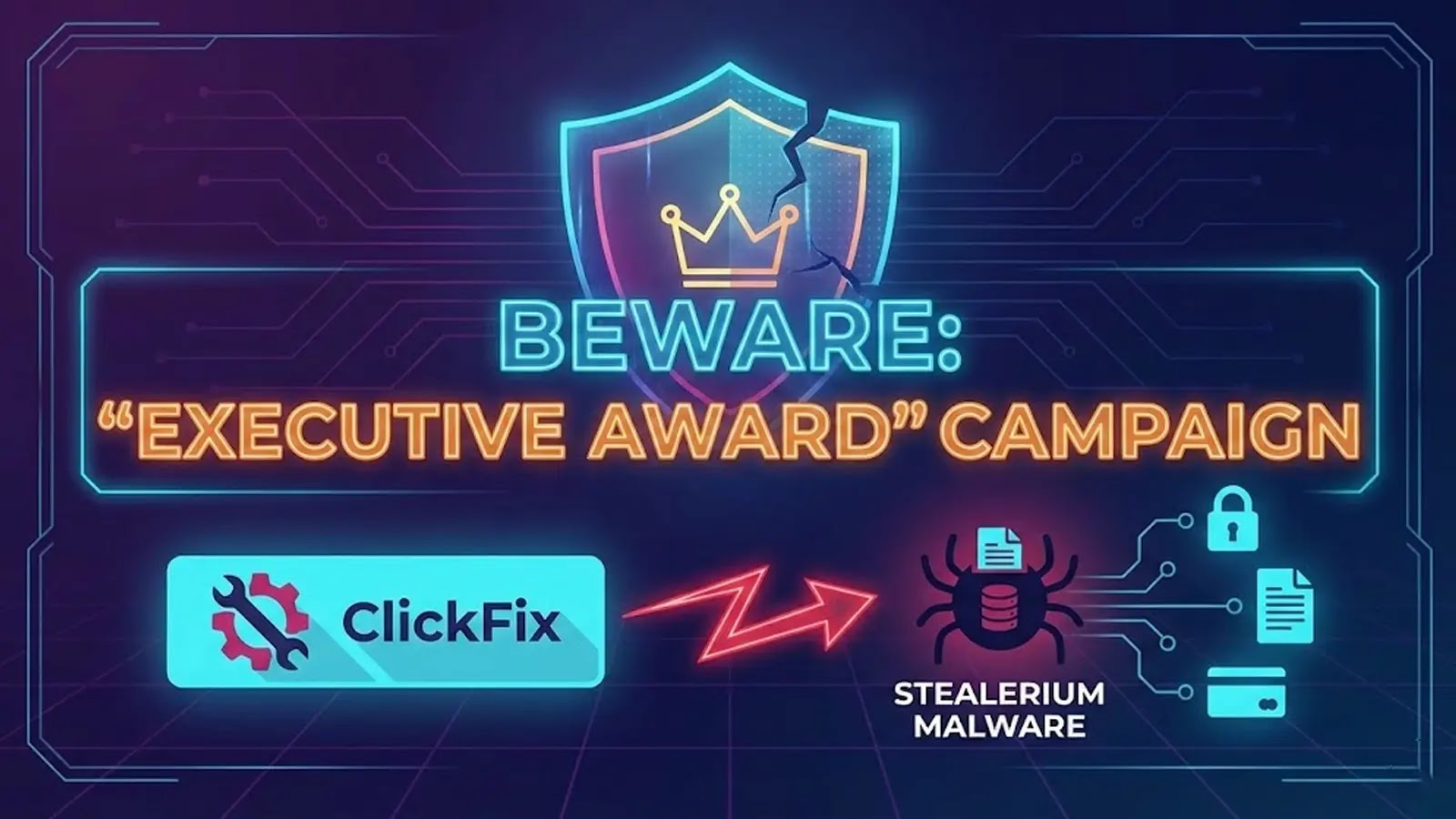
Beware of the New ‘Executive Award’ Campaign That Uses ClickFix to Deliver Stealerium Malware
Unmasking the Executive Deception: A New Phishing Threat Delivering Stealerium Malware
Organizations face an escalating threat from a sophisticated phishing campaign dubbed “Executive Award.” This multi-stage attack masterfully blends social engineering with potent malware delivery, aiming to compromise credentials and sensitive information. Understanding the mechanisms of this particular threat is critical for bolstering defensive postures against similar evolving tactics.
The Two-Stage Attack: Luring and Compromise
The “Executive Award” campaign operates through a meticulously crafted two-phase approach. Initially, threat actors leverage a compelling social engineering ploy to entice unsuspecting recipients. The lure, disguised as an internal award or recognition, creates a sense of urgency and importance, prompting users to interact with malicious links.
The first stage involves a convincing phishing email leading to a fake HTML form. This form is designed to impersonate legitimate login portals, tricking users into divulging their login credentials. Once these credentials are exfiltrated, the second, more destructive phase of the attack unfolds.
ClickFix and Stealerium: The Malware Delivery Mechanism
Following the credential harvesting, the campaign deploys a more insidious payload: the Stealerium information stealer. This malware is facilitated by a loader referred to as “ClickFix.” Stealerium is designed to extract a wide array of sensitive data from compromised systems, ranging from browser credentials and financial information to cryptocurrency wallet details and system configurations. The seamless, two-step process of credential theft followed by malware deployment underscores the advanced nature of this campaign.
Understanding Stealerium’s Capabilities
Stealerium belongs to a category of malware specifically engineered to exfiltrate valuable data. Its capabilities typically include:
- Credential Theft: Harvesting usernames and passwords from web browsers, email clients, and FTP applications.
- Financial Data Exfiltration: Targeting credit card information, banking details, and cryptocurrency wallet keys.
- System Information Collection: Gathering details about the operating system, installed software, and hardware configurations.
- File Grabber Functionality: Searching for and exfiltrating specific file types or sensitive documents.
- Screenshotting: Capturing images of the user’s desktop to gather visual information.
While a specific CVE for this particular Stealerium variant or the “Executive Award” campaign itself has not yet been assigned, general information stealer vulnerabilities and associated attack vectors are frequently documented. For broader understanding of information stealer threats, consider exploring related CVEs such as CVE-2023-34063 (related to a different stealer’s vulnerability) and CVE-2023-40810 (general malware distribution via phishing) which highlight common attack surfaces for such threats.
Remediation Actions and Protective Measures
Mitigating the risk posed by campaigns like “Executive Award” requires a multi-layered security approach. Organizations must prioritize both technical controls and robust employee training.
- Enhanced Email Security: Implement advanced email filtering solutions that can detect and block suspicious emails, including those with deceptive links, spoofed sender addresses, and malicious attachments.
- Multi-Factor Authentication (MFA): Enforce MFA across all critical systems and applications. Even if credentials are compromised, MFA acts as a crucial barrier to unauthorized access.
- Security Awareness Training: Conduct regular and engaging security awareness training for all employees. Emphasize the dangers of phishing, how to identify suspicious emails, and the importance of verifying sender identities and link legitimacy.
- Endpoint Detection and Response (EDR): Deploy EDR solutions to monitor endpoints for malicious activity, detect unusual processes, and identify potential malware infections, including those delivered by agents like ClickFix.
- Principle of Least Privilege: Limit user permissions to the absolute minimum required for their job functions. This reduces the potential damage if an account is compromised.
- Regular Software Updates: Keep all operating systems, applications, and security software up to date to patch known vulnerabilities that attackers might exploit.
- Incident Response Plan: Develop and regularly test a comprehensive incident response plan to ensure a rapid and effective response to security breaches.
Detection and Analysis Tools
Various tools can assist in detecting and analyzing threats like the “Executive Award” campaign and Stealerium. Integrating these into your security ecosystem is crucial.
| Tool Name | Purpose | Link |
|---|---|---|
| PhishTank | Community-based phishing URL verification | https://www.phishtank.com/ |
| VirusTotal | Aggregate malware analysis from multiple antivirus engines | https://www.virustotal.com/gui/ |
| urlscan.io | Website and link analysis for suspicious behavior | https://urlscan.io/ |
| Threat Intelligence Platforms (e.g., Anomali, Recorded Future) | Contextual threat data, actor tracking, and indicator feeds | (Provider-specific links) |
| Endpoint Detection & Response (EDR) Solutions (e.g., CrowdStrike, SentinelOne) | Real-time threat detection and response on endpoints | (Vendor-specific links) |
Conclusion: Staying Ahead of Social Engineering
The “Executive Award” campaign serves as a stark reminder of the persistent and evolving nature of phishing threats. The combination of cunning social engineering and sophisticated malware delivery mechanisms, like ClickFix leading to Stealerium, necessitates a proactive and adaptive security posture. By prioritizing robust email security, enforcing MFA, conducting continuous security awareness training, and employing advanced detection tools, organizations can significantly reduce their attack surface and protect against these financially motivated cyber threats.




