
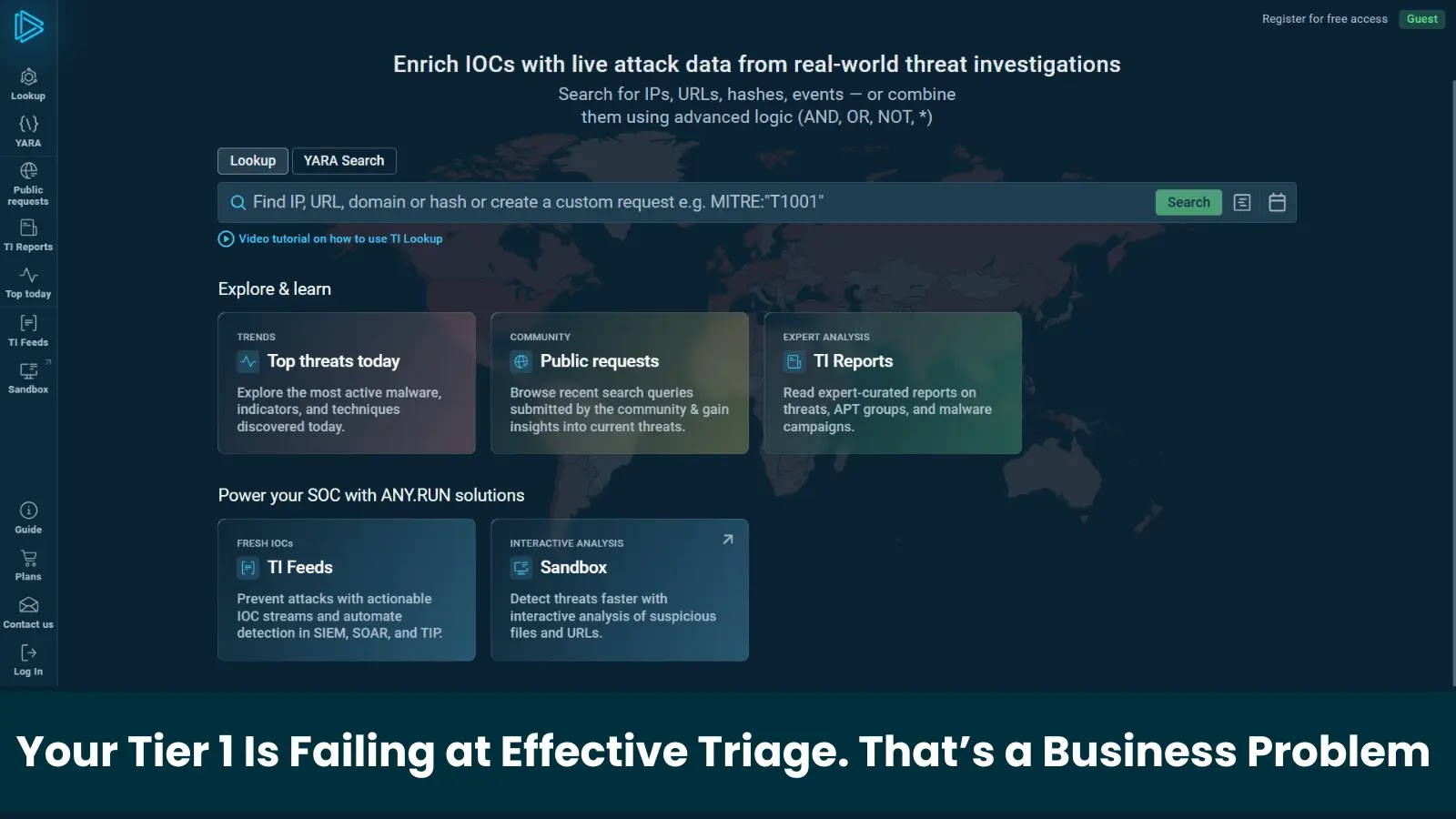
Your Tier 1 Analyst at SOC Team Is Failing at Effective Triage. That’s a Business Problem
In the high-stakes environment of a Security Operations Center (SOC), speed and accuracy are paramount. Decisions made in the first few minutes of an alert coming in can determine the fate of an organization’s security posture. When a Tier 1 security analyst, the frontline defense, falters in the critical task of alert triage, the ripple effects are significant. This isn’t just a technical glitch; it’s a profound business problem that directly impacts an organization’s resilience, financial stability, and reputation.
The Critical Role of Alert Triage in a SOC
Alert triage is the initial evaluation process for security alerts generated by various systems, such as SIEMs, IDSs, and endpoint detection and response (EDR) tools. It’s the moment a Tier 1 analyst determines whether an alert represents a legitimate security incident, a benign false positive, or an event requiring immediate escalation to a higher tier. Effective triage acts as a critical filter, ensuring that valuable resources are directed where they’re most needed and that real threats are identified before they can cause significant damage.
When this process is executed efficiently:
- Detection speed remains high: Genuine threats are recognized and acted upon swiftly.
- Response resources are optimized: Analysts aren’t wasting time investigating non-issues.
- Escalation paths are clear: Complex or critical incidents reach appropriate senior analysts or incident response teams quickly.
The Business Impact of Failed Triage
As highlighted by Cyber Security News, the breakdown of effective triage by Tier 1 analysts isn’t merely a technical hiccup; it precipitates a range of severe business consequences:
- Increased Mean Time To Detect (MTTD) and Mean Time To Respond (MTTR): False positives overwhelming the system mean real threats get buried. This delay allows attackers more time to move laterally, exfiltrate data, or deploy ransomware, escalating the scope and cost of an incident.
- Resource Misallocation and Burnout: Junior analysts spending excessive time chasing phantom threats leads to an inefficient use of human resources. This not only burdens the security team but also contributes to analyst fatigue and burnout, further degrading overall SOC effectiveness.
- Missed Real Incidents: The worst-case scenario is a legitimate and critical security event being miscategorized as a false positive or simply ignored amidst a sea of noise. This can lead to significant data breaches, system outages, and compliance violations.
- Financial Repercussions: Data breaches incur massive costs from incident response, legal fees, regulatory fines (e.g., GDPR, CCPA), notification expenses, and reputational damage. Prolonged downtime due to an unaddressed incident also results in lost revenue.
- Reputational Damage and Loss of Trust: A significant security incident, especially one linked to delayed detection, erodes customer trust and harms brand reputation, which can take years, if ever, to recover.
- Compliance Failures: Many regulatory frameworks mandate specific response times and reporting for security incidents. Failure to effectively triage and respond can lead to non-compliance penalties.
Common Reasons for Triage Failures
Several factors contribute to Tier 1 analysts struggling with effective triage:
- Alert Fatigue: SOCs are often inundated with thousands of alerts daily. The sheer volume makes it challenging to distinguish between critical threats and benign activity.
- Lack of Context and Correlation: Without sufficient context about the alert (e.g., asset criticality, user behavior, network topology), analysts find it hard to accurately assess its significance.
- Insufficient Training: Junior analysts may lack the experience, technical skills, or threat intelligence knowledge to correctly interpret complex alerts.
- Poorly Tuned Detection Rules: Overly broad or unrefined SIEM rules generate excessive false positives, drowning analysts in irrelevant information.
- Lack of Playbooks and Standard Operating Procedures (SOPs): Inconsistent or absent clear instructions for alert handling leads to varied and often ineffective responses.
- Outdated Threat Intelligence: Without current information on emerging threats, tactics, techniques, and procedures (TTPs), analysts may fail to recognize new attack patterns.
Remediation Actions for Enhancing Triage Effectiveness
Addressing the issue of ineffective triage requires a multi-faceted approach, combining technology, processes, and people-centric solutions:
- Optimize SIEM and EDR Rules: Regularly review and fine-tune detection rules to reduce false positives. Implement anomaly detection and behavioral analytics to highlight truly suspicious activities.
- Enhance Automation and Orchestration: Utilize Security Orchestration, Automation, and Response (SOAR) platforms to automate repetitive tasks, gather contextual information, and even initiate initial containment actions for certain alert types.
- Invest in Continuous Training and Skill Development: Provide ongoing training to Tier 1 analysts on threat landscapes, new attack vectors, specific tools, and incident response procedures. Foster a culture of continuous learning.
- Develop Comprehensive Playbooks and SOPs: Create clear, actionable playbooks for common alert types, guiding analysts through the triage process step-by-step, including data points to check, questions to ask, and escalation paths.
- Integrate Threat Intelligence: Ensure that security tools and analyst workflows integrate up-to-date threat intelligence feeds. This helps analysts quickly identify known malicious indicators of compromise (IOCs).
- Implement User Entity and Behavior Analytics (UEBA): UEBA tools can baselines normal user and entity behavior, making it easier to spot deviations that might indicate a genuine threat, reducing reliance on signature-based detection alone.
- Feedback Loops and QA: Establish a robust feedback mechanism between Tier 1 and Tier 2/3 analysts. Review triage decisions, identify areas for improvement, and use these insights to refine processes and training.
- Focus on Contextual Enrichment: Ensure that alerts are enriched with relevant context, such as asset criticality, user roles, network segment, and historical data, to aid in rapid and accurate decision-making.
Conclusion
The ability of a SOC to effectively triage security alerts is not merely a technical checkbox; it’s a fundamental pillar of an organization’s cybersecurity resilience. When Tier 1 analysts fail at this critical task, the consequences cascade, impacting detection speed, misallocating resources, and exposing the business to significant financial, operational, and reputational damage. By investing in optimized technology, comprehensive training, clear processes, and contextual enrichment, organizations can empower their frontline defenders to perform effective triage, transforming potential crises into manageable incidents and safeguarding the overall health of the business.




