
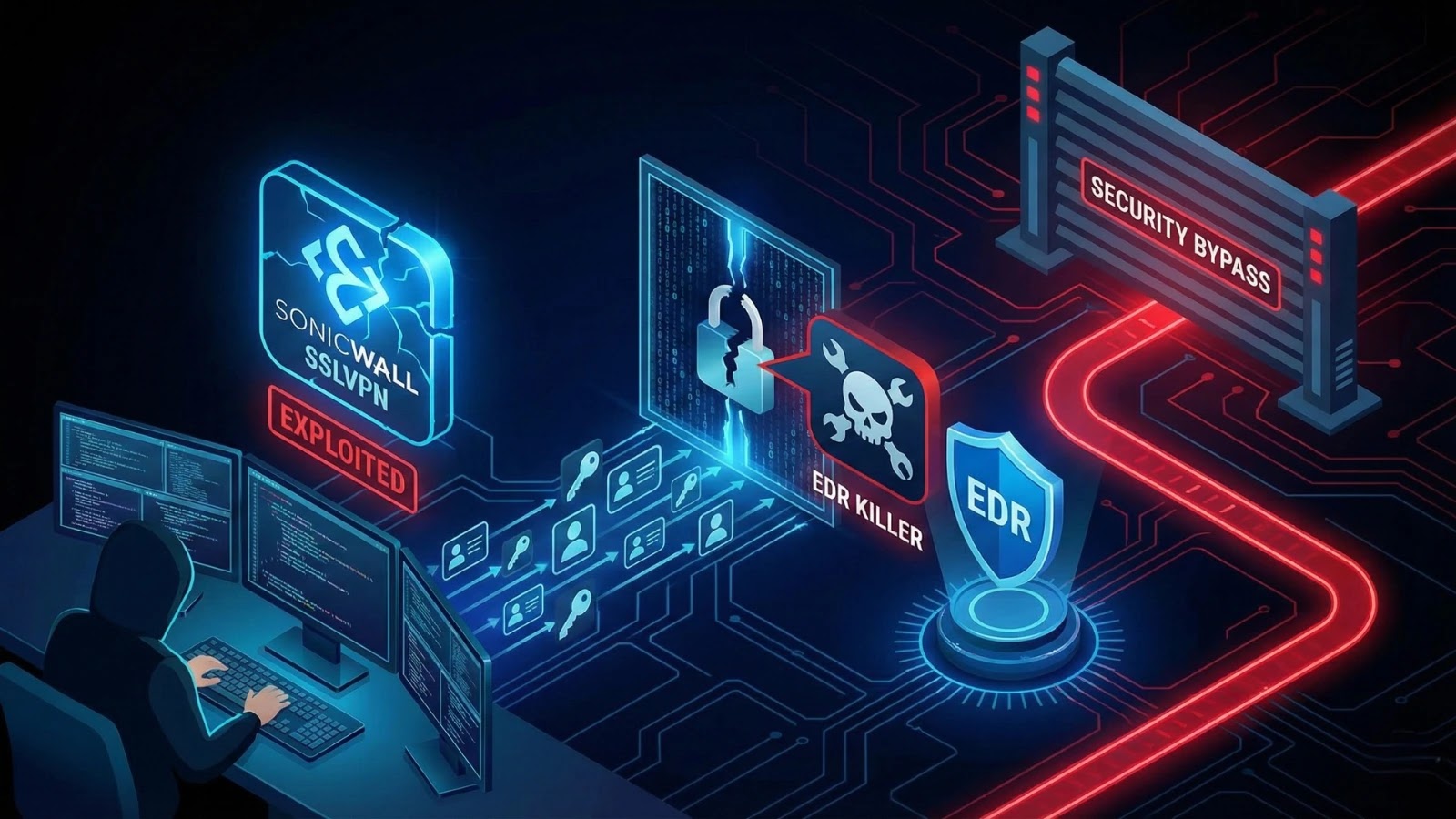
Hackers Exploit SonicWall SSLVPN Credentials to Deploy EDR Killer and Bypass Security
The cybersecurity landscape is relentlessly shaped by the ingenuity of threat actors. A recent campaign, detailed by Huntress in early February 2026, highlights a concerning evolution: hackers are actively exploiting compromised SonicWall SSLVPN credentials to breach enterprise networks. Their objective? To deploy a sophisticated “EDR killer” capable of blinding even advanced endpoint detection and response (EDR) solutions, effectively neutralizing a crucial layer of defense.
The SonicWall SSLVPN Credential Exploitation
This attack campaign leverages a fundamental vulnerability in security: the compromise of valid access credentials. Threat actors are gaining initial network access not through zero-day exploits or complex RCEs, but by utilizing legitimate SonicWall SSLVPN accounts. This method bypasses many perimeter defenses, as the traffic appears legitimate to network firewalls and VPN gateways. Once inside, they move swiftly to establish persistence and elevate privileges.
The EDR Killer: A “Bring Your Own Vulnerable Driver” (BYOVD) Attack
The core of this advanced attack lies in the deployment of an “EDR killer.” This isn’t a simple malware string; it’s a sophisticated “Bring Your Own Vulnerable Driver” (BYOVD) attack. In a BYOVD scenario, attackers exploit legitimate, albeit vulnerable, signed drivers to execute malicious code with kernel-level privileges. This technique allows them to:
- Disable or uninstall EDR agents.
- Terminate security processes.
- Manipulate system APIs to hide their activities.
- Achieve deep system access, often undetected by many user-mode security solutions.
By operating at the kernel level, the EDR killer can effectively blind the very tools designed to detect and respond to such intrusions, giving the attackers free rein within the compromised network. The specific vulnerable driver utilized in this campaign has not been publicly detailed, but the pattern of BYOVD attacks is well-established, often exploiting known flaws in older, legitimate drivers that are still broadly trusted by operating systems.
Impact and Risks Associated with EDR Killer Deployment
The successful deployment of an EDR killer carries severe ramifications for an organization:
- Complete Network Blindness: Security teams lose visibility into attacker activities on endpoints, rendering EDR solutions ineffective.
- Data Exfiltration: Unhindered by security, attackers can easily locate, access, and exfiltrate sensitive data.
- Ransomware Deployment: EDR circumvention creates an ideal environment for deploying ransomware, as prevention and detection mechanisms are severely hampered.
- Long-Term Persistence: Without EDR monitoring, attackers can establish deep, hard-to-detect persistence mechanisms, leading to prolonged compromise.
- Reputational Damage: Data breaches resulting from such attacks can severely damage an organization’s reputation and lead to significant financial penalties.
Remediation Actions and Proactive Defense Strategies
Organizations using SonicWall SSLVPN solutions and those concerned about sophisticated EDR bypass techniques must implement robust remediation and proactive defense strategies:
- Strict Credential Management:
- Implement strong, unique passwords for all VPN accounts.
- Enforce mandatory multi-factor authentication (MFA) for all SonicWall SSLVPN access.
- Regularly rotate VPN credentials, especially for administrative accounts.
- Monitor VPN Logs Aggressively:
- Scrutinize SonicWall SSLVPN logs for anomalous login attempts, geographically improbable logins, and unusual access patterns.
- Integrate VPN logs with a Security Information and Event Management (SIEM) system for centralized analysis and alert generation.
- Implement Least Privilege: Restrict VPN user access to only the resources absolutely necessary for their role. Segment networks to limit lateral movement potential.
- Patch and Update Diligently: Ensure all SonicWall appliances are running the latest firmware with all security patches applied. Refer to official SonicWall advisories for security updates.
- Advanced EDR/XDR Capabilities: While the EDR killer aims to bypass, modern EDR/XDR platforms offer advanced behavioral analysis and kernel-level monitoring that may detect the BYOVD stage or subsequent attacker actions. Ensure your EDR solution is maintained and configured for maximum efficacy.
- Application Whitelisting: Implement application whitelisting solutions to prevent unauthorized drivers and executables from running on endpoints.
- Regular Security Audits and Penetration Testing: Conduct regular audits of VPN configurations and perform penetration tests that specifically target credential compromise and EDR bypass techniques.
- Employee Awareness Training: Educate employees about phishing tactics and the importance of protecting their credentials, as these are often the initial vector for compromise.
Tools for Detection and Mitigation
While no single tool guarantees full protection against sophisticated EDR bypasses, a combination of the following can significantly enhance your defensive posture:
| Tool Name | Purpose | Link |
|---|---|---|
| Huntress | Managed detection and response, focusing on persistent footholds and advanced threats. | https://www.huntress.com/ |
| SIEM Solutions (e.g., Splunk, Elastic, Sentinel) | Consolidated log analysis, threat detection, and correlation from various sources, including VPNs. | https://www.splunk.com/ https://www.elastic.co/ |
| MFA Solutions (e.g., Duo, Okta, Microsoft Azure MFA) | Adds an essential layer of security to VPN access by requiring more than just a password. | https://duo.com/ https://www.okta.com/ |
| Endpoint Hardening Tools (e.g., Microsoft Defender Application Control) | Application whitelisting and control over driver execution. | Microsoft WDAC |
Conclusion
The exploitation of SonicWall SSLVPN credentials followed by the deployment of an EDR killer represents a significant escalation in threat actor tactics. This campaign underscores the critical importance of foundational security hygiene, such as strong credential management and robust logging, alongside the necessity for advanced threat detection capabilities. Organizations must proactively harden their network perimeters, rigorously monitor for suspicious activity, and bolster their endpoint defenses to counter these evolving and increasingly potent threats. Staying informed about attacker methodologies and regularly reviewing security postures is no longer just good practice; it’s essential for survival against sophisticated cyber adversaries.




