
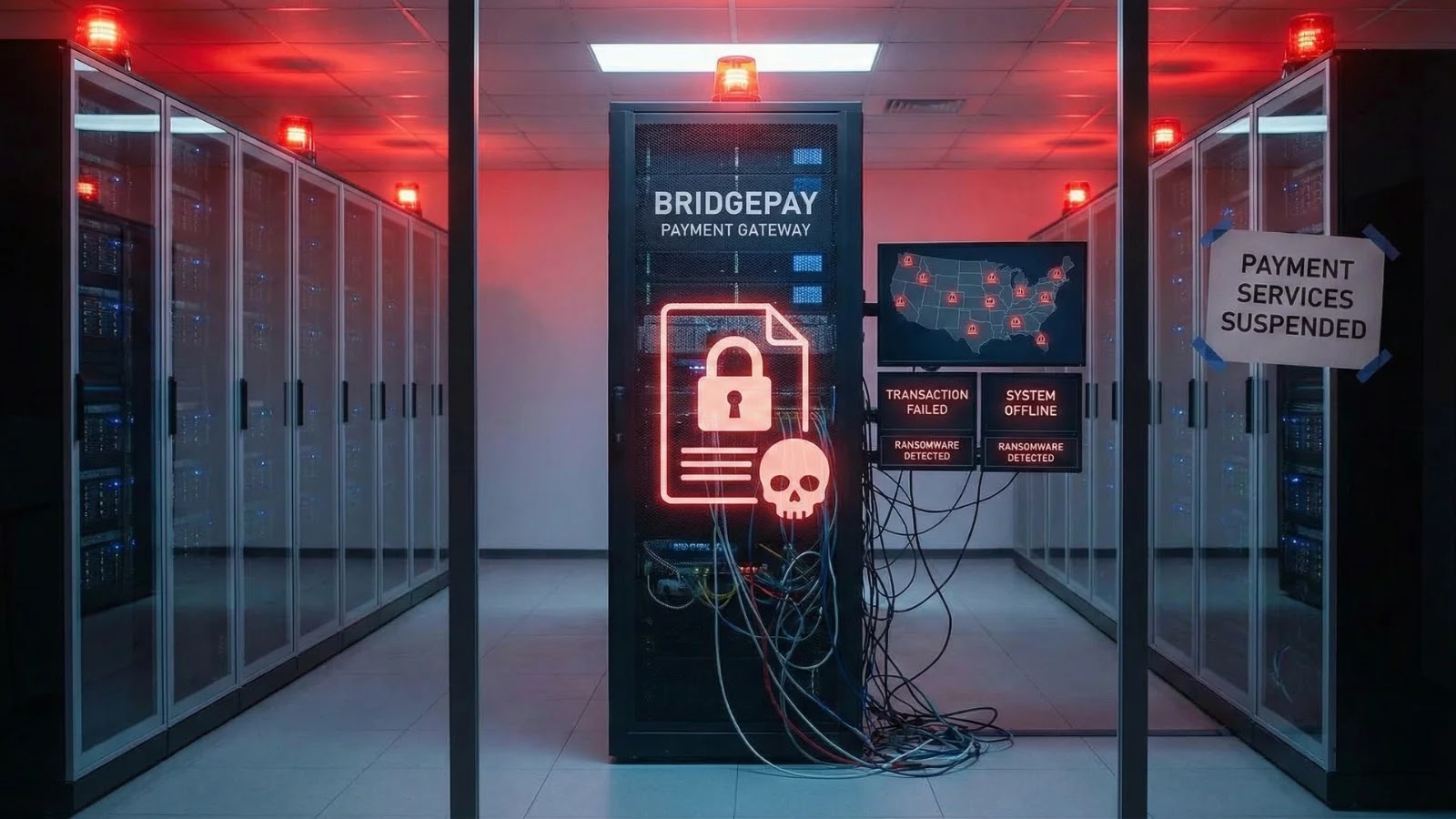
BridgePay Payment Gateway Hit by Ransomware, Causing Nationwide Outages
Ransomware Strikes BridgePay: Disrupting Nationwide Payment Processing
In a stark reminder of the pervasive threat of cyberattacks, BridgePay Network Solutions, a prominent U.S. payment gateway provider, recently confirmed a significant ransomware incident. This attack led to widespread service disruptions, crippling card processing capabilities for countless merchants across the nation. The incident, which began in the early hours of February 6, 2026, highlights the critical vulnerabilities within financial infrastructure and the far-reaching impact of successful cyber extortion.
Timeline of the BridgePay Ransomware Attack
The operational disruption at BridgePay began to manifest around 3:29 a.m. EST on February 6, 2026. Initial reports indicated degraded performance across key systems, including the Gateway.Itstgate.com virtual terminal, crucial reporting functions, and API services – all essential components for seamless payment processing. Within just a few hours, by 5:48 a.m. EST, BridgePay formally acknowledged the incident, confirming a ransomware attack as the root cause of the widespread outage. This rapid escalation underscores the swift and debilitating nature of modern ransomware campaigns, which aim to encrypt critical data and systems before response teams can fully react.
Impact on Merchants and the Payment Ecosystem
As a major payment gateway, BridgePay’s compromise sent ripples throughout the U.S. retail and service sectors. Merchants relying on BridgePay for processing credit and debit card transactions faced immediate and severe challenges. The inability to process payments directly impacts revenue streams, customer satisfaction, and operational efficiency. Such outages can lead to significant financial losses, reputational damage for affected businesses, and a breakdown in consumer trust. The incident serves as a critical case study illustrating the interconnectedness of our financial systems and the cascading effects when a central component like a payment gateway is compromised.
Understanding Ransomware and Its Threat to Financial Services
Ransomware attacks involve malicious software that encrypts a victim’s files, rendering them inaccessible until a ransom, typically demanded in cryptocurrency, is paid. For financial service providers like BridgePay, these attacks are particularly devastating. The highly sensitive nature of financial data, coupled with the imperative for continuous service availability, makes these organizations prime targets. Threat actors often leverage various initial access vectors, including phishing, exploiting unpatched vulnerabilities (e.g., CVE-2023-38831 or CVE-2023-34362, common in recent attacks), or compromising remote access services. Once inside, they move laterally, escalate privileges, and then deploy the ransomware payload across the network.
Remediation Actions for Payment Processors and Merchants
Addressing and mitigating ransomware threats requires a multi-layered approach, both for payment gateway providers and the merchants who rely on them. Proactive measures are paramount to minimize the likelihood and impact of such attacks.
- Robust Backup and Recovery Strategies: Implement comprehensive, immutable backups stored offline and offsite. Regularly test recovery procedures to ensure business continuity post-attack.
- Endpoint Detection and Response (EDR): Deploy EDR solutions across all endpoints to detect and respond to suspicious activities indicative of ransomware.
- Network Segmentation: Isolate critical systems and data to limit the lateral movement of attackers within the network.
- Patch Management: Maintain a rigorous patch management program to address known vulnerabilities promptly, particularly for internet-facing systems and critical infrastructure.
- Multi-Factor Authentication (MFA): Enforce MFA for all remote access, privileged accounts, and critical systems to prevent unauthorized access.
- Employee Training: Conduct regular cybersecurity awareness training to educate employees about phishing, social engineering, and the importance of strong security practices.
- Incident Response Plan: Develop and regularly test a detailed incident response plan specifically for ransomware attacks, outlining roles, responsibilities, and communication protocols.
- Threat Intelligence: Subscribe to and act upon threat intelligence feeds to stay informed about emerging ransomware variants and attack techniques.
- Regular Security Audits and Penetration Testing: Conduct periodic security audits and penetration tests to identify weaknesses before attackers do.
Tools for Ransomware Detection and Mitigation
| Tool Name | Purpose | Link |
|---|---|---|
| CrowdStrike Falcon Insight | Advanced EDR for real-time threat detection and response. | CrowdStrike |
| Veeam Backup & Replication | Comprehensive data backup, recovery, and replication. | Veeam |
| Tenable Nessus | Vulnerability scanning and assessment. | Tenable |
| Microsoft Defender for Endpoint | Endpoint security platform with EDR capabilities. | Microsoft |
| Palo Alto Networks Next-Gen Firewall | Network security, threat prevention, and segmentation. | Palo Alto Networks |
Key Takeaways from the BridgePay Incident
The BridgePay ransomware attack underscores several critical lessons for the cybersecurity community and organizations handling sensitive data. No entity, regardless of its size or specialization, is immune to sophisticated cyber threats. The speed at which such attacks can incapacitate critical services highlights the need for continuous vigilance, robust preventative measures, and well-rehearsed incident response capabilities. For businesses relying on third-party services like payment gateways, understanding the security posture of their vendors and having contingency plans in place is no longer optional but a fundamental requirement for operational resilience.




