
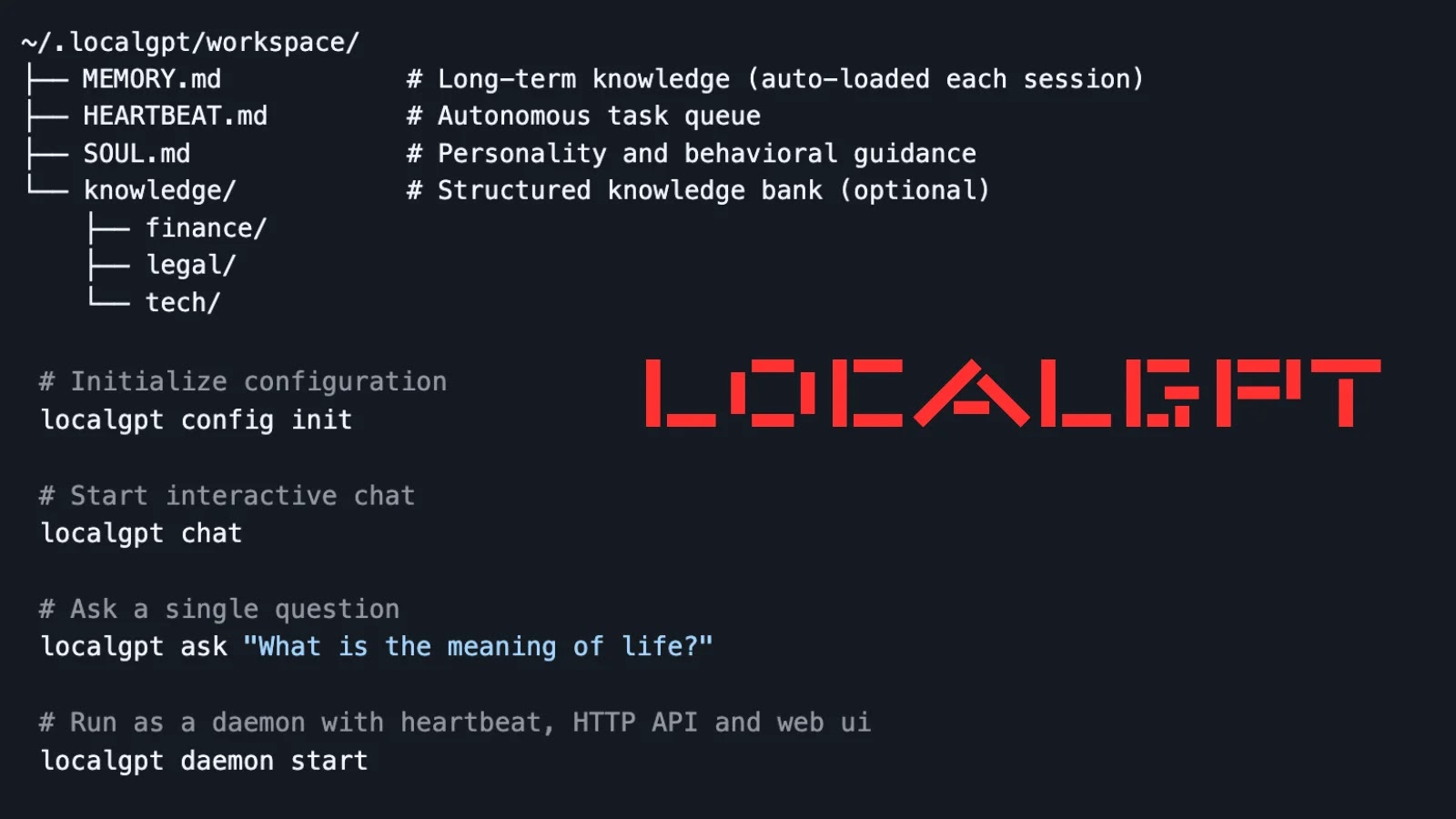
LocalGPT – A Secure Local Device Focused AI Assistant Built in Rust
The proliferation of artificial intelligence (AI) has ushered in an era of unprecedented technological advancement, yet it has also presented new challenges, particularly concerning data privacy and security. Cloud-based AI assistants, while powerful, often necessitate the transmission of sensitive user information to external servers, raising legitimate concerns about data breaches and surveillance. This inherent vulnerability underscores a critical need for secure, localized AI solutions. We explore LocalGPT, an innovative AI assistant engineered in Rust, designed to operate entirely on end-user devices, offering a robust alternative to cloud-dependent models without compromising privacy.
The Privacy Imperative of Local AI
The convenience offered by cloud AI platforms like ChatGPT and Claude comes at a potential cost: the exposure of user data to remote infrastructures. Every interaction, every query, every piece of information shared with these services is transmitted across networks and stored on servers controlled by third parties. This architecture inherently creates a target for malicious actors, making user data susceptible to breaches, unauthorized access, and potential misuse. For individuals and organizations handling sensitive information, the risk associated with relying on external cloud infrastructure for AI assistance is substantial. The critical need, therefore, is for AI solutions that allow users to maintain complete control over their data, ensuring that sensitive information never leaves the local environment.
Introducing LocalGPT: Rust-Powered Local AI
LocalGPT emerges as a compelling answer to these privacy concerns. Developed entirely in Rust, a language renowned for its memory safety and performance, LocalGPT is engineered to maximize security and minimize its footprint. Its core differentiator is its complete independence from cloud infrastructure. The application runs as a single, compact binary, reportedly around 27MB, directly on the user’s local device. This design principle means that all processing, all data handling, and all AI inference occur exclusively within the confines of the user’s hardware. Consequently, sensitive memory and tasks are never exposed to remote servers or third-party cloud environments, creating a fortress-like secure perimeter around user interactions with the AI.
Rust’s Role in Enhanced Security
The choice of Rust as the development language for LocalGPT is not coincidental; it is a strategic decision that directly contributes to the tool’s security posture. Rust’s compile-time memory safety guarantees eliminate common vulnerability classes such as null pointer dereferences, buffer overflows, and data races, which are prevalent in languages like C and C++. This intrinsic memory safety significantly reduces the surface area for exploitation by attackers. Furthermore, Rust’s performance characteristics ensure that LocalGPT can deliver efficient AI processing locally without requiring excessive system resources, making it a practical solution for a wide range of devices.
Compatibility and Local Processing
While the reference information about LocalGPT is somewhat limited in details regarding its specific models or comprehensive feature set beyond local operation, its inspiration from and compatibility with existing paradigms is a key aspect. The emphasis is on local processing, which implies that it likely leverages quantized models or efficient inference engines designed to run on consumer hardware. This approach is crucial for delivering a responsive AI experience without relying on the computational power of data centers. The ability to perform complex tasks, understand natural language, and generate relevant responses entirely offline represents a significant leap forward in data sovereignty for AI applications.
The Future of Private AI Assistants
LocalGPT represents a pivotal shift in the AI assistant landscape, prioritizing privacy and security above all else. As the demand for AI integration continues to grow across personal and professional spheres, the necessity for solutions that protect sensitive data will become paramount. LocalGPT demonstrates that powerful AI capabilities are achievable without sacrificing user privacy or relying on potentially vulnerable cloud infrastructures. This Rust-based approach sets a new standard for local AI, offering a secure, efficient, and user-controlled alternative for those who demand the highest level of data protection.




