What Is Spanning Tree Protocol (STP)?
What is Spanning Tree Protocol (STP): Explained, Cisco & More
In the intricate world of network management, ensuring seamless and reliable communication is paramount. The Spanning Tree Protocol (STP) emerges as a critical network protocol, acting as a vigilant guardian against the perils of network loops that can cripple network performance. This article delves into the depths of STP, exploring its functionality, benefits, and various implementations, including its role in Cisco environments. We aim to provide a comprehensive understanding of how STP maintains network stability and prevents disruptive broadcast storms, a common issue without STP.
Understanding STP and Its Importance
What is Spanning Tree Protocol?
Spanning Tree Protocol, or STP, is a network protocol designed to prevent loops in a network topology. Network loops can lead to broadcast storms, which degrade network performance significantly. STP operates by logically blocking redundant paths within a network, creating a single spanning tree for data to traverse. This spanning-tree protocol ensures a loop-free environment, maintaining network stability and preventing the endless forwarding of data packets. STP is enabled on most switches to automatically detect and block network loops.
Benefits of STP
The primary benefit of STP is that it prevents loops, thus averting broadcast storms that can paralyze a network. By blocking redundant paths, STP ensures network stability and reliability. Without STP, a network is vulnerable to constant data retransmission, leading to severe performance degradation. Furthermore, STP simplifies network management. Network administrators can rely on the protocol to automatically manage network topology changes, allowing for easier troubleshooting and maintenance of the network.
How STP Works
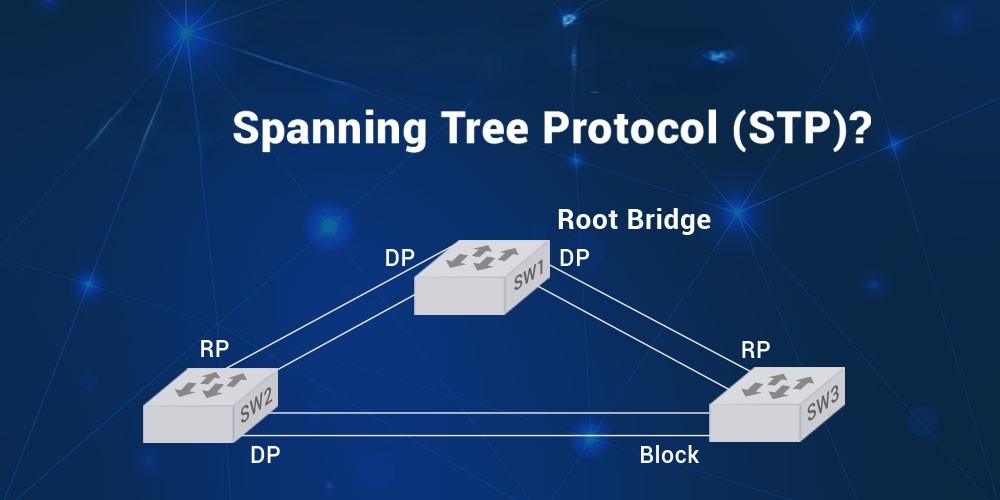
STP works by selecting a root bridge, which becomes the focal point of the spanning tree. All other switches calculate their best path to this root bridge. The algorithm considers the path cost, which is determined by the bandwidth of the links. Ports are assigned roles such as root port, designated port, and blocking port. The root port is the best path to the root bridge, while the designated port forwards traffic on a network segment. Blocking ports prevent loops by not forwarding traffic. Bridge Protocol Data Units (BPDUs) are exchanged to communicate topology information.
Types of Spanning Tree Protocol
Standard STP
The original Spanning Tree Protocol, often referred to as standard STP or classic STP, is defined by IEEE 802.1d. Its primary goal is to prevent loops in a network topology by creating a single spanning tree. STP works by selecting a root bridge, and then each switch determines the shortest path cost to the root bridge. Ports are assigned roles such as root port, designated port, or blocking port. Bridge Protocol Data Units (BPDUs) are used to exchange information. While effective, the convergence time can be slow, especially in larger networks where changes in the network topology require recalculation and updating of the spanning tree. This can impact network performance and cause temporary disruptions.
Rapid Spanning Tree Protocol (RSTP)
Rapid Spanning Tree Protocol (RSTP), defined by IEEE 802.1w, is an evolution of STP designed to provide faster convergence after a topology change. RSTP achieves this by introducing new port states and BPDU formats, allowing switches to quickly agree on the network topology. Instead of relying on timers, RSTP uses a handshake mechanism to quickly transition ports to forwarding state or blocking state. RSTP maintains backward compatibility with standard STP, ensuring that devices running different versions of STP can still communicate. It significantly reduces the convergence time, enhancing network stability and performance. RSTP is particularly beneficial in modern networking environments.
Comparison of STP and RSTP
While both STP and RSTP aim to prevent loops, they differ significantly in convergence speed and operational mechanisms. STP relies on timers and can take up to 30-50 seconds to converge, while RSTP uses a faster handshake mechanism, achieving convergence in just a few seconds. RSTP introduces new port roles and states, providing more granular control over the network topology. Standard STP relies on blocking redundant paths to prevent network loops, whereas rapid STP enables quick restoration of the spanning tree. RSTP is the preferred choice for modern networking environments, offering improved network performance and faster response to changes in the network. Implementing RSTP prevents network disruptions with its rapid convergence capabilities.
Components of STP
Bridge Protocol Data Units (BPDUs)
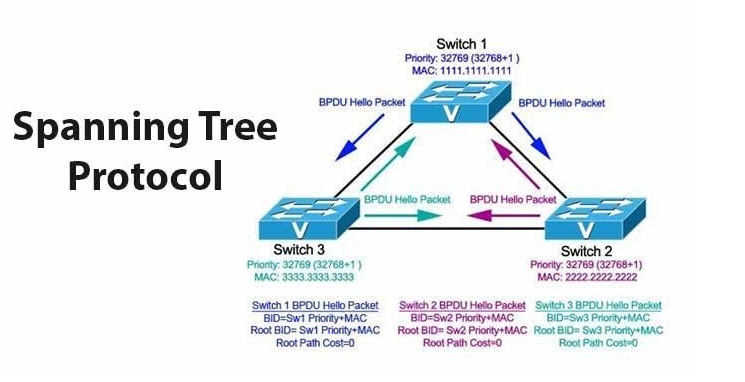
At the core of how the spanning tree protocol operates are Bridge Protocol Data Units, or BPDUs. These are data messages exchanged between switches to share information about the network topology. The information contained within these BPDUs includes the root bridge ID, the path cost to the root bridge, and the bridge ID of the sending switch. Switches use this information to determine the network topology and to identify and block redundant paths. The BPDU is crucial for the spanning tree algorithm to function correctly, ensuring that the spanning tree is maintained and updated. Various versions of STP, including rapid spanning tree protocol, use different BPDU formats to facilitate faster convergence.
Switches and Ports in STP
In the spanning tree protocol framework, switches and their ports play distinct roles. The switch designated as the root bridge serves as the central point, and every other switch calculates its best path cost to this root bridge. Ports are assigned roles based on their position in the spanning tree and their relationship to the root bridge. A root port represents the best path to the root bridge, while a designated port is responsible for forwarding traffic on a specific network segment. Ports that could create loops are placed in a blocking state. The interaction between switches and their ports is essential for maintaining a loop-free network topology, especially within the stp protocol.
STP Port States
STP defines several port states that dictate how a port functions within the network. These states are crucial for proper network operation, and include:
- Blocking: A port in this state prevents loops by not forwarding traffic.
- Listening: Here, a port listens to BPDUs to determine the network topology.
- Learning: During this state, the port learns MAC addresses.
- Forwarding: This state allows the port to forward traffic.
Rapid spanning tree protocol introduces additional port states for faster convergence. These stp port states ensure that the spanning-tree protocol effectively manages redundant paths and prevents broadcast storms, contributing to network stability and preventing network loops.
Configuring STP on Cisco Switches
Enabling STP
Enabling the spanning-tree protocol on Cisco switches is a fundamental step in ensuring network stability. The spanning tree protocol is enabled by default on most Cisco switches, but it’s crucial to verify its configuration. Network administrators can use Cisco’s command-line interface (CLI) to check the STP status. Ensuring that STP is active helps prevent network loops. Verifying the presence of a single spanning tree is essential to maintain network performance.
STP Modes and Configuration
Cisco switches support various stp modes, including the original spanning tree protocol, rapid spanning tree protocol (RSTP), and multiple spanning tree protocol (MSTP). RSTP offers faster convergence, while MSTP allows for multiple spanning tree instance, providing a tree for each VLAN. Configuring these modes involves setting the switch priority, path cost, and port roles to optimize the spanning tree for the network topology. Cisco’s CLI provides commands to adjust the timers and parameters to suit specific network requirements.
Using STP in Layer 2 Networks
STP prevents network loops in Layer 2 networks by logically blocking redundant paths. In a typical local area network (LAN), multiple switches are interconnected to provide redundancy. STP examines the topology and selects a root bridge, calculating the best path cost from each switch to the root bridge. Blocking redundant paths ensures a loop-free environment, preventing broadcast storms that can degrade network performance. The spanning tree algorithm is crucial for preventing loops and ensuring network stability.
Alternatives to Spanning Tree Protocol
Understanding Alternatives
While STP has been a cornerstone network protocol for preventing network loops, several alternatives offer enhanced performance and features. These alternatives address some of the limitations of stp, such as slow convergence and inefficient bandwidth utilization. Alternatives like TRILL (Transparent Interconnection of Lots of Links) and SPB (Shortest Path Bridging) provide multipath routing, enabling better load balancing and faster convergence than the traditional spanning-tree protocol. The goal is to provide network stability with enhanced efficiency.
When to Use Alternatives
Alternatives to the spanning tree protocol are best considered in modern networking environments that require high bandwidth and fast convergence. Data centers and large enterprise networks often benefit from technologies like TRILL or SPB, which offer multipath support and improved scalability compared to traditional STP. When changes in the network topology must be accommodated swiftly, and when stp prevents optimal network performance, alternatives become particularly attractive. These protocols can efficiently manage complex topologies.
Benefits of Alternatives over STP
Here are some of the primary advantages that protocols like TRILL and SPB offer compared to the traditional spanning tree protocol:
- Faster convergence, which minimizes the effects of topology modifications.
- Better bandwidth utilization, achieved by using multiple paths concurrently.
- Improved scalability, allowing for larger and more complex network designs.
These alternatives differ from STP by leveraging multiple paths simultaneously, thereby boosting network throughput and resilience. Furthermore, they deliver more efficient traffic forwarding and adapt more effectively to changing network conditions, enhancing network stability and preventing loops.

Spanning-tree protocol: What is STP and why is it used in an ethernet network?
Spanning-tree protocol (STP) is a Layer 2 network protocol that prevents loops in an ethernet network with redundant links by creating a loop-free topology. STP detects redundant links between switches in the network and blocks selected ports so only a single active path exists to forward frames, forming a common spanning tree for the entire network or different spanning instances depending on the STP variant.
Stp protocol: How is the root bridge chosen and what role does bridge priority play?
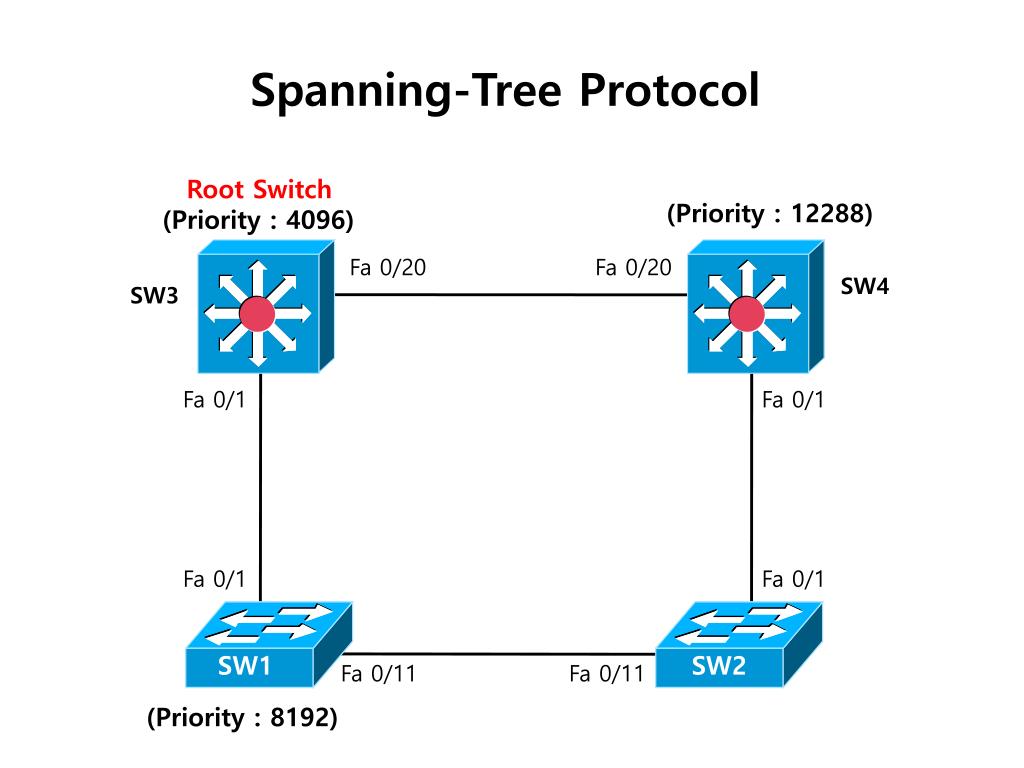
STP elects a root bridge using the lowest bridge ID, which combines a configurable bridge priority and the switch MAC address; the switch with the lowest value becomes the root bridge. Bridge priority is used to influence which switch becomes the root bridge, while path costs and designated port selection determine the active path from each switch to the root. STP automatically recalculates the topology if switches in the network go down or when links change.
Rstp and stp: What are the differences between RSTP and STP and when should you use them?
RSTP (Rapid Spanning Tree Protocol) is an evolution of classic STP that significantly reduces convergence time after topology changes, making it better for networks with redundant paths and faster failover needs. Both protocols preserve the same basic concepts—root bridge election, blocking ports, and active path selection—but RSTP introduces additional port roles and faster handshake mechanisms. Choose RSTP over legacy STP for modern networks, especially where quick recovery is required; however, compatibility with older switches and types of STP (like per-vlan spanning tree or separate spanning tree implementations) should be considered.
Alternatives to stp: What alternatives exist for networks with redundant paths and separate spanning needs?
Alternatives to STP include technologies such as link aggregation (to combine links rather than block them), shortest path bridging (SPB), transparent interconnection of lots of links (TRILL), and modern layer 3 designs that avoid large layer 2 topologies. Per-vlan spanning tree or separate spanning tree variants can isolate traffic per VLAN, but SPB/TRILL provide different spanning behaviors that allow multiple active paths and better utilization of redundant links in large stp network deployments.