
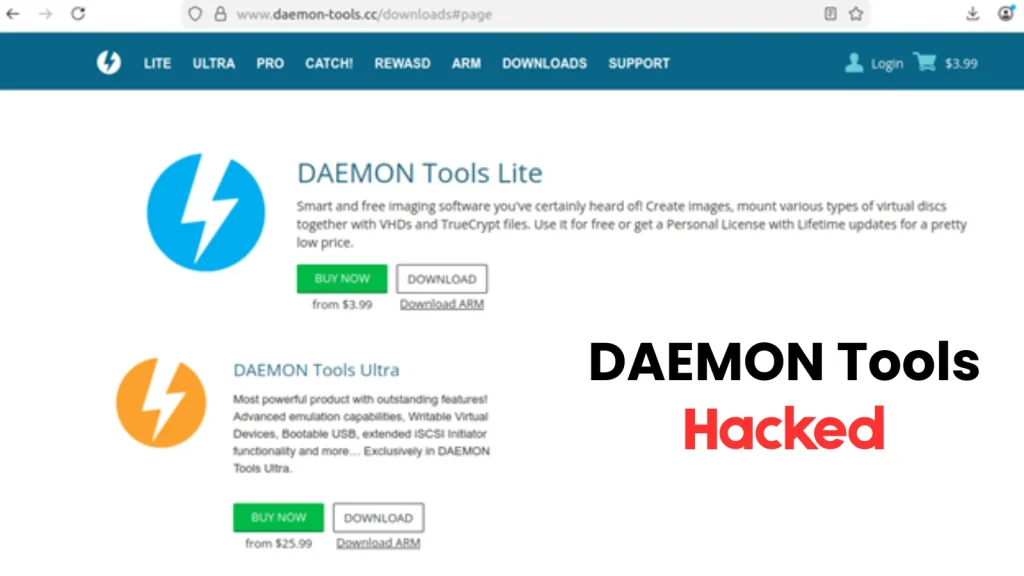
DAEMON Tools Software Hacked to Deliver Malware in a Supply Chain Attack
In a stark reminder of the persistent and evolving threat of supply chain attacks, popular disk image mounting software DAEMON Tools has been compromised to deliver malicious payloads to users globally. Discovered in early May 2026 by Kaspersky security researchers, this sophisticated attack highlights the critical need for vigilance even when downloading software from seemingly legitimate sources.
DAEMON Tools Supply Chain Attack: A Deep Dive
The breach originated with the trojanization of official DAEMON Tools installers, distributed directly from the software’s legitimate website. This means that users who downloaded DAEMON Tools from its official online presence, expecting a clean and functional application, were instead receiving a compromised version designed to infiltrate their systems.
Kaspersky’s investigation pinpointed April 8, 2026, as the start date for the distribution of these malicious installers. The attackers managed to inject their malware into the supply chain at a fundamental level, impacting various versions of the DAEMON Tools software. This incident underscores the difficulty in detecting such attacks, as they leverage trusted channels and legitimate software as a vector for infection.
Understanding the Threat: What is a Supply Chain Attack?
A supply chain attack targets an organization by compromising less secure elements in its supply network. In the context of software, this often means injecting malicious code into applications during development, build processes, or distribution. Users then unknowingly download and execute the compromised software, granting the attackers access to their systems.
The DAEMON Tools incident serves as a classic example. The attackers didn’t need to breach individual user systems directly; they targeted the software developer’s infrastructure, allowing their malware to spread through a trusted avenue. This method is incredibly potent because it bypasses many traditional perimeter defenses that users and organizations might have in place.
Impact of the DAEMON Tools Compromise
While the specific payloads and their full capabilities are still under ongoing analysis, the nature of a supply chain attack involving trojanized installers suggests a broad and potentially severe impact. Malicious payloads delivered in such a manner can range from information stealers and ransomware to sophisticated backdoors enabling long-term espionage and control. Users who installed DAEMON Tools between April 8, 2026, and the discovery of the breach in early May 2026, are at significant risk.
Remediation Actions
For individuals and organizations who may have been exposed to the compromised DAEMON Tools installers, immediate action is crucial:
- Isolate Affected Systems: Disconnect any systems that installed DAEMON Tools during the compromise period from the network to prevent further spread of potential malware.
- Antivirus/EDR Scans: Perform full system scans using reputable antivirus or Endpoint Detection and Response (EDR) solutions. Ensure your security software is updated to the latest definitions.
- Password Reset: Change all passwords on affected systems, especially for critical accounts and services. Consider enabling multi-factor authentication (MFA) wherever possible.
- Reinstall Operating System: For critical systems or high-risk environments, a clean reinstallation of the operating system is the most secure remediation, followed by installing applications from verified, clean sources.
- Monitor Network Traffic: Look for unusual outbound connections or suspicious network activity coming from systems that had DAEMON Tools installed.
- Stay Informed: Follow official announcements from DAEMON Tools and cybersecurity researchers regarding further details of the attack and any specific removal tools or patches.
Detection and Mitigation Tools
Effective defense against supply chain attacks and general malware requires a multi-layered approach. Here are some tools that can aid in detection and mitigation:
| Tool Name | Purpose | Link |
|---|---|---|
| Virustotal | Online service for analyzing suspicious files and URLs (multiple antivirus engines). | https://www.virustotal.com/ |
| Process Monitor (Sysinternals) | Advanced monitoring tool for Windows that shows real-time file system, Registry and process/thread activity. | https://docs.microsoft.com/en-us/sysinternals/downloads/procmon |
| Autoruns (Sysinternals) | Shows you what programs are configured to run during system bootup or login. | https://docs.microsoft.com/en-us/sysinternals/downloads/autoruns |
| Snort | Open source intrusion prevention system (IPS) and intrusion detection system (IDS). | https://www.snort.org/ |
| YARA | Tool aimed at helping malware researchers identify and classify malware samples. | https://yara.readthedocs.io/en/stable/ |
Protecting Against Future Supply Chain Attacks
This DAEMON Tools incident serves as a powerful reminder of the sophisticated threats targeting the software supply chain. To bolster defenses:
- Software Integrity Verification: Always verify the integrity of downloaded software using checksums, digital signatures, or other validation mechanisms provided by the vendor.
- Source Verification: Download software only from official, trusted sources. Be wary of third-party download sites.
- Security Patches: Keep all operating systems and software updated with the latest security patches.
- Endpoint Security: Implement robust endpoint security solutions, including EDR and next-generation antivirus, capable of detecting advanced threats.
- Supply Chain Audits: Organizations should conduct regular security audits of their software supply chain, including third-party components and vendor security practices.
- Principle of Least Privilege: Limit user permissions to only what is necessary for their roles.
The DAEMON Tools compromise is a critical example of the challenges in securing the modern software ecosystem. Constant vigilance, robust security practices, and a healthy skepticism of even trusted sources are essential for mitigating the risks of supply chain attacks.




