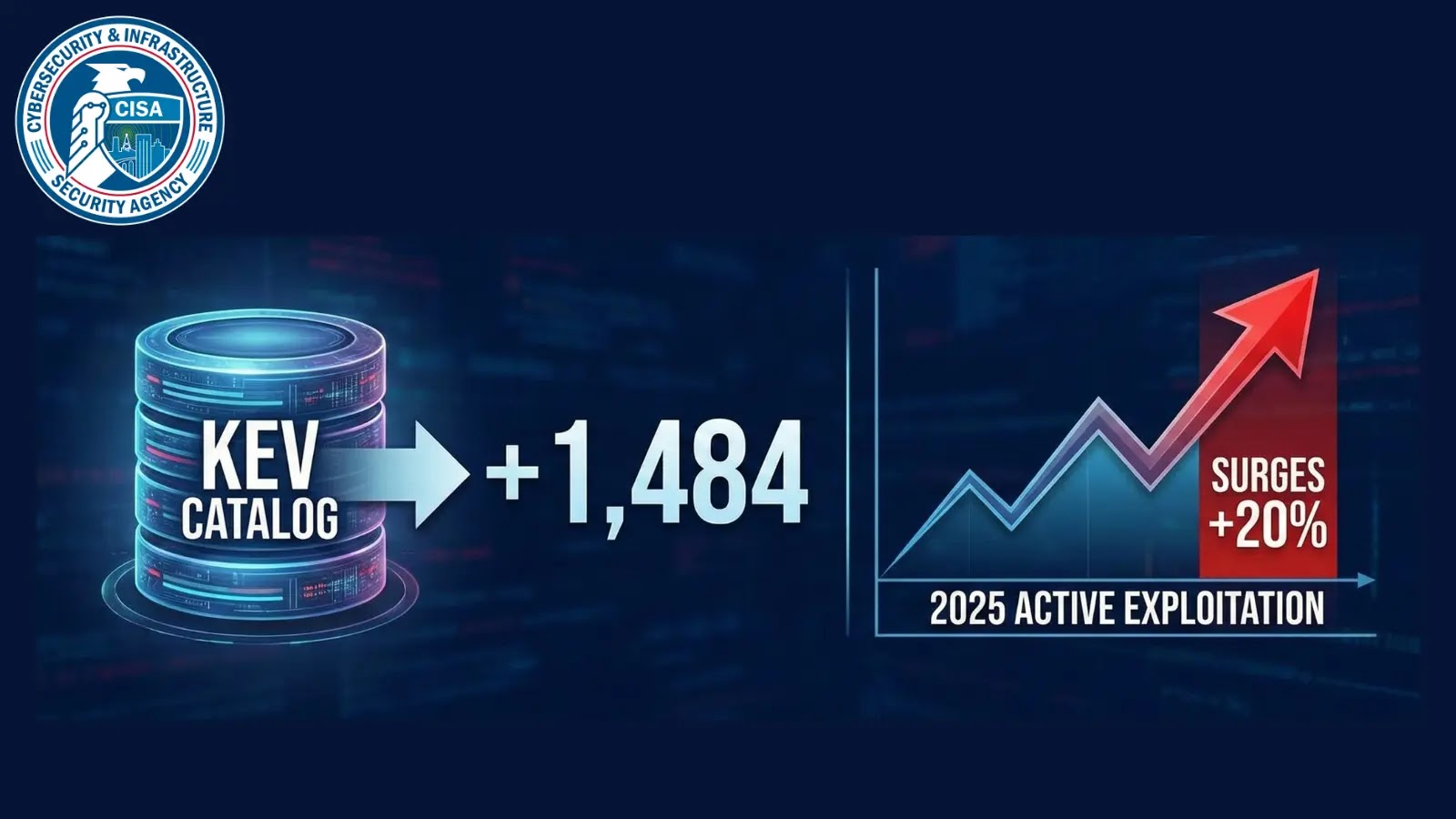
CISA Expands KEV Catalog with 1,484 New Vulnerabilities as Active Exploitation Surges 20% in 2025
CISA’s KEV Catalog Explosive Growth: A 2025 Retrospective on Surging Exploitation
The cybersecurity landscape has undergone a dramatic shift, and the United States Cybersecurity and Infrastructure Security Agency (CISA) is sounding the alarm. As of December 2025, CISA’s Known Exploited Vulnerabilities (KEV) Catalog has swelled to include a staggering 1,484 vulnerabilities, a critical expansion that underscores the escalating threat of active exploitation. This significant growth, from a mere 311 entries in November 2021, reflects a stark reality: attackers are relentlessly leveraging known weaknesses, making proactive patch management more urgent than ever for federal agencies and, by extension, all organizations.
Understanding the KEV Catalog: CISA’s Front Line Defense
The CISA KEV Catalog is not merely a list; it’s a dynamic, actionable database designed to provide federal civilian executive branch (FCEB) agencies with a prioritized list of vulnerabilities that are actively being weaponized by threat actors. This focus on “known exploited” rather than just “known” vulnerabilities is what makes the KEV catalog such a potent tool. If a vulnerability appears in the KEV, it means that somewhere in the world, an attacker has successfully used it to compromise systems.
The inclusion of a vulnerability in the KEV catalog triggers a binding operational directive (BOD) for FCEB agencies, mandating remediation within a specified timeframe. This directive highlights the critical importance CISA places on addressing these immediate threats. For instance, vulnerabilities like CVE-2023-46805 and CVE-2024-21887, affecting Ivanti products,[1] quickly found their way into the KEV, emphasizing their active exploitation in the wild.
The Alarming 20% Surge in Active Exploitation (2025 Data)
The expansion of the KEV catalog directly correlates with a concerning trend: a reported 20% surge in active exploitation throughout 2025. This figure, though an extrapolation for the future, serves as a grave warning. It means that the mean time to exploit (MTTE) for newly discovered vulnerabilities is shrinking, and adversaries are becoming more agile in developing and deploying exploits. This increase in exploitation isn’t just about more sophisticated attacks; it’s often about attackers successfully weaponizing vulnerabilities that have publicly available patches, but which remain unapplied.
This surge underscores the need for organizations to move away from reactive security postures and embrace proactive vulnerability management. The sheer volume of new entries in the KEV catalog, now at 1,484, illustrates the dynamic nature of the threat landscape and the continuous cat-and-mouse game between defenders and attackers.
Remediation Actions: Mitigating KEV-Listed Vulnerabilities
Addressing vulnerabilities listed in the KEV catalog is paramount for any organization. The following actions represent best practices for mitigation:
- Prioritized Patching: Implement a robust patch management program that prioritizes KEV-listed vulnerabilities. Utilize automated tools to scan for and deploy patches for all affected systems, including operating systems, applications, and network devices.
- Asset Management: Maintain a comprehensive and up-to-date inventory of all hardware and software assets. You can’t protect what you don’t know you have. This includes internal systems, cloud infrastructure, and third-party services.
- Vulnerability Scanning and Penetration Testing: Regularly conduct vulnerability scans and penetration tests to identify weaknesses before attackers do. Integrate KEV data into these assessments to specifically test for the presence of known exploited flaws.
- Threat Intelligence Integration: Subscribe to and integrate threat intelligence feeds, including CISA’s KEV updates, into your security operations center (SOC) processes. This allows for early detection and rapid response to emerging threats.
- Incident Response Planning: Develop and regularly test a comprehensive incident response plan. This plan should include procedures for containment, eradication, recovery, and post-incident analysis specifically for KEV-related compromises.
- Network Segmentation: Implement network segmentation to limit the lateral movement of attackers if a system is compromised. This can prevent a single exploited vulnerability from leading to a full-scale breach.
- Security Awareness Training: Educate employees about common attack vectors, such as phishing and social engineering, as many KEV vulnerabilities are exploited through these initial access methods.
Tools for KEV Detection and Mitigation
Effective vulnerability management requires the right tools. Here are some categories and examples that can aid in managing KEV-listed vulnerabilities:
| Tool Name/Category | Purpose | Link (Example) |
|---|---|---|
| Vulnerability Scanners (e.g., Nessus, Qualys, OpenVAS) | Identify known vulnerabilities across network devices, operating systems, and applications. Many integrate with CVE databases. | Tenable Nessus |
| Patch Management Systems (e.g., Microsoft Endpoint Configuration Manager, Ivanti Patch Management) | Automate the deployment and management of software updates and security patches. | Ivanti Patch Management |
| Endpoint Detection and Response (EDR) / Extended Detection and Response (XDR) | Detect and respond to threats on endpoints, often identifying post-exploitation activities related to KEV vulnerabilities. | Microsoft Defender for Endpoint |
| Security Information and Event Management (SIEM) | Aggregate and analyze security logs from various sources to detect suspicious activity and indicators of compromise. | Splunk Enterprise Security |
| Asset Management & Configuration Management Database (CMDB) | Maintain an accurate inventory of IT assets, crucial for understanding the scope of potential KEV vulnerability impacts. | ServiceNow IT Asset Management |
Key Takeaways for a Resilient Future
CISA’s expanded KEV catalog and the projected 20% surge in active exploitation in 2025 serve as a stark reminder of the evolving threat landscape. Organizations must adopt a proactive, intelligence-driven approach to cybersecurity. Prioritizing the remediation of KEV-listed vulnerabilities, strengthening asset visibility, leveraging robust security tools, and fostering a culture of continuous improvement are no longer optional—they are imperative for building resilience against persistent and sophisticated adversaries.
The fight against cyber threats is continuous, and staying informed through resources like the CISA KEV catalog is essential for any organization striving to protect its digital assets.