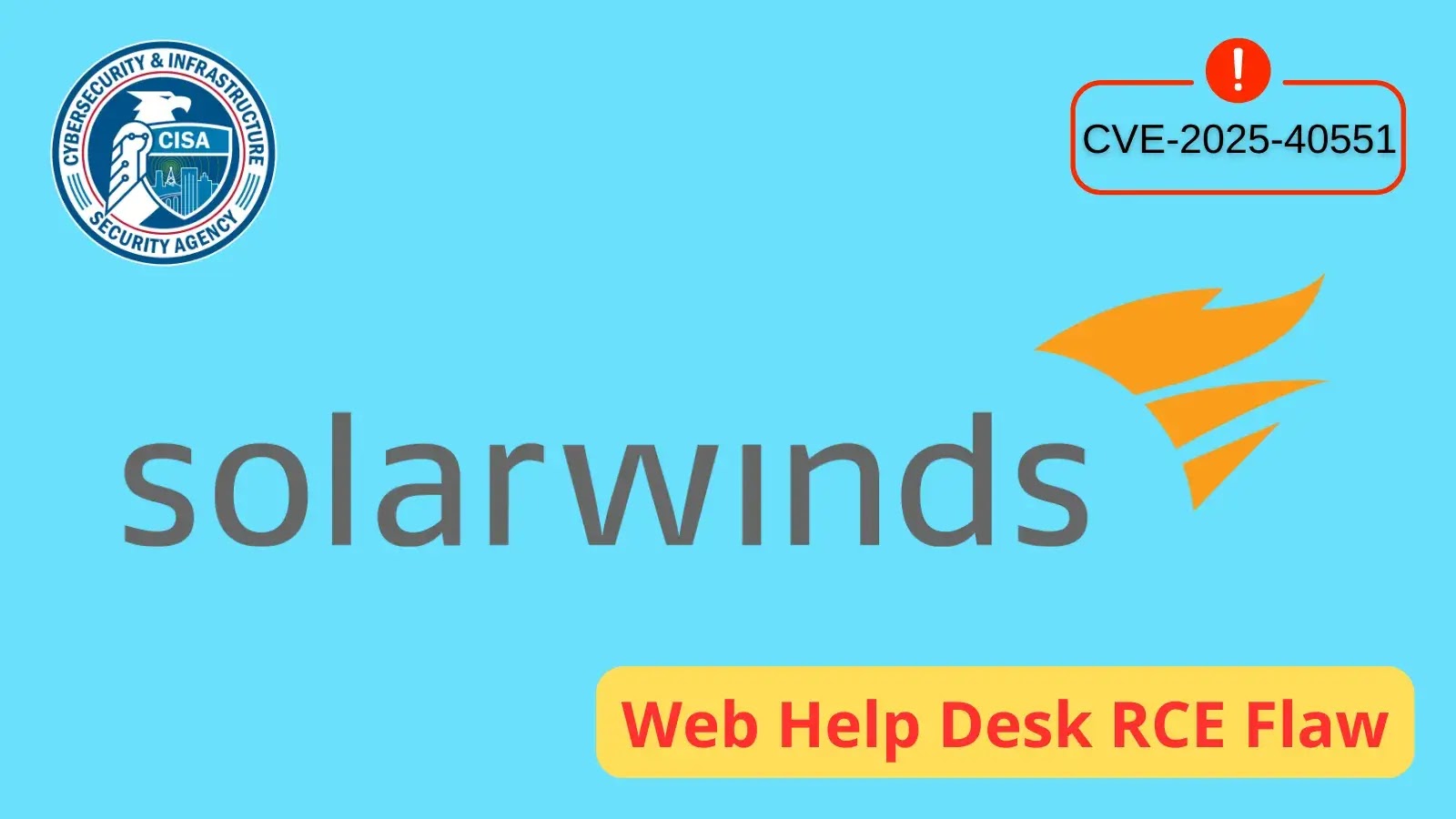
CISA Warns of SolarWinds Web Help Desk RCE Vulnerability Exploited in Attacks
Urgent Warning: SolarWinds Web Help Desk RCE Vulnerability Under Active Exploitation
A critical remote code execution (RCE) vulnerability in SolarWinds Web Help Desk is currently being exploited in the wild, prompting an urgent warning from the Cybersecurity and Infrastructure Security Agency (CISA). This flaw, tracked as CVE-2025-40551, poses a significant risk to organizations utilizing SolarWinds Web Help Desk, as it could allow attackers to execute arbitrary commands on affected systems without requiring any form of authentication.
For IT professionals and security teams, understanding and addressing this vulnerability immediately is paramount. The potential for unauthenticated RCE means a severe compromise could occur swiftly and silently, granting adversaries deep access into network infrastructure.
Understanding CVE-2025-40551: Deserialization of Untrusted Data
The core of CVE-2025-40551 lies in an unsafe deserialization of untrusted data. Classified under CWE-502 (Deserialization of Untrusted Data), this vulnerability occurs when an application deserializes data that has been provided or manipulated by an attacker. When an application processes this maliciously crafted serialized object, it can lead to arbitrary code execution.
In the context of SolarWinds Web Help Desk, this means that an attacker can send specially crafted input to the application. If the application attempts to deserialize this input without proper validation or sanitization, the embedded malicious code could be executed with the privileges of the Web Help Desk service. The gravity of this vulnerability is amplified by its unauthenticated nature, eliminating a significant barrier to exploitation.
Impact and Risks of RCE Vulnerabilities
Remote Code Execution (RCE) vulnerabilities are considered among the most severe threats in cybersecurity. Their exploitation can lead to a wide range of devastating outcomes for an organization, including:
- Full System Compromise: Attackers gain complete control over the affected server, allowing them to install malware, modify data, or establish persistent backdoors.
- Data Exfiltration: Sensitive organizational data, including customer information, intellectual property, and internal records, can be stolen.
- Lateral Movement: A compromised Web Help Desk server can serve as a pivot point for attackers to move deeper into the network, potentially compromising other critical systems.
- Denial of Service (DoS): In some cases, RCE can be used to disrupt the availability of services, leading to operational downtime and financial losses.
- Reputational Damage: Data breaches and system compromises can severely damage an organization’s reputation and erode customer trust.
Given the active exploitation, organizations must treat this vulnerability with the utmost urgency to prevent potential breaches and mitigate ongoing risks.
Remediation Actions
Immediate action is required to address CVE-2025-40551. Organizations using SolarWinds Web Help Desk should follow these steps diligently:
- Apply Patches Immediately: Monitor SolarWinds’ official security advisories and knowledge bases for the release of patches addressing CVE-2025-40551. Apply these updates as soon as they become available.
- Isolate Affected Systems: If immediate patching is not feasible, consider temporarily isolating the SolarWinds Web Help Desk instance from external network access. This can be achieved through firewall rules or network segmentation.
- Implement Network Segmentation: Ensure that the SolarWinds Web Help Desk server is placed in a segmented network zone, limiting its ability to interact with other critical assets in the event of a compromise.
- Monitor for Suspicious Activity: Enhance monitoring for the Web Help Desk server. Look for unusual process execution, unexpected network connections, or unauthorized file modifications. Utilize Endpoint Detection and Response (EDR) solutions for proactive threat hunting.
- Review Access Controls: Regularly audit and enforce least privilege principles for all accounts interacting with the Web Help Desk system.
- Perform Security Audits: Conduct regular security audits and penetration testing to identify and address other potential vulnerabilities within your environment.
Detection and Mitigation Tools
| Tool Name | Purpose | Link |
|---|---|---|
| Vulnerability Scanners (e.g., Nessus, Qualys, OpenVAS) | Identify known vulnerabilities, including deserialization flaws, on network devices and applications. | Tenable Nessus |
| Web Application Firewalls (WAF) | Protect web applications from common attacks, including those targeting deserialization, by filtering and monitoring HTTP traffic. Often includes rule sets for known exploit patterns. | AWS WAF |
| Endpoint Detection and Response (EDR) Solutions | Monitor endpoint activity for suspicious processes, network connections, and file changes that could indicate RCE exploitation. | CrowdStrike Falcon Insight |
| Network Intrusion Detection/Prevention Systems (NIDS/NIPS) | Detect and prevent known exploit patterns and anomalous network traffic related to RCE attempts. | Snort |
Key Takeaways for Cybersecurity Professionals
The CISA warning regarding CVE-2025-40551 in SolarWinds Web Help Desk underscores the persistent threat posed by deserialization vulnerabilities, especially when exploited without authentication. For organizations, the path forward is clear: prioritize immediate patching, implement robust network segmentation, and maintain vigilant monitoring. Proactive defense strategies combined with rapid response capabilities are essential to safeguard critical assets against such potent threats. Stay informed by regularly consulting official vendor security advisories and cybersecurity news outlets for the latest updates.