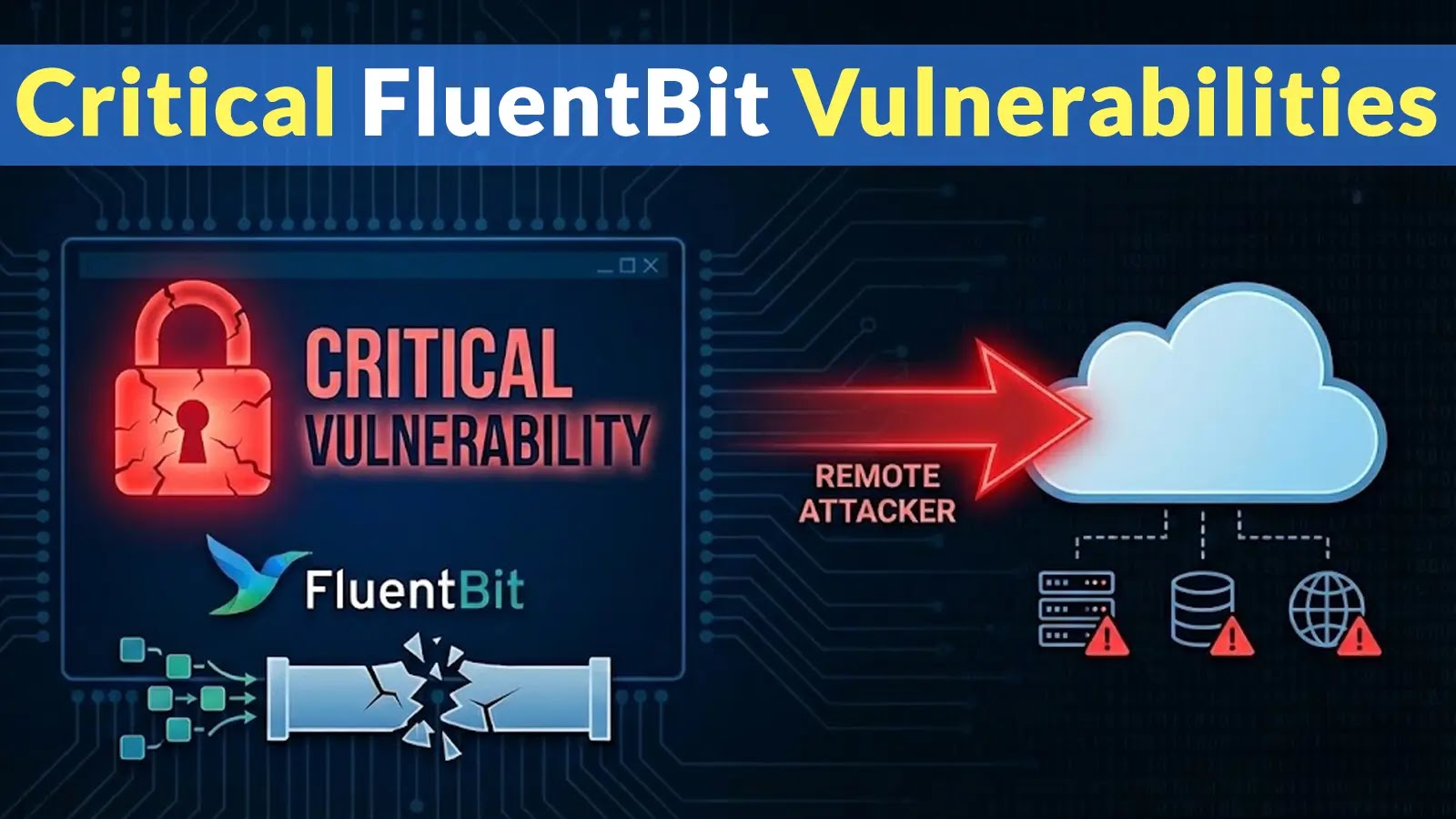
Critical FluentBit Vulnerabilities Let Attackers to Cloud Environments Remotely
Unmasking the Critical Fluent Bit Vulnerabilities: A Remote Threat to Cloud Environments
Imagine the very backbone of your cloud infrastructure, the system responsible for meticulously gathering and forwarding crucial logs, suddenly becoming a conduit for attackers. This isn’t a hypothetical scenario; a new chain of five critical vulnerabilities in Fluent Bit has exposed billions of containerized environments to potential remote compromise. Fluent Bit, an open-source logging and telemetry agent deployed over 15 billion times globally, is a ubiquitous component at the heart of modern cloud operations. Its presence spans across critical sectors, from banking systems to major cloud platforms, making these vulnerabilities particularly alarming.
The Pervasive Reach of Fluent Bit
Fluent Bit’s efficiency and lightweight nature have made it an indispensable tool for collecting, processing, and forwarding logs and metrics from diverse sources. Whether it’s monitoring application performance, troubleshooting issues, or ensuring regulatory compliance, Fluent Bit plays a pivotal role in maintaining visibility within complex, distributed systems. Its widespread adoption across virtually all cloud providers and enterprise environments means that a weakness in this single component can have vast, cascading implications for data security and operational integrity.
Understanding the Vulnerability Chain: CVEs and Their Impact
The recently discovered vulnerabilities form a critical chain that, when exploited, can grant attackers profound control. While the specific details of each vulnerability require careful analysis, the collective impact is a remote compromise of systems leveraging Fluent Bit. This could lead to unauthorized access to sensitive data, disruption of services, or even the deployment of malicious code within affected environments.
- CVE-2024-4323: An information leak vulnerability allowing unauthorized access to sensitive memory regions.
- CVE-2024-4324: A write-out-of-bounds vulnerability that can lead to arbitrary code execution.
- CVE-2024-4325: A heap-buffer-overflow vulnerability, another potential avenue for remote code execution.
- CVE-2024-4326: A heap-use-after-free vulnerability that could enable denial of service or further exploitation.
- CVE-2024-4327: Another read-out-of-bounds vulnerability, potentially leading to information disclosure.
Collectively, these vulnerabilities present a significant attack surface that can be exploited to achieve remote code execution, information disclosure, and potentially full system compromise. The sheer number of deployments makes this discovery particularly critical.
Remediation Actions: Securing Your Fluent Bit Deployments
Immediate action is paramount to mitigate the risks posed by these critical Fluent Bit vulnerabilities. Organizations must prioritize patching and implementing robust security measures. The following steps are crucial:
- Update Fluent Bit Immediately: The most crucial step is to update to the latest patched version of Fluent Bit. The developers have released fixes for these vulnerabilities. Verify your Fluent Bit version and upgrade without delay.
- Review Configuration and Access: Re-evaluate your Fluent Bit configurations. Ensure that only necessary ports are open and that network access to Fluent Bit instances is strictly limited to trusted sources. Implement the principle of least privilege.
- Implement Network Segmentation: Isolate Fluent Bit instances within your network using firewalls and network segmentation. This limits the blast radius should an exploit occur.
- Monitor Fluent Bit Logs and Metrics: Pay close attention to the logs generated by Fluent Bit itself, as well as the logs it processes from other applications. Look for anomalous behavior, unexplained restarts, or unusual outbound connections.
- Regular Security Audits: Conduct frequent security audits and penetration testing of your containerized environments and cloud infrastructure. This helps identify weaknesses before they can be exploited.
- Utilize Container Security Tools: Employ container security platforms that offer vulnerability scanning, runtime protection, and compliance checks for your containerized applications, including those using Fluent Bit.
Tools for Detection and Mitigation
Leveraging appropriate tools is essential for maintaining a strong security posture against Fluent Bit vulnerabilities and similar threats.
| Tool Name | Purpose | Link |
|---|---|---|
| Fluent Bit (Updated Version) | Mitigation (Apply patches) | https://fluentbit.io/download/ |
| Trivy | Container/Image Vulnerability Scanner | https://aquasec.com/cloud-native-security-resources/glossary/trivy/ |
| Clair | Container Image Vulnerability Analysis | https://quay.io/repository/clair/clair |
| Falco | Runtime Security for Containers | https://falco.org/ |
| Wazuh | Host-based Intrusion Detection System (HIDS) & SIEM | https://wazuh.com/ |
Protecting Your Cloud Environment Amidst Emerging Threats
The discovery of these critical Fluent Bit vulnerabilities underscores the continuous need for vigilance in cloud security. Given Fluent Bit’s integral role in logging and telemetry across billions of deployments, these flaws present a significant risk of remote compromise, impacting everything from banking systems to major cloud providers. Proactive patching, rigorous configuration management, and continuous monitoring are not merely best practices; they are foundational requirements for safeguarding your digital assets. As the cloud landscape evolves, so too must our approach to securing its underlying components. Stay informed, stay patched, and prioritize your security posture to effectively counter escalating cyber threats.