Critical n8n Vulnerability Enables System Command Execution Via Weaponized Workflows
Unmasking the Critical n8n Vulnerability: RCE via Weaponized Workflows
The landscape of enterprise automation is constantly evolving, with platforms like n8n empowering organizations to streamline complex processes. However, this power comes with inherent security responsibilities. A recent discovery has sent ripples through the cybersecurity community: a critical Remote Code Execution (RCE) vulnerability in n8n, allowing authenticated attackers to compromise host servers through weaponized workflows. This flaw is not merely a new threat but a significant regression and expansion of the previously identified CVE-2025-68613, underscoring persistent risks within the platform’s expression evaluation engine.
The RCE Threat: How Weaponized Workflows Strike
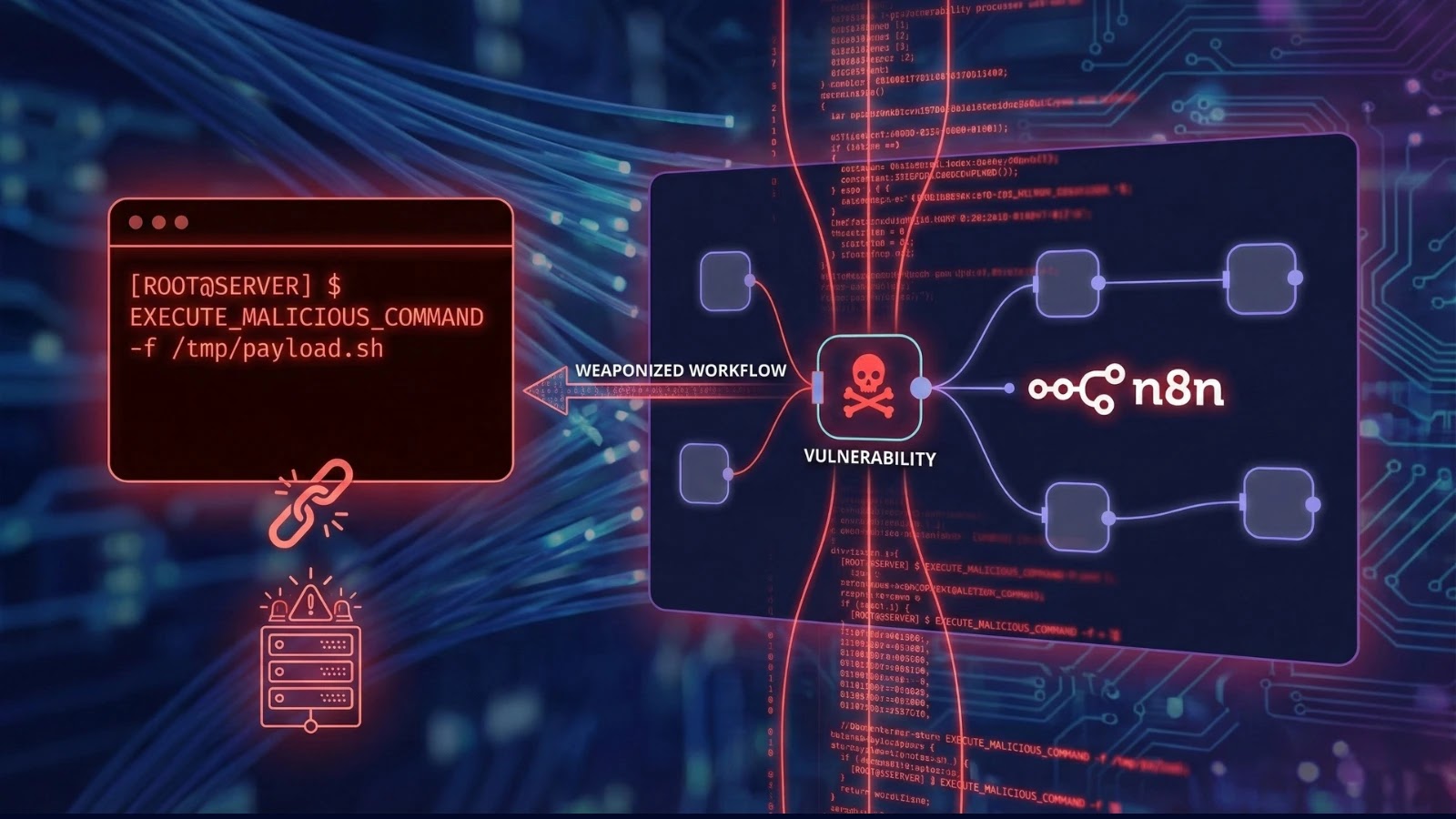
At its core, this n8n vulnerability enables an authenticated attacker to execute arbitrary system commands on the host server. The attack vector lies within “weaponized workflows.” In n8n, workflows define a series of automated tasks. Attackers can craft malicious workflows that, when executed, exploit a weakness in n8n’s expression evaluation engine. This engine, responsible for interpreting dynamically generated code or commands within workflows, can be tricked into executing unintended system-level commands rather than benign automation logic.
The impact of such an exploit can be severe. Successful RCE grants attackers full control over the compromised server, potentially leading to data breaches, installation of malware, lateral movement within the network, or complete system disruption. For organizations heavily reliant on n8n for critical operations, this vulnerability presents an immediate and substantial risk.
Beyond CVE-2025-68613: A Persistent and Evolving Danger
What makes this new vulnerability particularly concerning is its direct lineage to and expansion upon CVE-2025-68613. This indicates that the underlying architectural weaknesses in n8n’s expression evaluation engine have not been fully addressed. Rather than a distinct new flaw, this represents an evolution of a known problem, suggesting that previous remediation efforts may have been incomplete or bypassed. This pattern highlights the critical need for robust, ongoing security audits and more comprehensive patches for complex platforms like n8n.
The term “regression” is crucial here. It implies that a previously mitigated vulnerability has re-emerged or that a patch introduced new, exploitable pathways. This phenomenon often occurs when fixes are applied superficially rather than addressing the root cause of the security flaw. For n8n users, this means a heightened awareness of past vulnerabilities is just as important as understanding new ones.
Understanding the Expression Evaluation Engine
The expression evaluation engine is a fundamental component of n8n, enabling flexible and dynamic workflow logic. It allows users to define custom code snippets, manipulate data, and make decisions within a workflow based on various inputs. While incredibly powerful, such engines are also prime targets for attackers if not rigorously secured. Flaws in sandboxing, input validation, or execution context can lead to command injection or other forms of RCE.
When an attacker weaponizes a workflow, they are essentially crafting an input that the expression evaluation engine misinterprets as a legitimate command, but one designed to harm the underlying system rather than perform its intended automation task. This could involve injecting shell commands disguised as valid expressions, for example.
Remediation Actions: Securing Your n8n Instance
Immediate action is paramount to protect n8n deployments from this critical RCE vulnerability. Here’s what IT professionals, security analysts, and developers must do:
- Apply Patches Immediately: Monitor official n8n channels for security advisories and a patched version addressing this vulnerability. Apply all available security updates as soon as they are released.
- Restrict User Permissions: Implement the principle of least privilege. Ensure that only trusted users with legitimate operational needs have access to create and modify workflows. Limit access to the n8n instance itself.
- Isolate n8n Environments: Deploy n8n in a securely isolated environment. Use containers (Docker, Kubernetes) with strict resource limits and network policies. This can help contain the blast radius if an RCE exploit occurs.
- Implement Input Validation and Sanitization (where possible): While the vulnerability likely lies within the core engine, developers extending n8n with custom nodes should rigorously validate and sanitize all user-supplied input to prevent injection attacks within their custom components.
- Regular Security Audits: Conduct frequent security audits and penetration tests on your n8n deployments to identify and address potential weaknesses proactively.
- Monitor Logs for Anomalies: Establish comprehensive logging for your n8n instances. Monitor for unusual workflow executions, unexpected system calls, or outbound network connections from the n8n host.
Tools for Detection and Mitigation
Leveraging appropriate tools can significantly enhance your ability to detect and mitigate threats associated with critical vulnerabilities like this n8n RCE.
| Tool Name | Purpose | Link |
|---|---|---|
| Nessus / OpenVAS | Vulnerability Scanning & Asset Discovery | https://www.tenable.com/products/nessus https://www.greenbone.net/en/community-edition/ |
| Snort / Suricata | Intrusion Detection/Prevention Systems (IDS/IPS) | https://www.snort.org/ https://suricata.io/ |
| Security Information and Event Management (SIEM) | Centralized Log Management & Anomaly Detection (e.g., Splunk, Elastic Stack) | https://www.splunk.com/ https://www.elastic.co/elastic-stack/ |
| Docker / Kubernetes Security Tools | Container Security Scanning & Runtime Protection (e.g., Clair, Falco) | https://github.com/quay/clair https://falco.org/ |
Key Takeaways for a Secure Workflow Environment
This critical RCE vulnerability in n8n underscores a fundamental truth in cybersecurity: automation platforms, while powerful, introduce new attack surfaces that require diligent protection. The re-emergence and expansion of a previously identified flaw highlight the importance of not just patching, but understanding and eradicating the root causes of vulnerabilities. Organizations must prioritize immediate patching, robust access controls, environmental isolation, and continuous security monitoring to safeguard their n8n deployments and, by extension, their entire infrastructure.