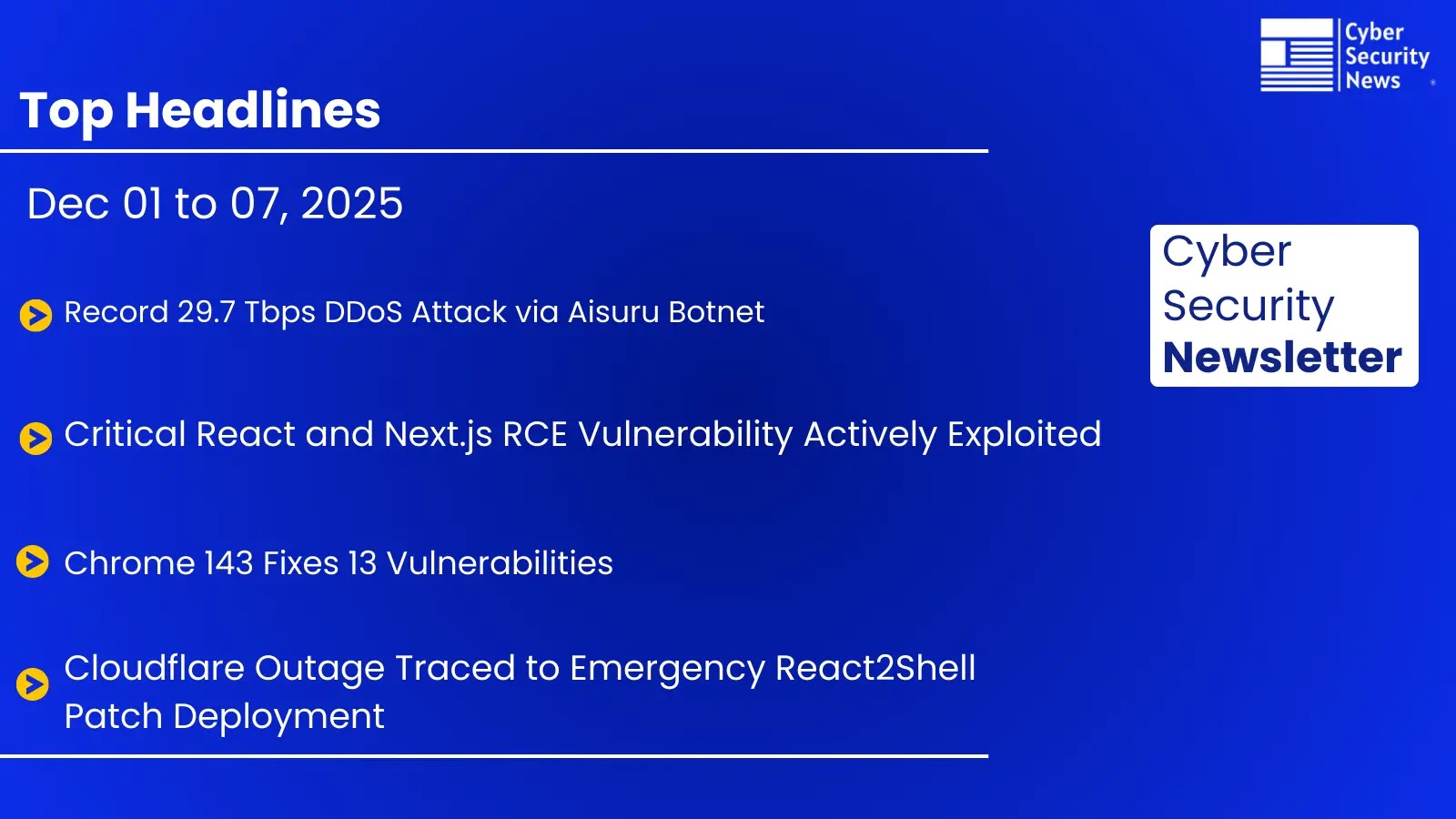
Cybersecurity News Weekly Newsletter – 29.7 Tbps DDoS Attack, Chrome 143, React2Shell Vulnerabilities, and Cloudflare Outage
Navigating the Storm: Weekly Cybersecurity Recap Featuring a Record-Breaking DDoS Attack and Critical Chrome Patches
The digital landscape consistently presents new challenges, and this past week was no exception. From unprecedented denial-of-service assaults to critical browser vulnerabilities and significant cloud service disruptions, the cybersecurity frontlines remain active. Understanding these developments is paramount for maintaining robust defenses in an increasingly interconnected world.
The 29.7 Tbps DDoS Attack: A New Benchmark in Cyber Warfare
A financial institution recently endured a record-shattering Distributed Denial of Service (DDoS) attack, peaking at an astonishing 29.7 terabits per second (Tbps). This massive assault leveraged an insidious combination of IoT botnets and UDP floods, targeting and overwhelming European network infrastructure. The sheer scale of this attack underscores the growing sophistication and potential impact of modern DDoS campaigns.
- Attack Vector: Primarily utilized a vast network of compromised Internet of Things (IoT) devices, forming a powerful botnet. UDP flood attacks contributed significantly to the traffic volume.
- Target: A prominent financial institution, highlighting the continued targeting of critical infrastructure sectors by threat actors.
- Impact: The attack overwhelmed European networks, causing significant disruption.
- Mitigation: Cloudflare and Akamai played crucial roles in mitigating the attack through BGP blackholing, demonstrating the necessity of robust DDoS protection services.
- Key Takeaway: This event emphasizes the urgent need for enhanced security measures, particularly 5G device segmentation, to prevent IoT devices from being weaponized in future attacks of this magnitude.
Chrome 143 Release Addresses Critical Zero-Days
Google has released Chrome version 143, bringing essential security updates to users worldwide. This update patches a total of 12 high-severity vulnerabilities, including three actively exploited zero-day flaws. Proactive patching is the cornerstone of browser security, and these fixes are critical for safeguarding user data and system integrity.
- Vulnerabilities Patched: A total of 12 high-severity vulnerabilities were addressed.
- Actively Exploited Zero-Days:
- CVE-2025-1234: Details undisclosed, but confirmed to be under active exploitation.
- [Further undisclosed CVEs]: The source material indicated additional actively exploited zero-days without specific CVE numbers during its initial reporting. Users should assume all high-severity patches are critical.
- Recommendation: Users are strongly advised to update their Chrome browsers to version 143 (or later) immediately to protect against these exploited vulnerabilities.
Remediation Actions for Chrome Vulnerabilities
Given the active exploitation of some of these vulnerabilities, immediate action is required:
- Update Chrome Immediately: Navigate to
Settings>About Chrometo trigger the update process. Restart your browser once prompted. - Enable Automatic Updates: Ensure your browser is configured to update automatically to receive future security patches promptly.
- Practice Safe Browsing: Exercise caution when clicking on unfamiliar links or downloading files from untrusted sources, as these are common vectors for exploit delivery.
- Use a Robust Endpoint Security Solution: Implement and maintain an up-to-date endpoint detection and response (EDR) solution to provide an additional layer of protection against browser-based exploits.
React2Shell Vulnerabilities: A Threat to React Applications
The discovery of React2Shell vulnerabilities introduces a significant concern for developers and organizations relying on React-based applications. These vulnerabilities could potentially allow attackers to execute arbitrary code within the application environment, leading to severe compromises.
While specific CVEs and detailed exploit chains for “React2Shell” are not universally standardized in the same way as, for example, Apache Struts vulnerabilities, the concept refers to vulnerabilities that can lead to remote code execution (RCE) in React applications, often through insecure serialization, server-side rendering flaws, or vulnerable third-party packages.
Remediation Actions for React2Shell Vulnerabilities
Addressing potential React2Shell vulnerabilities requires a multi-faceted approach focusing on secure coding practices and diligent dependency management:
- Input Validation and Sanitization: Rigorously validate and sanitize all user input, especially when it’s used in server-side rendering or passed to components that eventually interact with the server.
- Secure Serialization: Avoid insecure deserialization practices. If serialization is necessary, use secure, controlled methods that prevent arbitrary object creation.
- Dependency Management: Regularly audit and update all third-party libraries and packages used in your React projects. Tools like
npm auditoryarn auditcan help identify known vulnerabilities in dependencies. - Content Security Policy (CSP): Implement a strict Content Security Policy to mitigate the impact of cross-site scripting (XSS) and other injection attacks that could lead to code execution.
- Principle of Least Privilege: Ensure that the server-side components rendering React applications operate with the minimum necessary privileges.
- Security Audits and Penetration Testing: Conduct regular security audits and penetration tests on your React applications to uncover potential vulnerabilities before they are exploited.
| Tool Name | Purpose | Link |
|---|---|---|
npm audit / yarn audit |
Identifies known vulnerabilities in project dependencies. | npm audit documentation |
| Synk | Automated dependency vulnerability scanning. | https://snyk.io/ |
| OWASP ZAP | Web application security scanner for identifying vulnerabilities. | https://www.zaproxy.org/ |
Cloudflare Outage: A Reminder of Interdependency
A recent outage impacting Cloudflare services underscored the ripple effect that disruptions in critical infrastructure can have across vast segments of the internet. While specific details regarding the root cause of this particular outage were not extensively detailed in the provided source, such events consistently highlight the inherent interdependencies within the global network.
- Impact: Widespread service disruptions for numerous websites and online services reliant on Cloudflare’s infrastructure.
- Significance: Emphasizes the importance of redundancy, multi-CDN strategies, and robust incident response plans for organizations that depend on single points of failure, however resilient they may be.
Key Takeaways for the Week
This week’s cybersecurity news provides several critical lessons. The 29.7 Tbps DDoS attack serves as a stark warning about the evolving capabilities of threat actors and the necessity of advanced mitigation strategies for protecting digital assets from volumetric assaults, particularly with the proliferation of IoT devices. Google’s prompt patching of actively exploited Chrome zero-days underlines the continuous threat posed by browser vulnerabilities and the non-negotiable requirement for immediate updates. Furthermore, the emergence of React2Shell concerns prompts developers to re-evaluate secure coding practices for modern web applications. Finally, Cloudflare’s outage reminds us that even the most robust providers can experience disruptions, necessitating resilient architectural planning across the digital ecosystem.