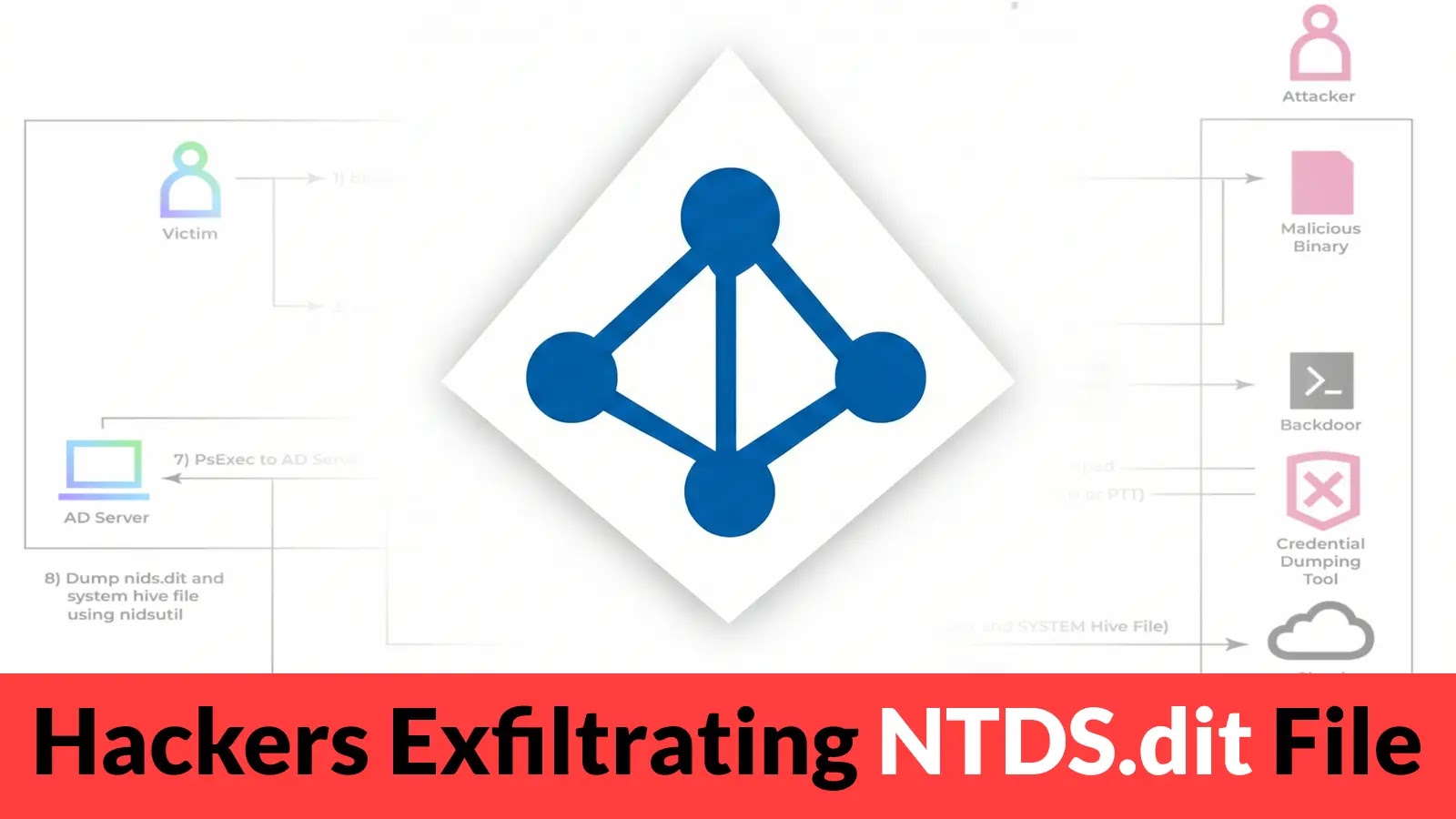
Hackers Exfiltrating NTDS.dit File to Gain Full Active Directory Access
Few assets within an organization’s digital infrastructure are as critical as Active Directory. It’s the cornerstone of identity and access management, the gatekeeper to your most valuable resources. When threat actors set their sights on Active Directory, they’re aiming for the crown jewels. A recent and concerning trend observed by security experts involves the increasing exfiltration of the NTDS.dit file. This direct assault on the heart of domain authentication poses an existential threat, granting attackers the keys to the entire kingdom.
Understanding the NTDS.dit File and Its Significance
The NTDS.dit file is a database that stores virtually all Active Directory data, including user objects, group objects, computer objects, and crucially, password hashes for every account in the domain. It’s stored on domain controllers and is an essential component of how Active Directory functions. Think of it as the ultimate directory for your organization’s digital identities.
When an attacker successfully exfiltrates this file, they gain offline access to these encrypted password hashes. While these hashes aren’t plaintext passwords, they can be subjected to sophisticated cracking techniques such as brute-force attacks, dictionary attacks, and rainbow table lookups. Tools like Mimikatz, when run on a compromised system with sufficient privileges, can also dump these hashes directly from memory.
How Attackers Exfiltrate NTDS.dit
Gaining access to the NTDS.dit file typically requires elevated privileges on a domain controller. Common vectors include:
- Lateral Movement: Attackers often gain an initial foothold through phishing, unpatched vulnerabilities, or weak credentials. They then use various techniques to escalate privileges and move laterally across the network until they compromise a domain controller.
- Pass-the-Hash/Pass-the-Ticket: These techniques allow attackers to authenticate to other services using stolen hash values or Kerberos tickets, bypassing the need for plaintext passwords.
- Volume Shadow Copy Service (VSS): A common and stealthy method involves creating a shadow copy of the volume containing the NTDS.dit file. This allows attackers to access snapshots of the file while it’s in use, avoiding file locking issues and often bypassing traditional antivirus detections.
- Specific Tools and Exploits: Tools like DCSync in Mimikatz (CVE-2015-0005) or built-in Windows utilities like
ntdsutil.execan be abused to extract the NTDS.dit or its contents, though DCSync specifically requests the hashes rather than the entire file. When discussing the NTDS.dit file itself, the focus is often on copying the file directly after establishing high-level access.
The Dangers of NTDS.dit Exfiltration
Once the NTDS.dit file is compromised and hashes are cracked, the implications are severe:
- Full Domain Compromise: Attackers can impersonate legitimate users, including domain administrators, giving them unrestricted access to all resources.
- Data Exfiltration: With full access, attackers can easily locate and steal sensitive data.
- Persistence: New backdoors and accounts can be created, ensuring long-term access to the network.
- Ransomware Deployment: A full Active Directory compromise is often a precursor to widespread ransomware attacks, as attackers can disable security controls and deploy ransomware efficiently.
Remediation Actions: Protecting Your Active Directory
Preventing NTDS.dit exfiltration and mitigating its impact requires a multi-layered security approach. Organizations must prioritize the security of their domain controllers.
- Strong Password Policies & Multi-Factor Authentication (MFA):Implement strong, unique passwords for all accounts, enforced with regular rotation where appropriate. Crucially, deploy MFA for all administrative accounts and as widely as possible for all users. This significantly reduces the impact of stolen password hashes.
- Principle of Least Privilege:Ensure that users and applications only have the minimum necessary permissions to perform their tasks. Restrict administrative access to domain controllers severely.
- Regular Patching and Vulnerability Management:Keep domain controllers and all connected systems fully patched. Regularly scan for vulnerabilities that could lead to privilege escalation.
- Network Segmentation:Isolate domain controllers on a secure network segment, restricting direct access to only absolutely necessary systems and users. Implement strict firewall rules.
- Advanced Threat Detection:Deploy Endpoint Detection & Response (EDR) and Security Information and Event Management (SIEM) solutions to monitor domain controllers for anomalous activity, such as unusual file access patterns, service installations, or command execution. Pay close attention to events related to the Volume Shadow Copy Service.
- Active Directory Security Auditing:Enable robust auditing on your Active Directory and domain controllers. Monitor for failed login attempts, privilege escalation, changes to critical security groups, and suspicious access to the NTDS.dit file or its parent directories.
- Backup and Recovery Strategy:Maintain secure, isolated backups of your Active Directory. In a worst-case scenario, this allows for recovery without reintroducing the compromise.
- Implement Microsoft’s Enhanced Security Administrative Environment (ESAE) or “Red Forest” Architecture:For large enterprises, consider implementing dedicated administrative forests to isolate highly privileged accounts from the production environment.
Tools for Detection and Mitigation
| Tool Name | Purpose | Link |
|---|---|---|
| Microsoft Defender for Identity (MDI) | Detects advanced attacks and insider threats against Active Directory, including suspicious calls to the NTDS.dit. | https://learn.microsoft.com/en-us/defender-for-identity/what-is-mdi |
| BloodHound | Maps Active Directory attack paths, helping identify privilege escalation routes to domain controllers. | https://bloodhoundenterprise.io/ |
| ADManager Plus | Active Directory management, reporting, and auditing tool that helps enforce security policies. | https://www.manageengine.com/products/active-directory-manager/ |
| Netwrix Auditor | Auditing solution for Active Directory that helps detect and investigate suspicious activity related to access and changes. | https://www.netwrix.com/active_directory_auditing.html |
Conclusion
The exfiltration of the NTDS.dit file represents a critical threat to an organization’s foundational security. As Active Directory remains a prime target, cybersecurity professionals must remain vigilant. By understanding the attack vectors, recognizing the severe implications, and implementing robust, layered defenses, organizations can significantly reduce their attack surface and protect against full domain compromise. Proactive defense, continuous monitoring, and a strong incident response plan are not merely recommendations; they are necessities in safeguarding the integrity of your identity infrastructure.