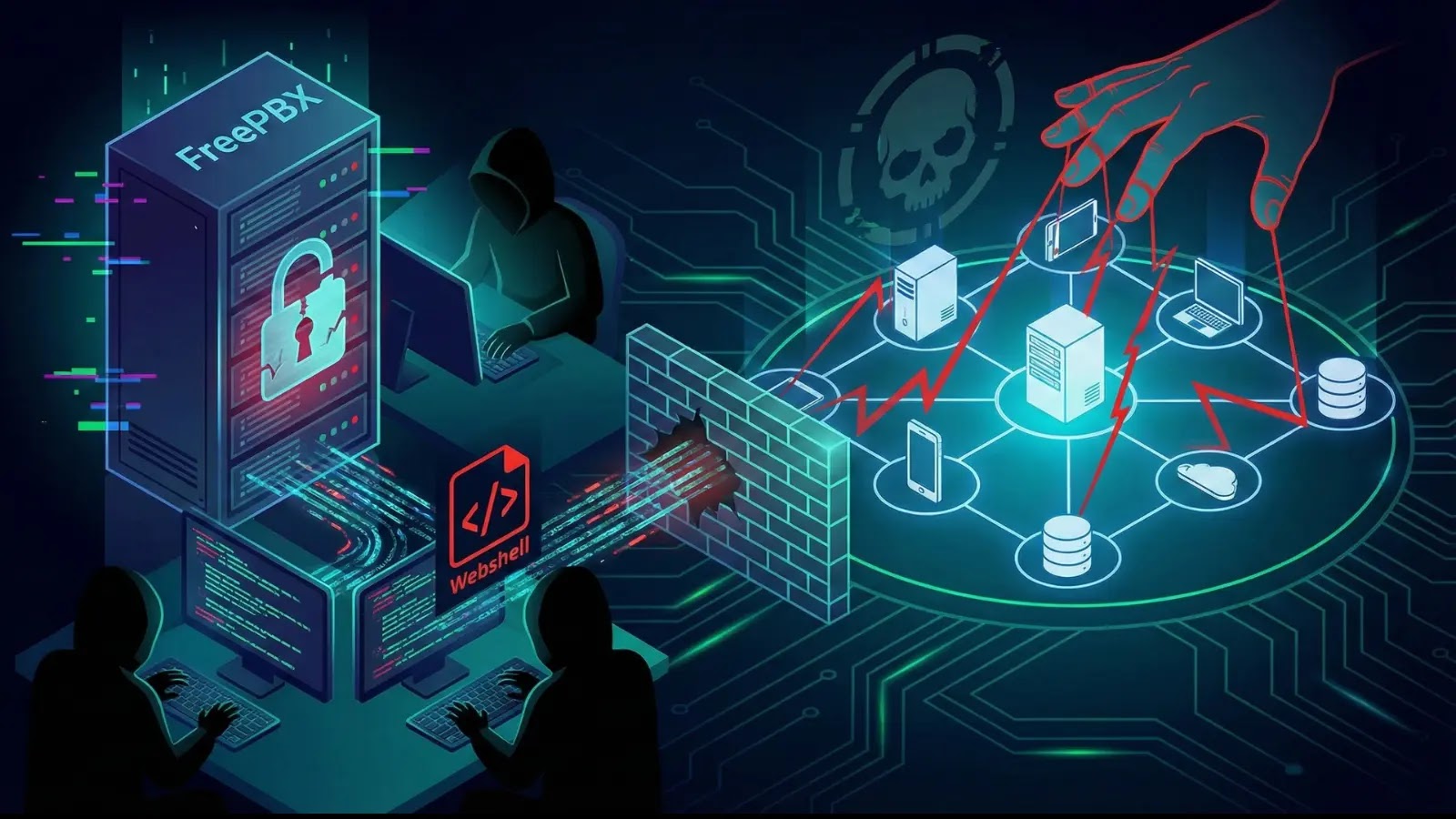
Hackers Exploiting FreePBX Vulnerability to Deploy Webshell and Gain Control of Systems
In the evolving landscape of cyber threats, the integrity of communication systems is paramount. A recent, highly sophisticated attack campaign has cast a stark light on the vulnerabilities inherent in widely deployed platforms, specifically FreePBX VoIP systems. Threat actors are actively exploiting a critical flaw to establish persistent control, posing a significant risk to organizations relying on these communication infrastructures.
This post delves into the specifics of this campaign, attributed to the group INJ3CTOR3, detailing the vulnerability, the mechanism of attack, and crucially, the steps organizations must take to safeguard their systems against such advanced persistent threats. Understanding these tactics is no longer optional; it’s a fundamental requirement for maintaining operational security.
Understanding the FreePBX Vulnerability: CVE-2025-64328
The core of this attack campaign lies in the exploitation of CVE-2025-64328. This critical vulnerability is identified as a post-authentication command-injection flaw residing within the FreePBX Endpoint Manager’s administrative interface. In simpler terms, once an attacker gains initial access, even with basic credentials, this flaw allows them to execute arbitrary commands on the underlying system.
The severity of command injection vulnerabilities cannot be overstated. They bypass many standard security controls, granting attackers direct access to the operating system. This particular flaw in FreePBX provides a clear pathway for full system compromise, transforming a communication server into a powerful pivot point for further malicious activities.
The “EncystPHP” Webshell: A Tool for Persistent Compromise
Once CVE-2025-64328 is successfully exploited, the threat actors deploy a malicious artifact dubbed “EncystPHP”. This is a highly sophisticated webshell designed for persistence and clandestine control.
A webshell is a malicious script or code uploaded to a web server, providing a backdoor for remote administration. EncystPHP, in this context, allows the attackers to:
- Execute arbitrary code on the FreePBX server.
- Upload, download, and modify files.
- Create new user accounts.
- Establish reverse shells for interactive access.
- Exfiltrate sensitive data.
The deployment of EncystPHP signifies a strategic move by the attackers to maintain long-term access, even if the initial exploit vector is patched. Its capabilities allow for complete administrative control, turning the compromised FreePBX system into a persistent base for the threat actor.
Attribution and Campaign Timeline: The INJ3CTOR3 Threat Actor
The malicious activity, initiated in early December 2025, has been attributed to the threat actor group INJ3CTOR3. While specific details about INJ3CTOR3’s origins or broader objectives are still emerging, their technical sophistication in weaponizing CVE-2025-64328 and deploying a custom webshell like EncystPHP demonstrates a high level of expertise.
The early December 2025 launch date indicates a relatively recent surge in these attacks. This timeline is critical for organizations to understand, as it means systems that were up-to-date prior to this period might still be vulnerable if they haven’t applied the latest security patches.
The Impact of a Compromised VoIP System
The implications of FreePBX system compromise extend far beyond simple service disruption. A successful attack can lead to:
- Eavesdropping and Call Interception: Threat actors can listen in on sensitive conversations, gaining access to proprietary information, trade secrets, or personal data.
- Fraudulent Call Generation: Compromised systems can be used to make premium-rate calls, leading to significant financial losses for organizations.
- Lateral Movement: The FreePBX server often resides within an organization’s internal network. A compromise can provide a foothold for attackers to move laterally and access other critical systems.
- Reputational Damage: Data breaches or service disruptions rooted in a compromised communication system can severely damage an organization’s reputation and customer trust.
- Denial of Service: Attackers can intentionally disrupt communication services, impacting business operations and emergency services.
Remediation Actions: Securing Your FreePBX Instance
Immediate action is required for organizations using FreePBX. Protecting your communication infrastructure against the INJ3CTOR3 campaign and similar threats necessitates a multi-faceted approach.
1. Patch Immediately:
- Identify the specific patch released by the FreePBX developers addressing CVE-2025-64328.
- Apply all available security updates and patches for your FreePBX installation and underlying operating system as a matter of urgency.
- Regularly check for and apply updates to all components of your FreePBX ecosystem.
2. Review and Strengthen Authentication:
- Enforce strong, unique passwords for all administrative accounts.
- Implement Multi-Factor Authentication (MFA) for all administrative interfaces, especially the Endpoint Manager.
- Audit existing user accounts and remove any unnecessary or dormant accounts.
3. Network Segmentation and Access Control:
- Isolate your FreePBX server on a dedicated network segment, limiting its exposure to the broader network.
- Implement strict firewall rules, allowing access to the administrative interface only from trusted IP addresses or through a VPN.
- Minimize the number of open ports on the FreePBX server.
4. Monitor for Indicators of Compromise (IoCs):
- Regularly review FreePBX system logs, web server logs, and OS logs for unusual activity. Look for suspicious file uploads (especially PHP files in unexpected directories), unauthorized command execution, or unusual outbound connections.
- Check for the presence of known webshells or suspicious files like “EncystPHP.”
- Utilize Intrusion Detection/Prevention Systems (IDPS) to monitor network traffic for anomalous patterns.
5. Regular Backups:
- Maintain frequent, verified backups of your FreePBX configuration and data. Store these backups securely and offline to prevent compromise during an attack.
Tools for Detection and Mitigation
Leveraging appropriate tools is vital in detecting and mitigating vulnerabilities like CVE-2025-64328 and the presence of webshells like EncystPHP.
| Tool Name | Purpose | Link |
|---|---|---|
| ClamAV | Open-source antivirus engine for detecting webshells and malware. | https://www.clamav.net/ |
| OSSEC HIDS | Host-based Intrusion Detection System for log analysis and file integrity monitoring. | https://www.ossec.net/ |
| Lynis | Security auditing tool for Linux, Unix, and macOS systems to harden configurations. | https://cisofy.com/lynis/ |
| Nmap | Network scanner for identifying open ports and services on FreePBX servers. | https://nmap.org/ |
| ModSecurity | Web Application Firewall (WAF) to protect web interfaces from common web attacks including command injection. | https://www.modsecurity.org/ |
Conclusion
The INJ3CTOR3 campaign exploiting CVE-2025-64328 in FreePBX systems is a serious reminder of the persistent and evolving threat landscape. The deployment of the “EncystPHP” webshell represents a sophisticated attempt by threat actors to gain and maintain complete administrative control over critical communication infrastructure. Organizations must prioritize immediate patching, reinforce authentication mechanisms, segment networks, and implement robust monitoring to detect and respond to these attacks. Proactive security measures are not just best practice; they are foundational to safeguarding operational continuity and sensitive data against advanced threats.