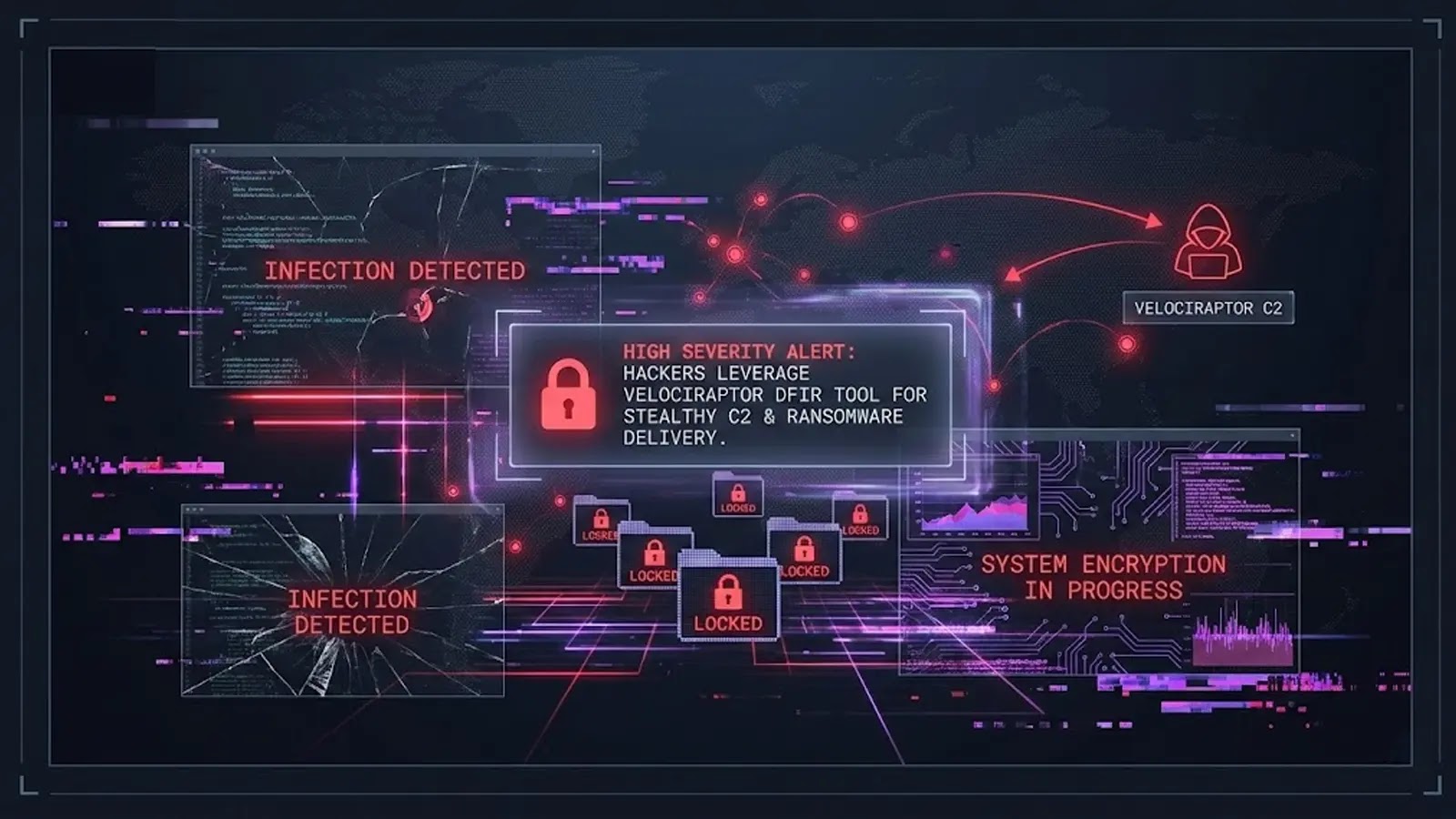
Hackers Leverage Velociraptor DFIR Tool for Stealthy C2 & Ransomware Delivery
In the relentless cat-and-mouse game of cybersecurity, attackers are constantly refining their methodologies to evade detection. A disturbing trend has emerged: the weaponization of legitimate administrative tools. This sophisticated tactic allows threat actors to operate under the radar, leveraging trusted software to achieve malicious ends. A recent campaign has brought this into sharp focus, revealing how adversaries are now exploiting Velociraptor, a highly respected Digital Forensics and Incident Response (DFIR) tool, for stealthy command and control (C2) and ransomware delivery.
The Evolution of Evasion: Legitimate Tools, Malicious Intent
Threat actors are notoriously adept at adapting. Instead of creating bespoke, easily identifiable malware, they are increasingly turning to tools that are already present in enterprise environments or can be easily deployed without raising immediate red flags. This strategy, often termed “living off the land,” makes it significantly harder for traditional security solutions to differentiate between legitimate administrative activities and malicious operations. The use of Velociraptor exemplifies this dangerous trend, transforming a powerful defensive asset into an offensive weapon.
Velociraptor: A DFIR Tool Turned Adversary Asset
Velociraptor is a powerful, open-source advanced DFIR tool designed to help security professionals rapidly collect and analyze endpoint data. Its capabilities include real-time endpoint monitoring, artifact collection, and automated incident response workflows. Precisely because of these robust features – its ability to interact deeply with endpoints, collect extensive data, and execute commands – it becomes extraordinarily valuable to an attacker. By deploying and configuring Velociraptor on compromised systems, adversaries gain:
- Stealthy Command and Control: Velociraptor’s legitimate communication channels and data transfer mechanisms can be repurposed by attackers to establish covert C2 infrastructure. This traffic often blends in with normal network activity, making it difficult for network security tools to detect anomalies.
- Efficient Data Exfiltration: The tool’s data collection capabilities can be abused to systematically gather sensitive information for exfiltration, all under the guise of legitimate data collection.
- Ransomware Delivery and Execution: Attackers can leverage Velociraptor’s powerful execution capabilities to deploy and execute ransomware payloads across an infected network, orchestrating a widespread attack with high efficiency.
- Lateral Movement: With administrative control via Velociraptor, threat actors can facilitate lateral movement within a compromised network, identifying and exploiting other vulnerable systems.
Understanding the Attack Vector
The campaign highlighted by Cyber Security News underscores a critical weakness: the trust placed in administrative tools. Attackers likely gain initial access through common vectors such as phishing, exploiting unpatched vulnerabilities, or weak credentials. Once inside, they elevate privileges and then deploy Velociraptor. Crucially, they aren’t exploiting a vulnerability in Velociraptor itself; rather, they are exploiting its legitimate functionality for malicious purposes. This makes detection particularly challenging, as the tool is performing actions it was designed for, albeit under the control of an unauthorized entity.
Remediation Actions and Proactive Defenses
Defending against the weaponization of legitimate tools like Velociraptor requires a multi-layered and proactive approach:
- Strict Endpoint Security Policies: Implement application allowlisting to prevent unauthorized execution of any software, including legitimate DFIR tools, unless explicitly approved.
- Privileged Access Management (PAM): Enforce stringent PAM controls to limit who can deploy and configure powerful tools like Velociraptor on endpoints. Implement just-in-time access for administrative tasks.
- Behavioral Monitoring and Anomaly Detection: Focus on detecting anomalous behavior rather than just known signatures. Look for unusual network connections, data transfers, or command executions emanating from legitimate tools. This includes monitoring for Velociraptor agents communicating with external, unauthorized servers.
- Network Segmentation: Segment your network to limit lateral movement. Even if an attacker compromises a single endpoint and deploys Velociraptor, well-executed segmentation can contain the damage.
- Regular Audits and Configuration Reviews: Periodically audit configurations of all administrative tools. Ensure that DFIR tools are only deployed when needed for specific, authorized incidents, and promptly removed or disabled afterward.
- User Education: Train employees to recognize and report phishing attempts and other social engineering tactics, as initial access often hinges on human error.
- Continuous Vulnerability Management: Keep all systems, applications, and network devices patched and up-to-date to minimize initial entry points for attackers.
Tools for Enhanced Detection and Mitigation
While the struggle against weaponized legitimate tools is ongoing, several types of tools can bolster your defenses:
| Tool Name | Purpose | Link |
|---|---|---|
| Endpoint Detection and Response (EDR) solutions | Advanced behavioral monitoring, threat hunting, and automated response capabilities. | – (Vendor specific) |
| Security Information and Event Management (SIEM) systems | Aggregates logs from across the IT environment for centralized analysis and anomaly detection. | – (Vendor specific) |
| Network Detection and Response (NDR) solutions | Monitors network traffic for suspicious patterns, C2 communications, and data exfiltration. | – (Vendor specific) |
| Application Allowlisting/Whitelisting software | Restricts execution of unauthorized programs; critical for preventing malicious tool deployment. | – (Vendor specific) |
| Privileged Access Management (PAM) solutions | Manages and secures privileged accounts, limiting access for deployment of administrative tools. | – (Vendor specific) |
Key Takeaways
The weaponization of Velociraptor for C2 and ransomware delivery signifies a critical shift in adversary tactics. Defenders must evolve beyond signature-based detection and embrace a security posture centered on behavioral analysis, stringent access controls, and comprehensive endpoint and network visibility. Organizations must recognize that even trusted, legitimate tools can become powerful weapons in the hands of sophisticated threat actors, necessitating a proactive and vigilant approach to cybersecurity.