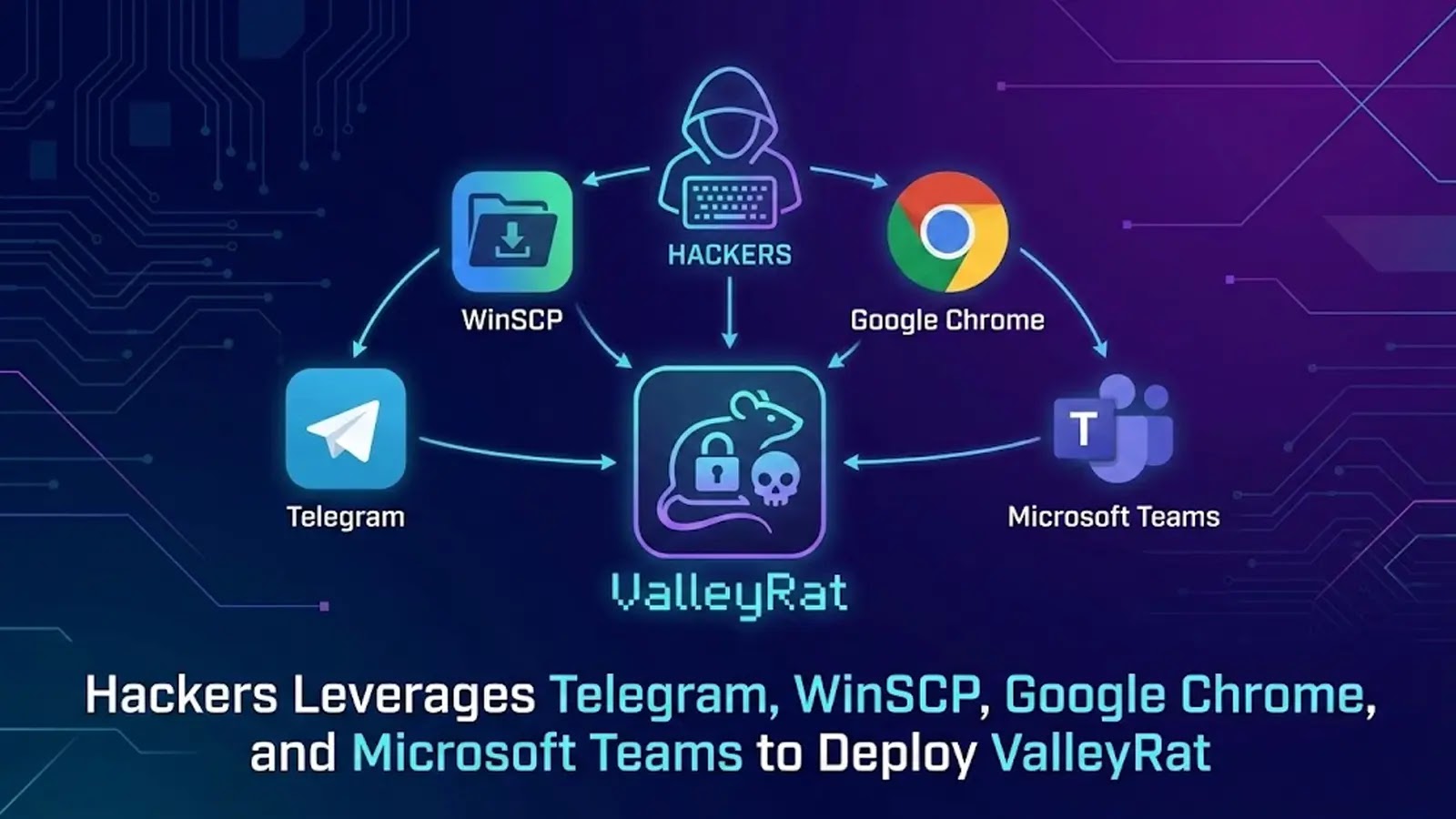
Hackers Leverages Telegram, WinSCP, Google Chrome, and Microsoft Teams to Deploy ValleyRat
The Silent Compromise: ValleyRat Leverages Popular Apps for Persistent Access
In a landscape where digital trust is paramount, a new and concerning malware campaign has surfaced, artfully exploiting the very applications users rely on daily. Cybersecurity analysts are sounding the alarm over a sophisticated operation distributing trojanized installers for ubiquitous tools like Telegram, WinSCP, Google Chrome, and Microsoft Teams. The insidious goal? To deploy ValleyRat, a potent Remote Access Trojan (RAT) engineered for deep, long-term system compromise. This campaign, attributed to the China-aligned Advanced Persistent Threat (APT) group known as Silver Fox, highlights a critical shift in attacker methodology, moving beyond zero-day exploits to weaponize user trust.
Understanding ValleyRat: A Persistent Threat
ValleyRat is not your run-of-the-mill malware. As a Remote Access Trojan, its primary objective is to establish and maintain unauthorized, covert access to a victim’s system. Once deployed, it grants attackers a wide range of capabilities, including:
- Data Exfiltration: Stealing sensitive information, documents, and credentials.
- Surveillance: Monitoring user activity, taking screenshots, and logging keystrokes.
- Remote Control: Executing commands, manipulating files, and installing additional malicious payloads.
- Persistence: Employing various techniques to survive reboots and evade detection, ensuring long-term access.
The danger of ValleyRat lies in its ability to operate stealthily, allowing attackers to remain undetected for extended periods, gathering intelligence and executing their objectives without immediate suspicion. This makes it a formidable tool for espionage and intellectual property theft.
The Trojan Horse Strategy: Abusing Trusted Applications
The genius, and indeed the malice, of this campaign lies in its distribution method. Instead of relying on obscure phishing links or complex vulnerabilities, Silver Fox has opted for psychological manipulation – leveraging the familiarity and trust associated with popular applications:
- Telegram: A widely used secure messaging app. Users downloading a “trojanized” version might assume they’re getting a legitimate update or a special client.
- WinSCP: A popular SFTP and FTP client, often used by developers and IT professionals. A compromised installer could be devastating for those dealing with sensitive data transfers.
- Google Chrome: The world’s most popular web browser. A fake installer can trick unsuspecting users into installing malware instead of their trusted browser.
- Microsoft Teams: An essential collaboration tool for businesses. Compromising Teams installations can provide direct access into corporate networks.
These trojanized installers appear legitimate, often mirroring the official application’s interface and functionality. However, in the background, they secretly install ValleyRat, turning a seemingly innocent download into a critical security breach.
Attribution and Implications: The Silver Fox APT Group
The attribution of this campaign to the Silver Fox APT group is significant. APT groups are typically state-sponsored or highly sophisticated organizations with extensive resources and long-term objectives. Their involvement suggests a well-planned and persistent effort, likely targeting specific individuals or organizations for strategic intelligence gathering or sabotage.
Their focus on widely used applications indicates a broad attack surface and a calculated effort to bypass traditional security measures that might focus solely on network-level threats. By infiltrating endpoints through seemingly legitimate software, they establish a foothold from within, making detection and eradication far more challenging.
Remediation Actions and Proactive Defense
Defending against sophisticated campaigns like the ValleyRat deployment requires a multi-layered approach focusing on vigilance, robust security practices, and continuous monitoring.
- Source Verification: Always download software directly from the official vendor’s website. Avoid third-party download sites, torrents, or suspicious links in emails, even if they appear to be from a known contact.
- Hash Verification: Where available, compare the downloaded file’s cryptographic hash (MD5, SHA256) with the one provided on the official vendor’s website.
- Endpoint Detection and Response (EDR): Implement EDR solutions to monitor for suspicious activity, anomalous process execution, and unauthorized network connections that could indicate ValleyRat’s presence.
- Regular Software Updates: Ensure all operating systems and applications are consistently updated to patch known vulnerabilities. While this campaign leverages trojanized installers, up-to-date software is a fundamental defense.
- User Awareness Training: Educate users about the dangers of downloading software from unofficial sources, identifying phishing attempts, and the importance of verifying digital signatures.
- Network Segmentation: Implement network segmentation to limit the lateral movement of malware if an endpoint becomes compromised.
- Principle of Least Privilege: Ensure users and applications operate with the minimum necessary permissions to perform their tasks.
Detection Tools for Identifying ValleyRat and Similar Threats
Employing the right tools is crucial for identifying and mitigating threats like ValleyRat. Below are some essential categories and examples:
| Tool Category | Purpose | Examples / Considerations |
|---|---|---|
| Endpoint Detection and Response (EDR) | Real-time monitoring, detection, and response to endpoint threats, including advanced malware and RATs. | CrowdStrike Falcon, SentinelOne, Microsoft Defender for Endpoint |
| Antivirus/Anti-Malware (AV) | Signature-based and heuristic detection of known malware. Essential first line of defense. | Malwarebytes, Sophos Intercept X, ESET Endpoint Security |
| Network Intrusion Detection/Prevention Systems (NIDS/NIPS) | Monitoring network traffic for suspicious patterns, C2 communications, and data exfiltration attempts. | Snort, Suricata, Palo Alto Networks (Firewalls with threat prevention) |
| File Integrity Monitoring (FIM) | Detects unauthorized changes to critical system files and configurations, often a sign of compromise. | OSSEC, Tripwire, Wazuh |
| Threat Intelligence Platforms (TIP) | Aggregates and analyzes threat data, providing context on APT groups, IoCs, and attack methodologies. | Recorded Future, Anomali ThreatStream |
Conclusion: Heightened Vigilance in a Landscape of Trust Exploitation
The ValleyRat campaign, orchestrated by the Silver Fox APT group, serves as a stark reminder that even the most trusted applications can become conduits for sophisticated attacks. By trojanizing popular software like Telegram, WinSCP, Google Chrome, and Microsoft Teams, attackers expertly bypass initial defenses and establish a persistent presence for long-term compromise. Effective defense hinges on a combination of technical safeguards, rigorous source verification, and continuous user education. Organizations and individuals must cultivate a culture of skepticism toward unofficial downloads and maintain a robust security posture to thwart these increasingly clever and impactful threats.