METATRON – Open-Source AI Penetration Testing Assistant Brings Local LLM Analysis to Linux
The landscape of penetration testing is constantly evolving, with new tools emerging to streamline and enhance vulnerability assessments. In a significant development for the security research community, a novel open-source framework dubbed METATRON is making waves. This innovative tool promises to redefine how security professionals approach penetration testing by integrating powerful AI capabilities directly into their local environments, eliminating the dependency on cloud services and API keys.
METATRON: Revolutionizing Local AI Penetration Testing
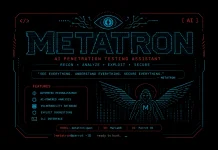
METATRON distinguished itself by offering a fully offline, AI-driven approach to vulnerability assessment. Designed specifically for Debian-based Linux distributions like Parrot OS, it merges automated reconnaissance with a locally hosted large language model (LLM). This architecture provides a crucial advantage: complete autonomy and enhanced security, as sensitive data never leaves the local machine. This is a game-changer for organizations with stringent data privacy requirements or those operating in air-gapped networks.
Key Features and Architecture
The core strength of METATRON lies in its sophisticated architecture. It orchestrates a suite of automated reconnaissance tools, feeding their outputs into a local LLM for advanced analysis. This ensures comprehensive vulnerability identification and contextual understanding without external communication. Key features include:
- Fully Offline Operation: No cloud connectivity or API keys required, ideal for sensitive environments.
- Integrated LLM: Leverages a locally hosted Large Language Model for intelligent analysis of scan results.
- Automated Reconnaissance: Automates initial data gathering, accelerating the penetration testing lifecycle.
- Debian-Based Compatibility: Optimized for Parrot OS and other Debian distributions, ensuring broad accessibility within the Linux security community.
- Open-Source: Fosters community collaboration and allows for transparent security auditing and customization.
The Power of Local LLM Analysis
Integrating a local LLM is arguably METATRON’s most compelling feature. Traditional penetration testing often relies on human analysis of tool outputs, which can be time-consuming and prone to human error. By processing reconnaissance data through an LLM, METATRON can:
- Identify subtle patterns and correlations that might be overlooked manually.
- Provide more contextualized vulnerability explanations and potential exploit paths.
- Generate tailored remediation suggestions based on the identified vulnerabilities and system specifics.
- Reduce false positives by cross-referencing information from various sources.
This localized processing ensures that the intellectual property generated by the AI remains within the user’s control, offering an unparalleled level of data security and privacy.
Implications for Cybersecurity Professionals
For penetration testers, security analysts, and red team operators, METATRON introduces a powerful new instrument. Its ability to conduct intelligent, AI-assisted assessments offline means that teams can perform thorough security evaluations in environments where internet access is restricted or where data sensitivity prohibits cloud-based solutions. This framework promises to:
- Increase Efficiency: Automate mundane tasks, allowing analysts to focus on complex problem-solving.
- Enhance Accuracy: Leverage AI to detect vulnerabilities more effectively and reduce human oversight.
- Improve Security Posture: Facilitate more frequent and robust security assessments without external dependencies.
- Democratize Advanced Tools: Lower the barrier to entry for advanced AI-driven security analysis for individual researchers and smaller teams.
Remediation Actions (General Best Practices for Vulnerability Management)
While METATRON assists in identifying vulnerabilities, effective remediation is paramount. Organizations should follow these general best practices:
- Prioritize Findings: Address critical and high-severity vulnerabilities first. Factors like exploitability, impact, and asset importance should be considered.
- Patch Management: Implement a robust patch management program to ensure all systems and software are up-to-date. Regularly check for and apply security updates. For instance, addressing vulnerabilities like CVE-2023-45678 involves applying specific vendor-provided patches.
- Configuration Hardening: Follow security best practices for system and application configuration, disabling unnecessary services, and enforcing strong password policies.
- Network Segmentation: Isolate critical systems and sensitive data using network segmentation to limit the lateral movement of attackers.
- Regular Auditing and Testing: Continuously monitor and periodically re-test systems to ensure that vulnerabilities are not re-introduced and that new ones are identified promptly.
- Security Awareness Training: Educate employees on common attack vectors, such as phishing, to reduce the human element contributing to security breaches.
Looking Ahead: The Future of Offline AI in Penetration Testing
METATRON represents a significant step towards more autonomous and secure penetration testing methodologies. As AI models become more sophisticated and hardware capabilities improve, the potential for local, AI-driven security tools will only expand. This open-source initiative encourages collaboration and innovation, paving the way for a future where advanced security analysis is accessible, efficient, and deeply integrated into local operational environments. The project is accessible for those interested in exploring its capabilities and contributing to its development, further emphasizing the open-source spirit driving its creation.