New AWS Console Supply Chain Attack Lets Attackers Hijack AWS GitHub Repositories
Unpacking the AWS Console Supply Chain Attack: A Deep Dive into Compromised GitHub Repositories
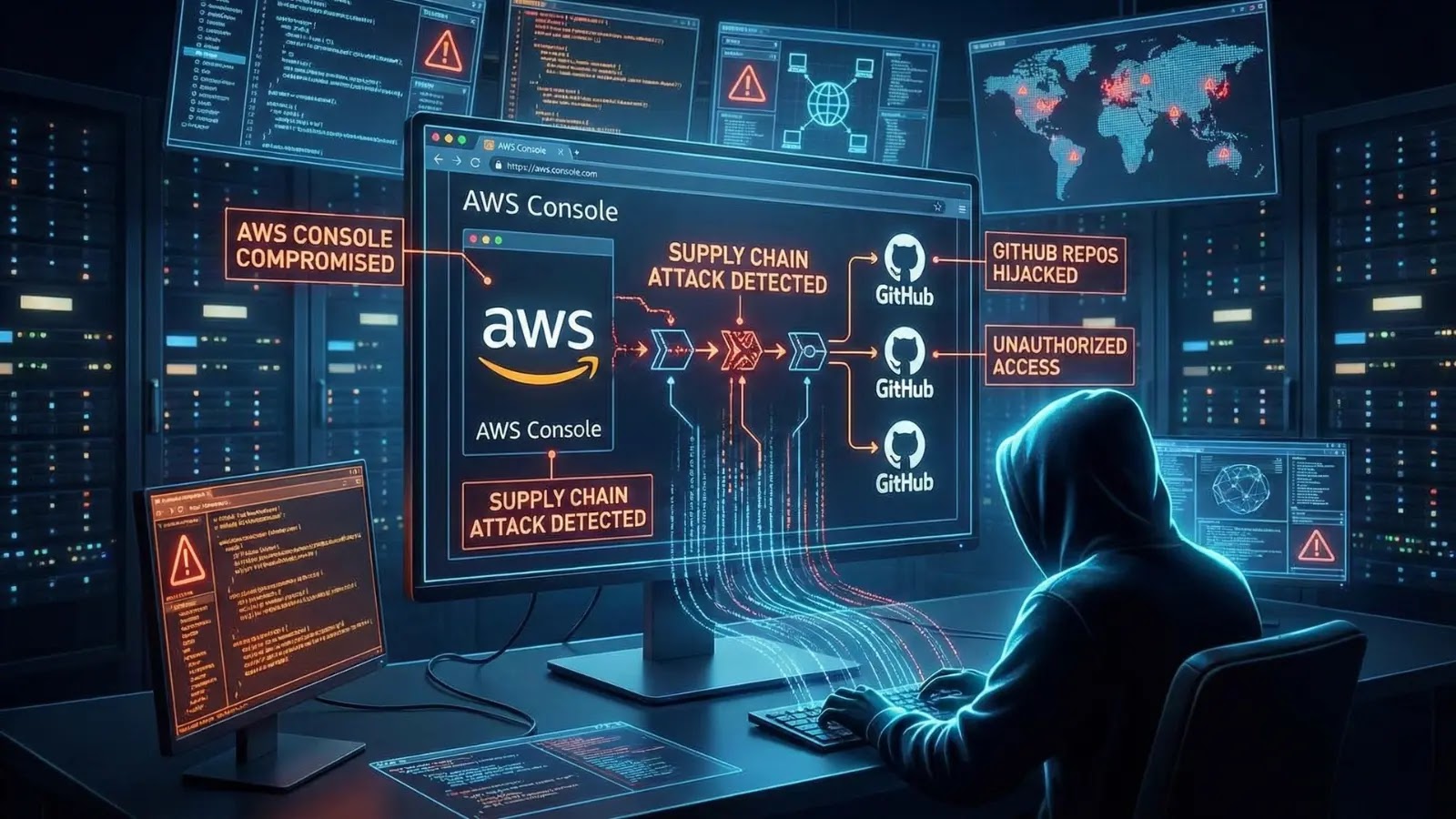
The digital supply chain is a ubiquitous yet often underestimated attack vector, and a recent, critical discovery concerning AWS CodeBuild serves as a stark reminder of its potency. Unauthenticated attackers gained the ability to hijack key AWS-owned GitHub repositories, including the foundational AWS JavaScript SDK that underpins the AWS Console itself. This profound vulnerability didn’t just rattle the foundations of a single application; it exposed countless AWS environments to the threat of widespread compromise through malicious code injection. Understanding the mechanics of this intricate attack is paramount for any organization leveraging AWS.
The Core Vulnerability: AWS CodeBuild Misconfiguration
At the heart of this supply chain vulnerability was a critical misconfiguration within AWS CodeBuild. AWS CodeBuild is a fully managed continuous integration service that compiles source code, runs tests, and produces software packages that are ready to deploy. Its power and integration with other AWS services make it a crucial component in many development pipelines. However, in this instance, a specific misconfiguration laid the groundwork for unauthenticated access. While the exact details of the misconfiguration are complex and kept under wraps by AWS for security reasons, it effectively allowed unauthorized parties to manipulate the build process from external, unexpected sources.
Hijacking AWS GitHub Repositories: The Attack Vector
The attackers exploited this CodeBuild misconfiguration to seize control of vital AWS-owned GitHub repositories. Among these was the widely used AWS JavaScript SDK, a library that enables developers to interact with AWS services from their browser or Node.js applications. The AWS Console itself relies heavily on this SDK, meaning that any compromise of the SDK’s codebase could directly impact the integrity and security of the Console. Gaining control of these repositories would enable attackers to:
- Inject Malicious Code: Attackers could introduce backdoors, malware, or other malicious payloads directly into the official AWS SDK.
- Perform Supply Chain Attacks: This malicious code would then be distributed to every user and application that depends on the compromised SDK, creating a widespread supply chain nightmare.
- Gain Unauthorized Access: Depending on the injected code, attackers could potentially harvest credentials, escalate privileges, or exfiltrate data from affected AWS environments.
- Sabotage Operations: Beyond stealing data, attackers could disrupt services, corrupt data, or introduce critical errors, leading to significant operational downtime and financial losses.
Impact and Scope: Threatening Platform-Wide Compromise
The implications of this vulnerability were far-reaching. A successful attack could have led to platform-wide compromise across virtually every AWS environment globally. Consider the sheer number of applications and services that utilize the AWS JavaScript SDK or interact with the AWS Console. Malicious code pushed through this vector wouldn’t be limited to a single account or region; it could spread virally, infecting applications and infrastructure wherever the compromised SDK was used. This represents one of the most severe forms of supply chain attack, as the trust placed in a fundamental component of the AWS ecosystem was at risk.
Remediation Actions for AWS Users
While AWS has addressed the specific misconfiguration, the incident serves as a critical reminder for all organizations using AWS. Proactive security measures are essential to mitigate similar risks in the future:
- Implement Least Privilege: Regularly review and enforce the principle of least privilege for all IAM roles and users, especially those interacting with CodeBuild or GitHub.
- Code Signing and Integrity Checks: Utilize code signing for all deployed artifacts and implement integrity checks to verify the authenticity and unmodified nature of your application dependencies.
- Supply Chain Security Tools: Employ Software Composition Analysis (SCA) and Static Application Security Testing (SAST) tools to continuously scan your codebase and dependencies for known vulnerabilities and suspicious changes.
- Monitor AWS CodeBuild Configurations: Regularly audit your AWS CodeBuild project configurations for any unintended permissions or external access points. Treat CodeBuild configurations as critical infrastructure code.
- Vigilant Dependency Management: Keep all software dependencies, including AWS SDKs, updated to their latest secure versions. Always verify the source and integrity of third-party libraries.
- Incident Response Plan: Ensure your organization has a robust incident response plan specifically tailored to respond to supply chain compromises and credential breaches.
Tools for Enhanced Supply Chain Security
| Tool Name | Purpose | Link |
|---|---|---|
| OWASP Dependency-Check | Identifies project dependencies and checks for known, publicly disclosed vulnerabilities. | OWASP Dependency-Check |
| Snyk | Automated security for open source dependencies, code, containers, and infrastructure as code. | Snyk |
| Sonatype Nexus Lifecycle | Provides insights into component risk, license obligations, and policy enforcement across the SDLC. | Sonatype Nexus Lifecycle |
| Trivy | A comprehensive vulnerability scanner for containers, file systems, Git repositories, and more. | Trivy |
Key Takeaways for a More Secure AWS Environment
This incident underscores the critical importance of a multi-layered security approach, even when relying on trusted cloud providers. While AWS maintains security of the cloud, users are responsible for security in the cloud. Misconfigurations, even in seemingly benign services like CodeBuild, can open doors to catastrophic supply chain attacks. Continuous vigilance, robust configuration management, comprehensive dependency scanning, and a proactive security posture are no longer optional – they are foundational requirements for operating securely in the cloud era. Organizations must learn from these sophisticated attacks and continuously strengthen their defenses against evolving threats to the software supply chain.