New GhostLocker Tool that Uses Windows AppLocker to Neutralize and Control EDR
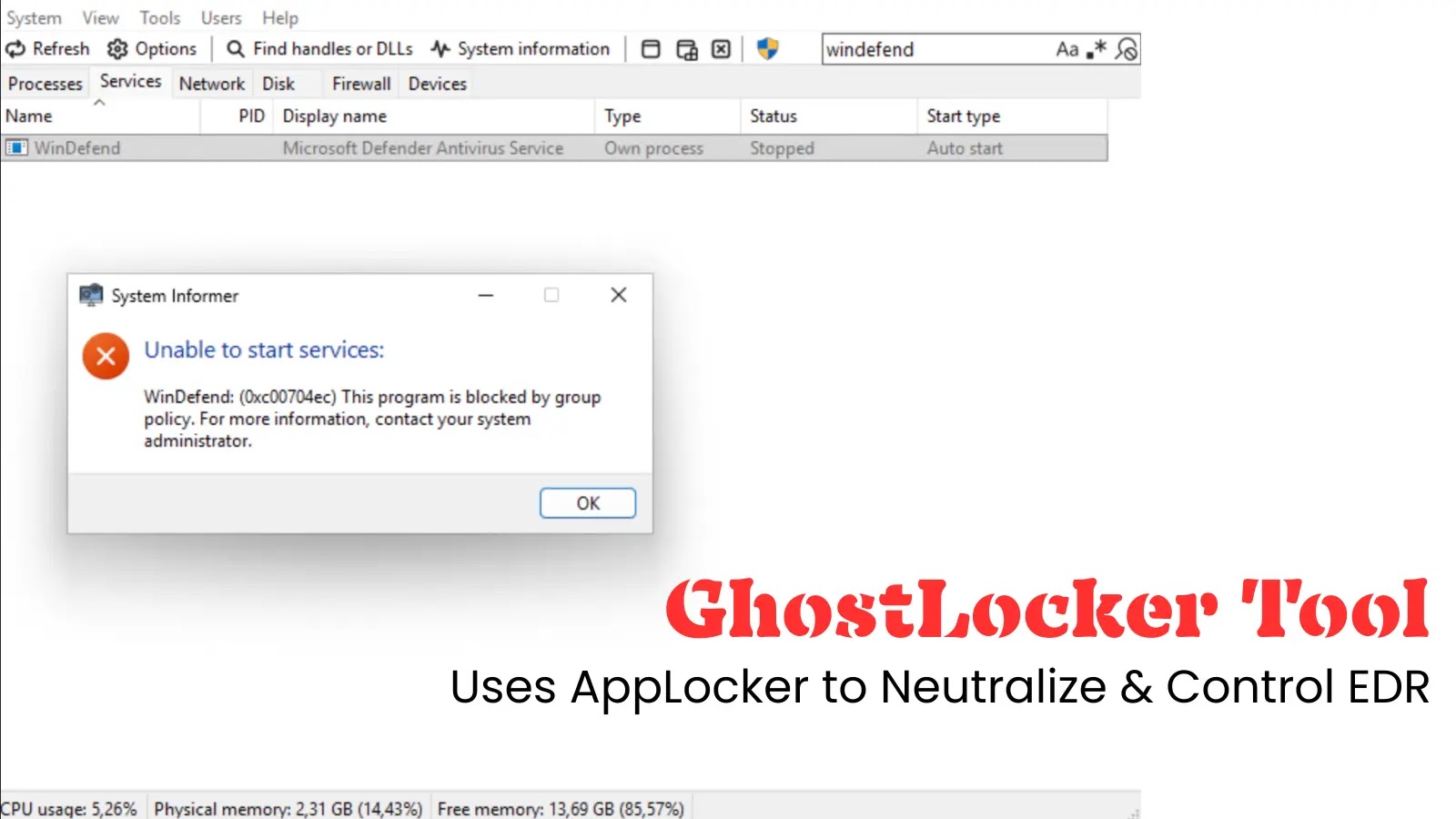
Endpoint Detection and Response (EDR) systems are the frontline guardians against sophisticated cyber threats. They promise to monitor, detect, and respond to malicious activities in real time. But what if a fundamental design choice in these crucial tools could be weaponized against them? A new tool, dubbed GhostLocker, demonstrates precisely this, exploiting a critical architectural vulnerability in modern EDR solutions by leveraging the native Windows AppLocker feature.
Developed by security researcher zero2504, GhostLocker exposes how an attacker can neutralize and even control EDRs, shining a spotlight on their reliance on userland components for analysis and reporting. This isn’t just another evasion technique; it points to a deeper architectural weakness that demands immediate attention from security professionals and EDR vendors alike.
Understanding GhostLocker and AppLocker’s Role
GhostLocker’s ingenuity lies in its ability to weaponize Windows AppLocker, a legitimate operating system feature designed to control which applications users can run. Traditionally, AppLocker is used to enhance security by whitelisting approved software and blocking unauthorized executables. GhostLocker flips this concept on its head.
The core mechanism involves manipulating AppLocker policies to prevent EDR agents from executing or from communicating effectively. EDR solutions typically operate within the userland space, meaning they run as applications on the operating system. By altering AppLocker rules, an attacker can effectively “lock out” the EDR agent, preventing it from monitoring system activity, sending alerts, or even receiving updates from its central management console.
The Architectural Vulnerability in EDR
Modern EDR solutions aim to provide comprehensive visibility and control. However, their reliance on userland components creates an inherent weakness. If an attacker gains sufficient privileges on a system (often through phishing, exploitation of vulnerabilities, or misconfigurations), they can then manipulate the environment in which the EDR operates. GhostLocker capitalizes on this by using a legitimate Windows feature to subvert the EDR’s operational integrity.
Unlike traditional methods of EDR evasion that might involve process injection or obfuscation, GhostLocker leverages a legitimate system control to prevent the EDR from even starting or functioning correctly. This makes detection significantly more challenging, as the actions taken by GhostLocker might appear as legitimate system configuration changes rather than overt malicious activity.
Impact and Implications for Cybersecurity
- Reduced Visibility: A neutralized EDR means a significant blind spot for security teams. Threats can operate undetected, moving laterally and escalating privileges without triggering alerts.
- Compromised Response: With the EDR incapacitated, automated response actions like process termination or network isolation cannot be initiated, allowing attackers more time to achieve their objectives.
- Persistence Mechanisms: An attacker could use GhostLocker to disable EDR before establishing persistence, making their presence on the network harder to eradicate.
- Supply Chain Risks: If attackers can compromise trusted applications and then use GhostLocker, the scope of a breach could expand rapidly.
Remediation Actions and Mitigations
Addressing the Architectural Vulnerability requires a multi-layered approach, focusing on strengthening the host environment and improving EDR resilience.
- Stronger Privilege Management: Adopt a stringent least-privilege model. Even if an attacker gains initial access, limiting their ability to modify system-level configurations like AppLocker policies can prevent them from neutralizing EDR.
- Enhanced Configuration Management: Regularly audit and enforce AppLocker policies to prevent unauthorized modifications. Tools like Group Policy Objects (GPOs) or Microsoft Intune can help centralize and secure these configurations.
- EDR Hardening and Self-Protection: EDR vendors must prioritize developing stronger self-protection mechanisms that operate at deeper kernel levels or employ trusted boot technologies to prevent userland manipulation of their agents. Research and implement ways for EDR agents to detect and resist attempts to disable them via AppLocker policy changes.
- Behavioral Anomaly Detection: Implement broader behavioral analytics that can detect unusual changes to critical system configurations, even if they are performed using legitimate tools. Abnormal AppLocker policy changes, especially when not tied to IT change management, should raise red flags.
- Layered Security Approach: Relying solely on EDR is insufficient. Combine EDR with network segmentation, strong identity and access management (IAM), and regular vulnerability management to create a more resilient defense.
- Integrity Monitoring: Implement file integrity monitoring (FIM) on critical operating system files and directories, including those related to AppLocker policies, to detect unauthorized changes.
Tools for Detection and Mitigation
| Tool Name | Purpose | Link |
|---|---|---|
| Microsoft AppLocker | Application whitelisting and control. Crucial for both defense and understanding GhostLocker’s mechanism. | Microsoft Learn |
| Group Policy Management Console (GPMC) | Centralized management of AppLocker policies in Active Directory environments. | Microsoft Learn |
| Sysmon | Advanced system monitoring for detecting unusual process creation, file modifications, and registry changes. Can help detect AppLocker policy manipulation. | Microsoft Sysinternals |
| EDR with Strong Self-Protection | While GhostLocker targets EDR, robust EDRs are developing stronger self-protection capabilities to detect and prevent tampering. | (Vendor Specific) |
Conclusion
GhostLocker serves as a stark reminder that even the most advanced security tools are not infallible. By weaponizing a native Windows feature, zero2504 has highlighted a critical architectural vulnerability in the EDR landscape: their reliance on userland components. This new approach to EDR neutralization underscores the need for organizations to implement defense-in-depth strategies, focusing not only on detection but also on robust endpoint hardening, stringent privilege management, and continuous monitoring of critical system configurations. Security professionals must understand this technique and adapt their defenses to counter such sophisticated attacks, pushing EDR vendors to develop more resilient and tamper-resistant solutions.