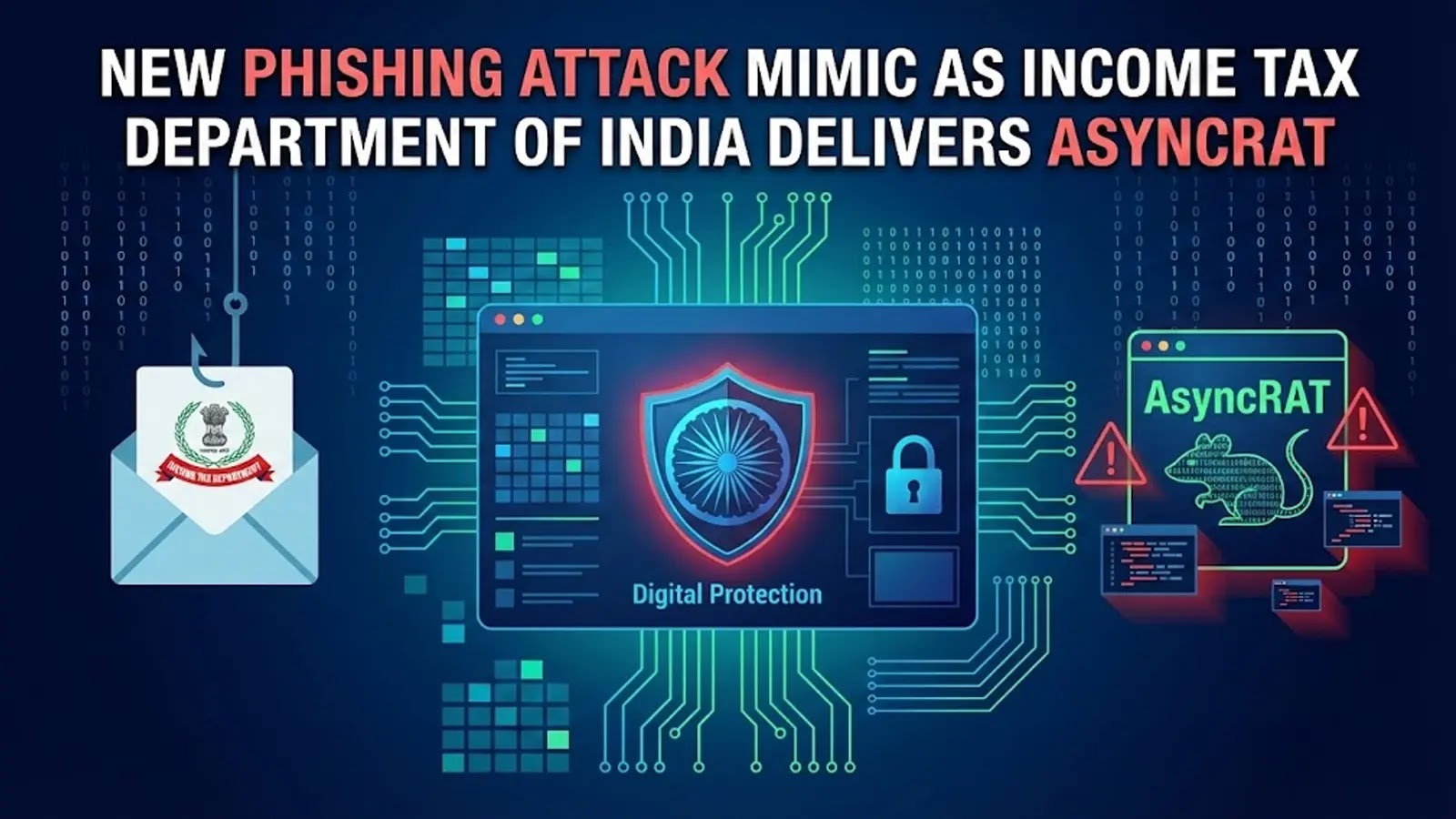
New Phishing Attack Mimic as Income Tax Department of India Delivers AsyncRAT
A Deceptive Tax Trap: New Phishing Campaign Delivers AsyncRAT in India
The digital landscape is a constant battleground, and threat actors relentlessly refine their tactics. A recent and particularly insidious phishing operation has emerged, targeting Indian companies with alarming sophistication. This campaign, active since November 2025, expertly impersonates the Income Tax Department of India, leveraging remarkably authentic government communication templates and legal references to deploy the dangerous AsyncRAT malware. Understanding the nuances of this threat is crucial for cybersecurity professionals and organizations operating in India.
The Anatomy of the Attack: Impersonation and Urgency
This particular phishing campaign stands out due to its meticulous attention to detail and psychological manipulation. The threat actors behind it have gone to great lengths to create a convincing illusion of legitimacy:
- Authentic Impersonation: Emails are meticulously crafted to mimic official communications from the Income Tax Department of India. This includes using legitimate-looking logos, sender addresses, and formatting.
- Bilingual Deception: To maximize its reach and credibility within India, the phishing messages are delivered in both Hindi and English. This caters to a broader audience and lends an air of officialdom.
- Legal Jargon and Urgency: The attackers strategically incorporate legal references to sections of the Income Tax Act. This not only enhances the perceived authenticity but also instills a sense of urgency and fear of legal repercussions, pressuring recipients to act quickly without proper scrutiny.
The primary goal of this elaborate ruse is to trick recipients into compromising their systems, leading to the delivery of AsyncRAT.
Async RAT: A Persistent Threat
AsyncRAT is a well-known and potent Remote Access Trojan (RAT). Its capabilities are extensive, making it a significant threat to compromised systems. Key functionalities include:
- Remote Control: Allows attackers to gain full remote control over the infected machine, performing actions as if they were physically present.
- Data Exfiltration: Can steal sensitive information, including credentials, financial data, and proprietary business documents.
- Keylogging: Records every keystroke made by the user, capturing passwords and other confidential input.
- Webcam and Microphone Access: Enables attackers to spy on victims through their webcam and microphone.
- File Management: Allows for uploading, downloading, deleting, and executing files on the compromised system.
- Persistence Mechanisms: Establishes persistence to survive reboots, ensuring continued access for the attackers.
The delivery of AsyncRAT through such a convincing phishing facade signifies a high level of sophistication and a determined effort to target specific organizations.
Remediation Actions and Prevention
Mitigating the risk of such sophisticated phishing attacks requires a multi-layered approach encompassing technical controls, user education, and incident response planning.
- Employee Training and Awareness: Conduct regular, realistic phishing simulations and training sessions. Educate employees on how to identify red flags in emails, especially those related to financial or legal matters. Emphasize verifying sender identities and scrutinizing links before clicking.
- Email Security Gateways: Implement robust email security solutions with advanced threat detection capabilities, including anti-phishing, anti-spoofing, and malware scanning.
- Endpoint Detection and Response (EDR): Deploy EDR solutions on all endpoints to detect and respond to malicious activity, including the execution of RATs like AsyncRAT.
- Network Segmentation: Segment your network to limit the lateral movement of attackers if a system is compromised.
- Least Privilege Principle: Enforce the principle of least privilege for all users and applications to minimize the impact of a successful compromise.
- Regular Backups: Maintain regular, secure, and offline backups of critical data to facilitate recovery in the event of a data breach or ransomware attack.
- Patch Management: Ensure all operating systems and applications are regularly updated to patch known vulnerabilities that attackers might exploit.
- Multi-Factor Authentication (MFA): Implement MFA for all critical systems and accounts to add an extra layer of security against credential theft.
Relevant Tools for Detection and Mitigation
Leveraging appropriate tools is vital for a strong cybersecurity posture.
| Tool Name | Purpose | Link |
|---|---|---|
| Proofpoint / Mimecast | Advanced Email Security Gateway | https://www.proofpoint.com/ / https://www.mimecast.com/ |
| CrowdStrike Falcon Insight | Endpoint Detection and Response (EDR) | https://www.crowdstrike.com/ |
| Palo Alto Networks Cortex XDR | Extended Detection and Response (XDR) | https://www.paloaltonetworks.com/cortex/xdr |
| Wireshark | Network Protocol Analyzer (for forensic analysis) | https://www.wireshark.org/ |
Key Takeaways
This sophisticated phishing campaign targeting Indian organizations highlights the evolving nature of cyber threats. The use of highly authentic government impersonation, bilingual messaging, and legal references demonstrates the attackers’ commitment to deceiving their targets. The objective – to deliver AsyncRAT – underlines the potential for significant data theft and system compromise. Vigilance, robust security controls, and continuous employee training are paramount to defending against such intricate attacks. Organizations must prioritize strengthening their email security, endpoint protection, and incident response capabilities to effectively counter these persistent threats.