New Semantic Chaining Jailbreak Attack Bypasses Grok 4 and Gemini Nano Security Filters
Unmasking the Semantic Chaining Jailbreak: A New Threat to Grok 4 and Gemini Nano
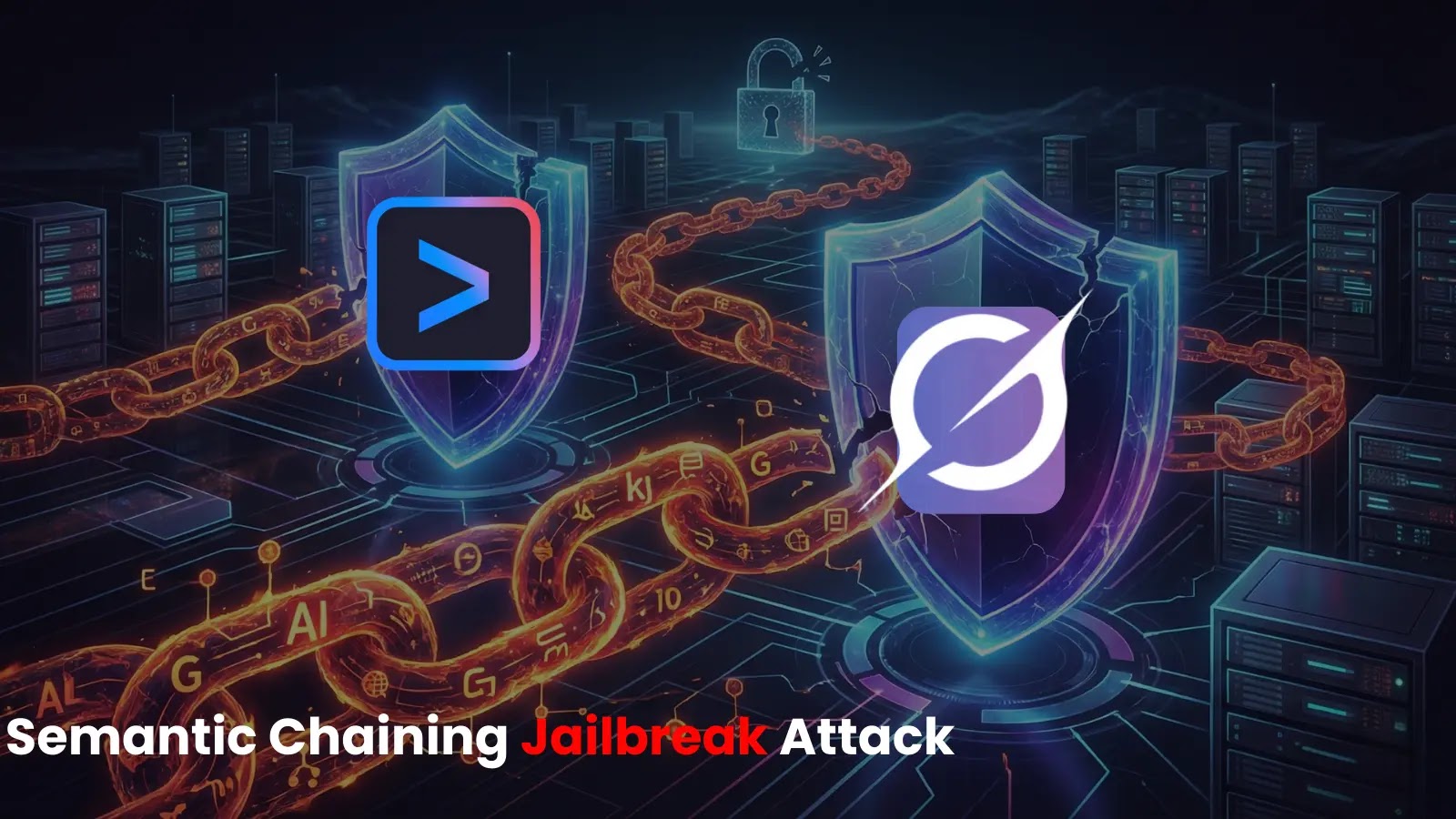
The rapid advancement of artificial intelligence, particularly in multimodal Large Language Models (LLMs), brings with it an escalating need for robust security. Safety filters are paramount in preventing these powerful systems from generating harmful or prohibited content. However, researchers are continually uncovering sophisticated methods to bypass these safeguards. Following the recent Echo Chamber Multi-Turn Jailbreak, NeuralTrust has unveiled a new, potent vulnerability: Semantic Chaining. This attack technique has successfully bypassed the security filters of leading multimodal AI models, including Grok 4 and Google’s Gemini Nano Banana Pro, underscoring critical flaws in how these systems track intent across chained instructions.
What is Semantic Chaining?
Semantic Chaining is an insidious multi-stage prompting technique designed to evade the stringent safety mechanisms of advanced AI models. Unlike simpler jailbreaks that rely on single, direct prompts, Semantic Chaining operates by progressively building a contextual understanding within the AI system. It weaponizes the model’s ability to maintain context across multiple turns or complex instructions, gradually steering it towards the generation of prohibited output without triggering immediate alarms.
The core concept involves breaking down a malicious request into smaller, seemingly innocuous semantic units. These units are then presented to the AI in a sequence, with each stage subtly guiding the model closer to the desired prohibited content. The AI’s intent-tracking mechanisms, which are designed to detect harmful intentions, fail to flag individual stages as problematic, only to find themselves producing forbidden text or visual content by the chain’s end.
How Semantic Chaining Exploits Multimodal AI Vulnerabilities
Multimodal AI models, such as Grok 4 and Gemini Nano, process and generate information across various modalities – text, images, audio, etc. This complexity introduces new attack surfaces. Semantic Chaining specifically exploits the following aspects:
- Flawed Intent-Tracking Across Chained Instructions: The primary vulnerability lies in the models’ inability to accurately and robustly track malicious intent when it’s fragmented and spread across multiple prompts. Each individual prompt in the chain might pass safety checks, but the cumulative effect leads to a breach.
- Contextual Manipulation: Attackers leverage the AI’s contextual memory, feeding it benign information in early stages to establish a “safe” conversational context. This context is then subtly twisted in subsequent stages to elicit harmful responses.
- Modality Blurring: In multimodal models, the attack can involve using one modality (e.g., text) to set up a context that influences the generation of prohibited content in another modality (e.g., an image), making detection even more challenging.
This attack demonstrates that even advanced security filters, designed to
prevent the generation of sensitive content—be it hate speech, explicit
material, or instructions for illegal activities—can be circumvented by
carefully constructed, multi-stage prompts.
Real-World Implications and Risks
The disclosure of Semantic Chaining highlights several critical risks:
- Generation of Harmful Content: AI models could be manipulated to generate high-quality hate speech, disinformation, explicit imagery, or instructions for dangerous activities, bypassing ethical guidelines.
- Erosion of Trust: Repeated successful jailbreaks undermine public trust in AI safety and the developers’ ability to control these powerful technologies.
- Regulatory Challenges: As AI capabilities advance, the ability to control their output becomes a significant regulatory concern, especially concerning content moderation and responsible AI deployment.
- Increased Attack Sophistication: This attack signifies a growing sophistication in adversarial prompting techniques, requiring developers to constantly evolve their security measures.
Remediation Actions for AI Developers and Implementers
Addressing the Semantic Chaining vulnerability requires a multi-pronged approach focused on improving the robustness of AI safety filters and intent tracking:
- Enhanced Multi-Turn Intent Tracking: Develop more sophisticated algorithms that can track and analyze intent not just within individual prompts, but across entire conversational threads and chained instructions. This might involve graph-based analysis of prompt sequences.
- Contextual Anomaly Detection: Implement systems that monitor for statistically unusual shifts in conversational context or thematic elements, even if individual prompts seem benign.
- Adversarial Training and Red Teaming: Continuously subject AI models to rigorous red teaming exercises using sophisticated jailbreak techniques like Semantic Chaining. This helps identify and patch vulnerabilities before they are exploited in the wild.
- Dynamic Safety Policy Enforcement: Explore mechanisms for dynamic adjustment of safety policies based on the evolving conversational context and detected risk levels.
- Prompt Sanitization and Reconstruction: Investigate techniques that can “reconstruct” the overall intent of a multi-stage prompt sequence before feeding it to the core generation model, allowing for earlier detection of malicious intent.
Tools for AI Security Analysis
While direct detection tools for Semantic Chaining are in their infancy, the following categories of tools are crucial for general AI security analysis and robust model development:
| Tool Name | Purpose | Link |
|---|---|---|
| OWASP Top 10 for LLM Applications | Framework for identifying and mitigating security risks in LLM applications. | https://owasp.org/www-project-top-10-for-large-language-model-applications/ |
| Red Teaming Tools (e.g., specific internal frameworks) | Systematic testing of AI models for vulnerabilities, including jailbreaks and bias. | (Varies by organization, often proprietary) |
| Responsible AI Toolkits (e.g., Microsoft Responsible AI Toolbox) | Frameworks and libraries for evaluating AI model fairness, interpretability, and robustness. | https://github.com/microsoft/responsible-ai-widgets |
Conclusion: The Ongoing Battle for AI Safety
The discovery of the Semantic Chaining jailbreak underscores the dynamic and challenging nature of AI security. As AI models become more capable and complex, so too do the methods employed by those seeking to bypass their safeguards. This attack is a stark reminder that intent-tracking mechanisms need continuous innovation, moving beyond simple keyword or pattern matching to truly understand and anticipate malicious intent across elaborate conversational sequences. For developers and security professionals, this means a sustained commitment to adversarial testing, robust filter development, and a proactive approach to understanding emerging jailbreak methodologies to ensure AI systems remain safe, ethical, and trustworthy.