PoC Exploit Released for Critical React, Next.js RCE Vulnerability (CVE-2025-55182)
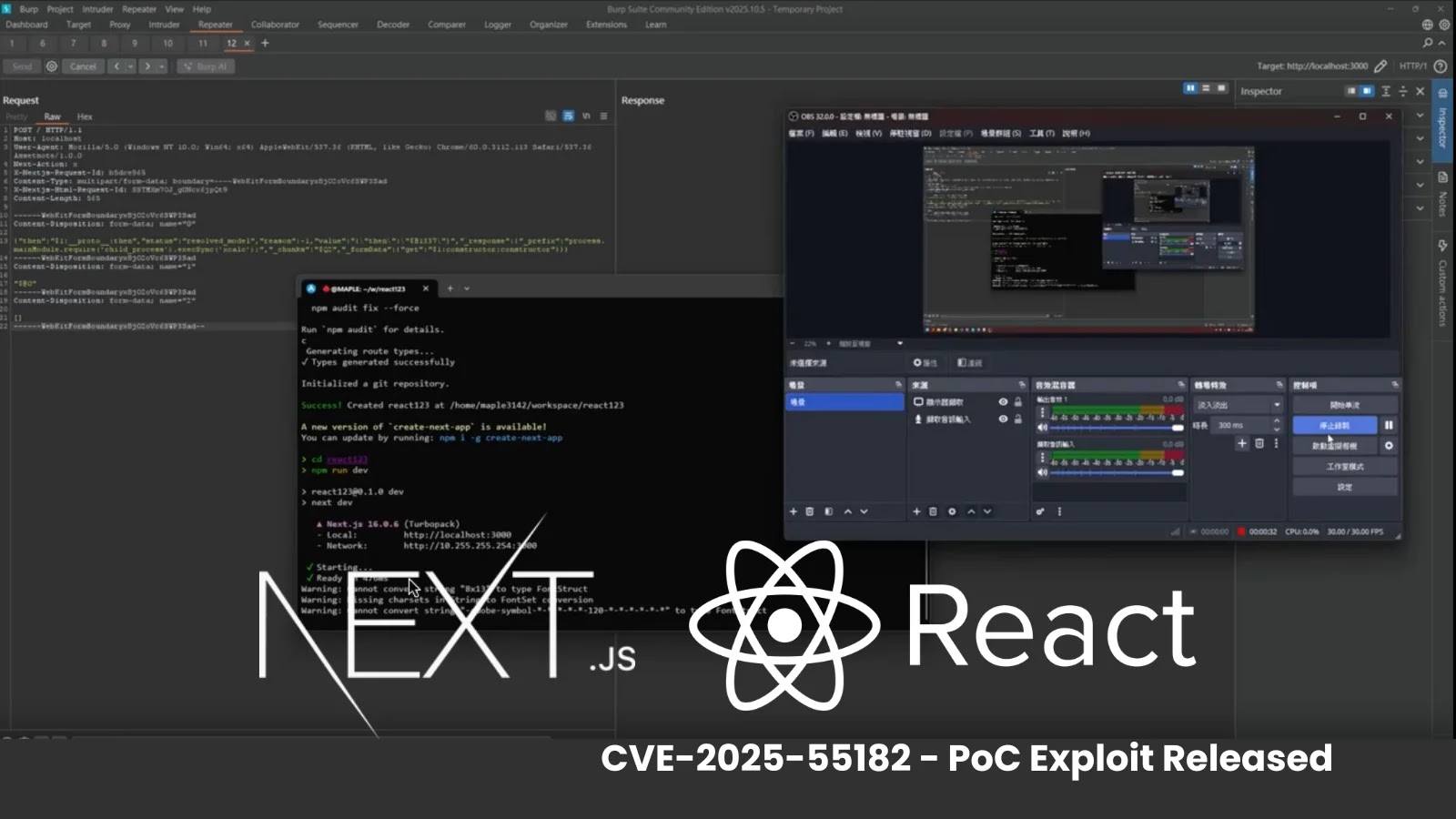
A storm is brewing in the web development world. This week, cybersecurity researchers publicly released a proof-of-concept (PoC) exploit for a critical remote code execution (RCE) vulnerability in React Server Components, impacting React and Next.js applications. Dubbed React2Shell by some, this flaw, identified as CVE-2025-55182, carries a maximum CVSS score of 10.0, signaling an urgent need for developers and organizations to assess their systems and take immediate action.
The emergence of a functional PoC exploit significantly escalates the threat landscape. While the vulnerability was previously known, the public availability of exploit code dramatically lowers the bar for malicious actors to compromise affected applications. Understanding the nature of this RCE vulnerability and implementing timely remediation are paramount to safeguarding web infrastructure.
Understanding the React2Shell Vulnerability (CVE-2025-55182)
At its core, CVE-2025-55182 exploits a critical weakness within React Server Components. Remote Code Execution, or RCE, means an attacker can execute arbitrary code on the server hosting the vulnerable application. This level of access grants an adversary extensive control, potentially leading to data theft, system compromise, or complete application takeover.
The vulnerability primarily affects:
- React versions: 19.0.0 through 19.2.0
- Next.js versions: 15.x and 16.x, specifically when utilizing the App Router feature.
The high CVSS score of 10.0 reflects the ease of exploitation and the severe impact on confidentiality, integrity, and availability. With a publicly available PoC, the window for unpatched systems to be targeted shrinks considerably.
Impact of a PoC Exploit Release
The transition from a theoretical vulnerability to a practical, demonstrable exploit (PoC) marks a critical shift in the threat lifecycle. Historically, PoC releases accelerate real-world attacks. Here’s why:
- Lowered Barrier to Entry: Less sophisticated attackers can now leverage pre-built code without needing deep understanding of the underlying vulnerability.
- Increased Attack Volume: Automated scanning and exploitation tools will quickly incorporate the PoC, leading to widespread attempts to identify and compromise vulnerable targets.
- Urgent Remediation: Organizations no longer have the luxury of extended patch cycles; immediate action becomes critical to mitigate risk.
For applications using the affected React and Next.js versions, the risk of a successful RCE attack has moved from hypothetical to imminent.
Remediation Actions
Given the severity and the public availability of a PoC, immediate action is required for all applications utilizing affected React and Next.js versions. Here are the crucial steps:
- Update React: Upgrade React to a patched version as soon as one becomes available. Monitor official React release channels for security advisories and updates beyond 19.2.0 or specific patches for the 19.x series.
- Update Next.js: For Next.js applications, update to a version that addresses CVE-2025-55182, particularly if using the App Router. Monitor the Next.js official documentation and release notes for security updates.
- Isolate Server Components: Review how React Server Components are used and ensure they do not process untrusted input directly without robust sanitization and validation.
- Web Application Firewall (WAF): Implement or enhance WAF rules to detect and block suspicious requests targeting potential RCE vectors, although this should be considered a temporary measure until patching occurs.
- Input Validation: Reinforce stringent input validation on all user-supplied data, particularly for any inputs processed by server-side React components.
- Principle of Least Privilege: Ensure that the user account under which your application runs has only the necessary permissions, limiting potential damage from a successful RCE.
Recommended Tools for Detection and Mitigation
Leveraging appropriate tools can assist in identifying vulnerable components and applying protective measures.
| Tool Name | Purpose | Link |
|---|---|---|
| Snyk | Software Composition Analysis (SCA) for identifying known vulnerabilities in dependencies, including React and Next.js versions. | https://snyk.io/ |
| OWASP Dependency-Check | OSS component analysis for identifying project vulnerabilities based on known CVEs. | https://owasp.org/www-project-dependency-check/ |
| Veracode / Checkmarx (SAST/DAST) | Static Application Security Testing (SAST) and Dynamic Application Security Testing (DAST) for code analysis and runtime vulnerability detection. | https://www.veracode.com/ https://checkmarx.com/ |
| Cloudflare WAF / AWS WAF | Web Application Firewall services to filter malicious traffic and protect against common web attacks. | https://www.cloudflare.com/waf/ https://aws.amazon.com/waf/ |
Conclusion
The public release of a PoC exploit for CVE-2025-55182, the critical RCE vulnerability affecting React and Next.js applications, underscores the urgent need for developers and organizations to fortify their defenses. With a CVSS score of 10.0, this flaw represents a severe threat that can lead to complete system compromise if left unaddressed.
Prioritize updating React and Next.js to patched versions immediately. Augmenting these updates with strong input validation, proper WAF configurations, and continuous monitoring will significantly reduce the attack surface. Proactive security measures are the only effective response to such critical vulnerabilities.