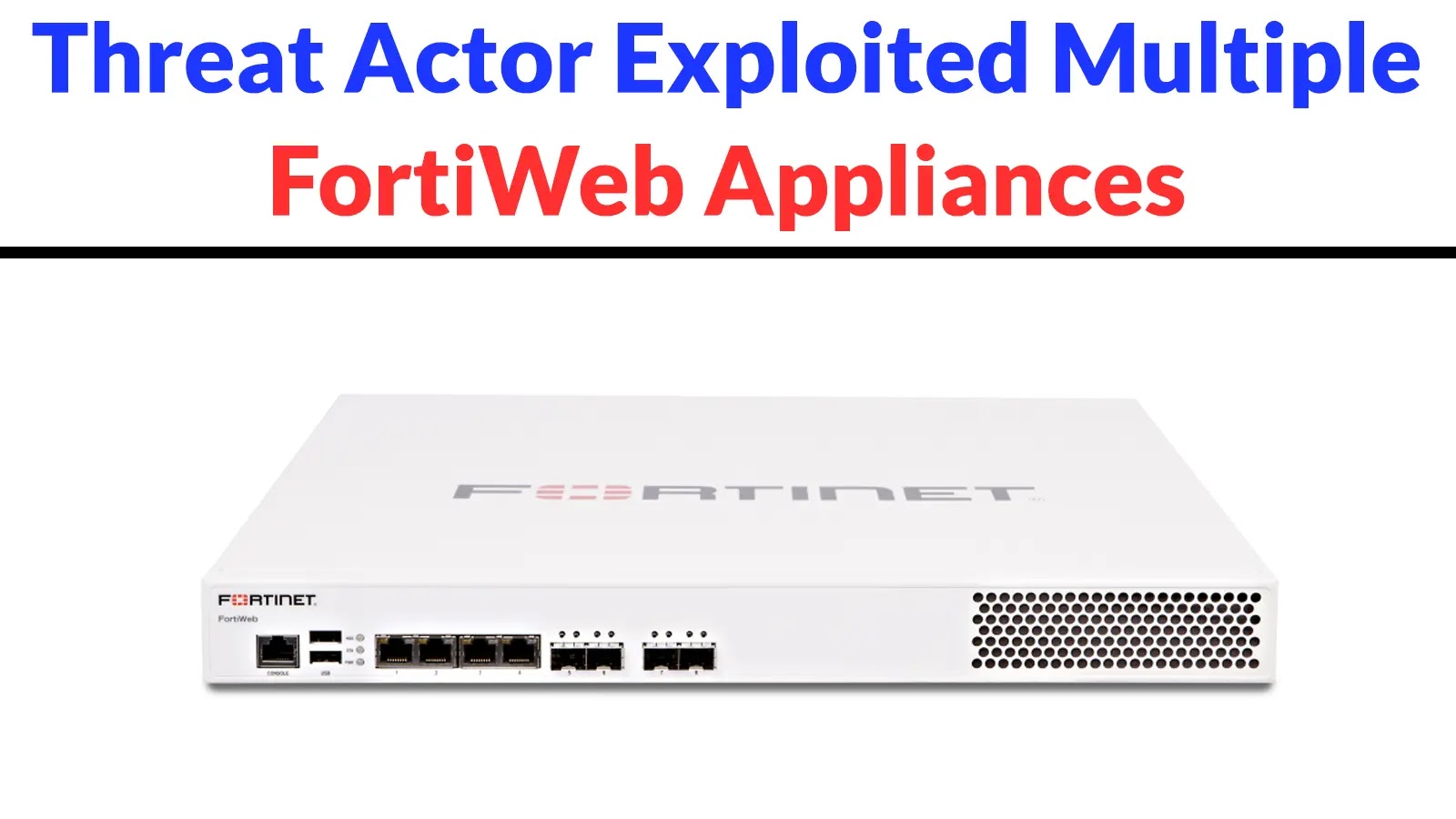
Threat Actor Exploited Multiple FortiWeb Appliances to Deploy Sliver C2 for Persistent Access
The Persistent Peril: Unpacked – FortiWeb Appliances Under Siege by Sliver C2
The digital defense perimeter is constantly under pressure. In a recent, concerning development, a sophisticated threat actor has been observed actively exploiting multiple unpatched FortiWeb appliances to establish persistent access using the increasingly popular Sliver Command and Control (C2) framework. This campaign serves as a stark reminder of the critical importance of timely patching and robust security hygiene, especially at the network edge. For IT professionals, security analysts, and developers, understanding the nuances of such attacks is paramount to fortifying their defenses.
The Attack Vector: Exploiting Outdated FortiWeb Appliances
The core of this attack hinges on the exploitation of vulnerabilities within outdated FortiWeb appliances. These devices, designed as web application firewalls (WAFs), are often the first line of defense against web-based threats. However, when left unpatched, they become attractive targets for adversaries. The threat actor specifically targets these edge devices, capitalizing on known weaknesses that should have long been remediated through routine updates. This strategy grants them an initial foothold into an organization’s network perimeter, often bypassing traditional security controls that might be vigilant against more common intrusion methods.
While the specific CVEs exploited in this campaign are not detailed in the source, it’s crucial to acknowledge that FortiWeb has had a history of vulnerabilities that, if left unpatched, can lead to remote code execution (RCE) or unauthorized access. Examples of such vulnerabilities in Fortinet products that could be leveraged in similar campaigns include:
- CVE-2022-42475: An out-of-bounds write vulnerability in FortiOS that could lead to remote code execution.
- CVE-2022-40684: An authentication bypass vulnerability in FortiGate and FortiProxy.
Note: It’s important to consult Fortinet’s official security advisories for the most up-to-date and specific vulnerability information pertaining to FortiWeb appliances.
Sliver C2: A Modern Adversary’s Tool of Choice
Once initial access is gained, the threat actor deploys Sliver C2. Sliver is an open-source, Go-based adversary emulation framework that has rapidly gained popularity among threat actors due to its advanced capabilities and evasive nature. Unlike older, more readily detectable C2 frameworks, Sliver offers several advantages to an attacker:
- Evasion: Its Go-based architecture allows for highly customizable payloads that can often bypass traditional antivirus and endpoint detection and response (EDR) solutions.
- Flexibility: Sliver supports various C2 channels, including HTTP, HTTPS, DNS, and named pipes, making it adaptable to different network environments and harder to detect.
- Cross-Platform Compatibility: Being written in Go, Sliver binaries can be compiled for multiple operating systems, providing broad applicability across target environments.
- Post-Exploitation Modules: It includes a rich set of post-exploitation modules for reconnaissance, privilege escalation, lateral movement, and data exfiltration.
The use of Sliver C2 underscores a growing trend where adversaries leverage sophisticated open-source offensive tools to establish persistent access and carry out their objectives with increased stealth and effectiveness. This shift necessitates a re-evaluation of defensive strategies, moving beyond signature-based detection to more behavior-based analysis and threat hunting.
The Goal: Persistent Access and Beyond
The primary objective of deploying Sliver C2 in this scenario is to maintain persistent access to the compromised network. From this vantage point, the threat actor can:
- Conduct Reconnaissance: Map out the network, identify critical assets, and discover valuable data.
- Escalate Privileges: Gain higher-level access necessary for further compromise.
- Lateral Movement: Move across the network to reach other systems and expand their control.
- Deploy Additional Malware: Introduce ransomware, data exfiltration tools, or other malicious payloads.
- Exfiltrate Data: Steal sensitive information, intellectual property, or customer data.
This long-term presence allows for a more comprehensive and damaging attack, often remaining undetected for extended periods, leading to significant financial and reputational damage for affected organizations.
Remediation Actions: Fortifying Your FortiWeb Defenses
Addressing this threat requires a multi-layered approach, with a strong emphasis on proactive measures. Organizations leveraging FortiWeb appliances, or any edge device, must prioritize the following:
- Immediate Patching and Updates: This is the most critical step. Ensure all FortiWeb appliances are running the latest firmware versions with all security patches applied. Establish a robust patch management policy and adhere to it strictly.
- Regular Vulnerability Scanning: Implement regular vulnerability scanning of all external-facing assets, including FortiWeb appliances, to identify and remediate weaknesses before adversaries can exploit them.
- Network Segmentation: Isolate FortiWeb appliances and other critical infrastructure components from the rest of the internal network as much as possible. This limits the blast radius of a potential compromise.
- Strong Access Controls: Implement strong, unique passwords for all administrative interfaces and enforce multi-factor authentication (MFA) wherever possible. Limit administrative access to FortiWeb appliances to only authorized personnel from secure workstations.
- Web Application Firewall (WAF) Rule Tuning: Regularly review and tune your FortiWeb WAF rules to detect and block suspicious traffic and known attack patterns. Ensure rules are up-to-date with the latest threat intelligence.
- Anomaly Detection and Threat Hunting: Implement robust logging and monitoring on your FortiWeb appliances and integrate these logs into a Security Information and Event Management (SIEM) system. Actively hunt for anomalous activity that could indicate the presence of a C2 framework like Sliver.
- Endpoint Detection and Response (EDR): Deploy EDR solutions on internal endpoints to detect and respond to post-compromise activities, even if C2 traffic bypasses network defenses.
- Incident Response Plan: Have a well-defined incident response plan in place and regularly test it. This ensures a swift and effective response in the event of a breach.
Recommended Tools for Detection and Mitigation
| Tool Name | Purpose | Link |
|---|---|---|
| Nessus | Vulnerability Scanning & Assessment | https://www.tenable.com/products/nessus |
| OpenVAS | Open Source Vulnerability Scanner | https://www.greenbone.net/en/community-edition/ |
| Wireshark | Network Protocol Analyzer (for C2 traffic analysis) | https://www.wireshark.org/ |
| Snort/Suricata | Intrusion Detection/Prevention Systems | https://www.snort.org/ / https://suricata.io/ |
| Splunk/ELK Stack | SIEM & Log Management | https://www.splunk.com/ / https://www.elastic.co/elastic-stack |
Key Takeaways for a Stronger Security Posture
The exploitation of FortiWeb appliances to deploy Sliver C2 is a clear signal of adversaries’ evolving tactics. It emphasizes several critical points for any organization:
- Patching is Non-Negotiable: Timely application of security updates for all systems, especially edge devices, remains the most fundamental defense.
- Open-Source Tools are Double-Edged: While beneficial for defenders, open-source offensive tools are readily adopted by threat actors, demanding enhanced detection capabilities.
- Defense-in-Depth is Essential: Relying on a single security control is insufficient. A layered approach combining WAFs, EDR, network segmentation, and robust monitoring is crucial.
- Proactive Threat Hunting: Organizations must move beyond reactive security and actively hunt for indicators of compromise within their networks.
By understanding these evolving threats and implementing comprehensive security measures, organizations can significantly reduce their attack surface and better protect their critical assets from sophisticated adversaries.