Threat Hunting Is Critical to SOC Maturity but Often Misses Real Attacks
The Paradox of Threat Hunting: Critical for SOC Maturity Yet Often Missing Real Attacks
Threat hunting is a foundational pillar of any robust Security Operations Center (SOC), a proactive quest to unearth stealthy adversaries before they can inflict significant damage. Yet, a striking paradox persists: while essential for elevating SOC maturity, many traditional threat hunting efforts fall short, struggling to pinpoint truly novel and impactful attacks. This isn’t a failure of intent, but often a limitation in the quality and relevance of the intelligence driving the hunt. High-performing SOC teams are now turning to more dynamic, real-world derived threat intelligence to bridge this critical gap, making their hunts both repeatable and genuinely impactful.
The Evolution of Threat Hunting: Beyond Signature-Based Detection
For years, cybersecurity fundamentally relied on signature-based detection. Known threats had known patterns, and security tools dutifully flagged them. However, adversaries evolve, employing polymorphic malware, zero-day exploits, and sophisticated evasion techniques that bypass static signatures. This gave rise to threat hunting – a proactive discipline focused on searching for undetected threats within a network. It assumes a breach has likely already occurred and aims to minimize dwell time.
A mature SOC understands that relying solely on automated alerts is insufficient. Analysts actively explore data, leveraging their expertise to connect seemingly disparate indicators of compromise (IOCs) and behaviors. The goal is to uncover the unknown unknowns, the attacks that have slipped past initial defenses. However, without grounded intelligence, this reactive hunting can often feel like searching for a needle in an ever-growing haystack, leading to high false positives and analyst fatigue.
The Challenge: Why Traditional Threat Hunting Misses Real Attacks
- Stale or Generic Intelligence: Many threat hunting efforts are powered by generic threat intelligence feeds that might be outdated, too broad, or not directly relevant to the organization’s specific attack surface. This leads to a lot of noise and less signal.
- Lack of Reproducible Attacker Behavior: Without insight into how real-world threats behave in a controlled environment, hunters struggle to identify the subtle behavioral anomalies that indicate a genuine attack. They might know an adversary uses a certain technique (e.g., T1059.001 – PowerShell for command and scripting interpretation), but not the specific nuances of that activity.
- Over-reliance on IOCs: While IOCs (IP addresses, hashes, domains) are useful, they are often ephemeral and easily changed by attackers. A hunt solely focused on IOCs will likely miss adaptive adversaries.
- Limited Context: Without understanding the full execution chain and impact of a threat, it’s difficult to prioritize hunting efforts or understand the true risk.
Sandbox-Derived Threat Intelligence: The Game Changer
The key to transforming threat hunting from a shotgun approach to a precise sniper shot lies in high-fidelity, sandbox-derived threat intelligence. Platforms like ANY.RUN provide an invaluable window into actual attacker behaviors. When millions of malware samples, URLs, and files are executed in a controlled sandbox environment, analysts gain a wealth of actionable insights:
- Real-time Behavioral Data: Sandboxes capture the full spectrum of an attacker’s actions – process creation, registry modifications, network connections, file system changes, and even human-like interactions (e.g., mouse movements). This provides a rich tapestry of behavioral IOCs.
- Contextualized Indicators: Instead of just a hash, hunters get the full story: “This specific CVE-2023-XXXXX exploit leads to a TrickBot infection that then attempts to steal credentials using Mimikatz via T1003.001 – LSASS Memory dumping.”
- Repeatable Hunt Queries: With documented attack chains and behaviors, SOC teams can develop specific, high-fidelity hunt queries. For example, instead of broadly looking for “suspicious PowerShell,” they can focus on PowerShell commands initiating specific network beaconing patterns observed in a sandbox analysis.
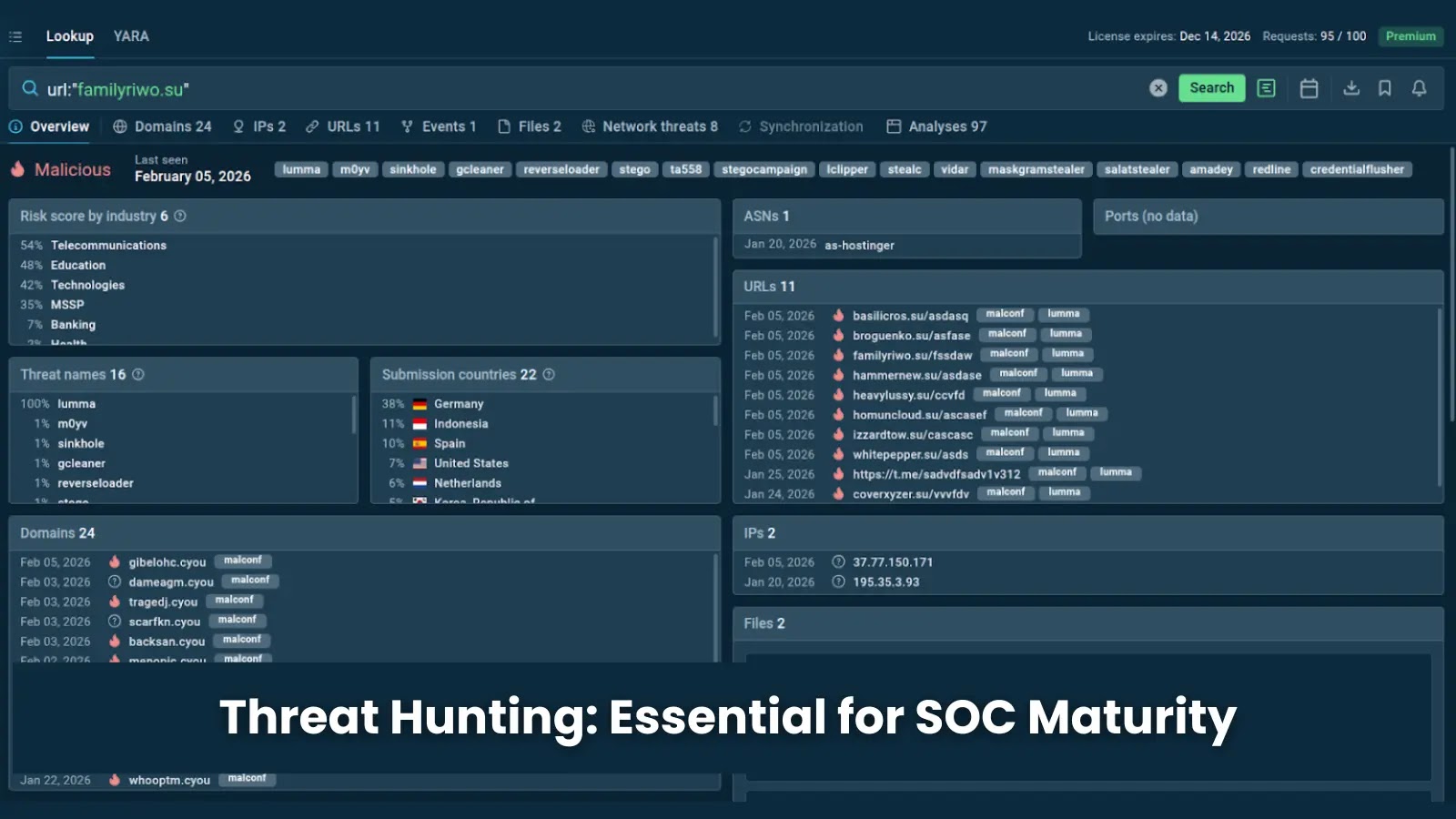
- Faster TI Lookup and Enrichment: Tools like ANY.RUN’s TI Lookup allow analysts to quickly search a vast repository of existing analyses to enrich their current investigations. If a suspicious file hash or IP address is encountered, a quick lookup can reveal its known malicious behaviors and previous campaigns.
Integrating Sandbox Intelligence for Enhanced SOC Maturity
Incorporating sandbox-derived intelligence into the threat hunting lifecycle significantly elevates SOC maturity by:
- Improving Signal-to-Noise Ratio: By focusing on behaviors observed in real-world malware executions, hunters can create more precise queries, reducing false positives and allowing analysts to focus on genuine threats.
- Proactive Detection of Novel Threats: As new malware strains emerge, sandbox analysis quickly provides the behavioral fingerprints necessary to hunt for their presence before traditional signatures are updated.
- Enhanced Incident Response: When a threat is detected, the detailed analysis from the sandbox provides critical context for incident responders, helping them understand the attack’s scope, impact, and necessary remediation steps. For instance, knowing a specific CVE-2024-XXXXX was leveraged can guide patching efforts.
- Better Threat Prioritization: Understanding the actual capabilities and impact of observed threats allows SOC teams to prioritize their hunting efforts and allocate resources more effectively to the most critical risks.
Remediation Actions and Best Practices
To fully leverage sandbox-derived threat intelligence and mature your threat hunting capabilities, consider these actions:
- Integrate Sandbox Analysis into Workflows: Ensure suspicious files and URLs are automatically or manually submitted to a robust sandbox environment for analysis.
- Develop Behavioral Hunt Playbooks: Based on sandbox outputs, create specific hunt playbooks that look for the observed behavioral TTPs (Tactics, Techniques, and Procedures) within your environment.
- Leverage TI Lookup Actively: Encourage analysts to use TI lookup tools proactively during investigations to quickly contextualize IOCs and behaviors they encounter.
- Continuous Learning and Adaptation: Threat actors constantly evolve. Regularly review sandbox analysis results to identify new TTPs and update your hunt queries accordingly.
- Invest in Analyst Training: Train your SOC analysts on how to interpret sandbox reports effectively and translate behavioral indicators into actionable hunt hypotheses.
Conclusion
Threat hunting is undeniably critical for any organization aspiring to a mature security posture. However, its effectiveness hinges on the quality and relevance of the intelligence guiding the hunt. By embracing sandbox-derived threat intelligence, SOC teams can move beyond generic searches to repeatable, impactful hunts grounded in real attacker behaviors. This shift not only uncovers stealthy threats that traditional methods miss but also significantly strengthens the overall resilience and responsiveness of the security operations center, turning a reactive defense into a proactive, intelligent pursuit of the adversary.