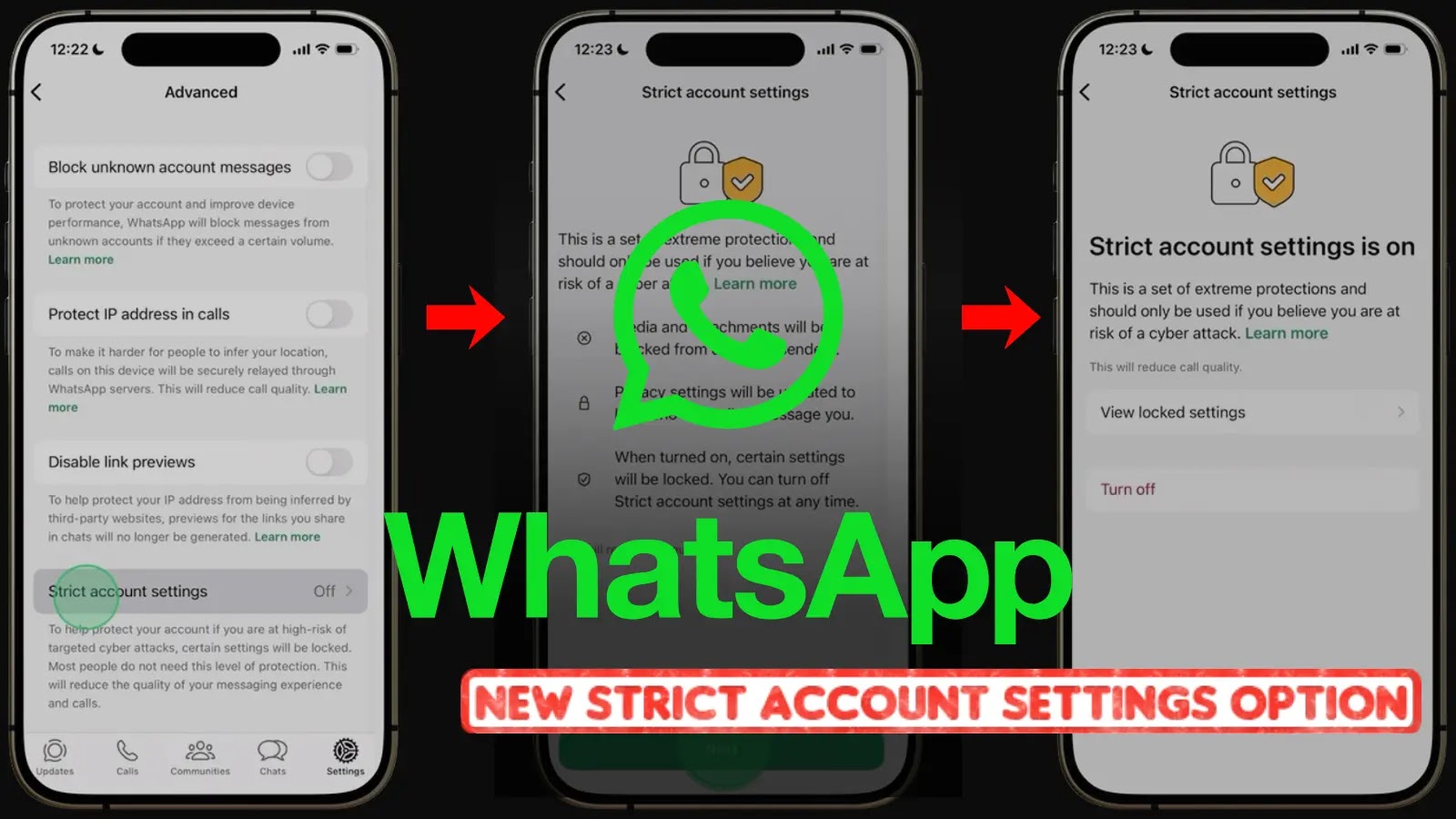
WhatsApp New Strict Account Settings Option to Protect Your Account from Hackers
WhatsApp Bolsters Security: Introducing Strict Account Settings for Enhanced Protection
In an era where digital communication is foundational, securing our messaging platforms is paramount. WhatsApp, a global leader in instant messaging, has recently rolled out a critical new feature: Strict Account Settings. This “lockdown-style” security option is a direct response to the escalating sophistication of cyber-attacks, offering a fortified defense mechanism for those most at risk. This article delves into the implications of this new setting, its target audience, and how it represents a significant step forward in user security.
Understanding WhatsApp’s New Strict Account Settings
The introduction of Strict Account Settings by WhatsApp isn’t just another incremental update; it’s a strategic enhancement designed to counter highly advanced cyber threats. This feature operates on a principle of rigid verification, making it significantly harder for malicious actors to compromise an account, even with initial access to credentials. While the precise technical implementation details are proprietary, the core concept revolves around imposing stricter checks and balances during account access and restoration processes.
This initiative follows a trend among secure communication platforms to offer advanced security postures for high-risk individuals. It acknowledges that standard security protocols, while effective for the general user base, may not suffice against state-sponsored attacks or well-resourced criminal organizations.
Who Benefits Most from Strict Account Settings?
WhatsApp’s new privacy feature is specifically tailored for individuals operating in environments prone to sophisticated digital espionage and targeted attacks. The primary beneficiaries include:
- Journalists: Often targets due to their work exposing sensitive information and powerful entities.
- Activists: Regularly face surveillance and attempts at disruption by adversarial groups.
- Public Figures: High-profile individuals whose accounts possess significant influence and are therefore attractive targets for impersonation or disruption.
- Government Officials and Diplomats: Holds sensitive data and are frequently subjected to phishing campaigns and advanced persistent threats (APTs).
- Human Rights Defenders: Work in sensitive areas and often become targets for their advocacy.
These groups often encounter threats that go beyond typical phishing attempts, including SIM swap attacks, zero-day exploits (e.g., those highlighted by CVE-2019-3568 which impacted WhatsApp with Pegasus spyware), and other advanced social engineering tactics. Strict Account Settings aims to be a robust deterrent against such sophisticated intrusion attempts.
Beyond End-to-End Encryption: Layering Security
WhatsApp has long been lauded for its default end-to-end encryption, a cornerstone of its privacy architecture. This encryption ensures that only the sender and recipient can read messages, safeguarding communications from eavesdropping by third parties, including WhatsApp itself. However, encryption alone cannot prevent account takeover if an attacker gains control through other means, such as SIM swapping or tricking users into revealing verification codes.
Strict Account Settings complements end-to-end encryption by adding a crucial layer of access control. It focuses on hardening the account recovery and login processes, making it exponentially more difficult for unauthorized users to gain entry, even if they manage to intercept initial verification messages. This multi-layered defense strategy is essential in today’s complex threat landscape.
Remediation Actions and Best Practices
While WhatsApp’s Strict Account Settings provide a powerful new defense, users, especially those at high risk, should combine this with comprehensive cybersecurity best practices:
- Activate Two-Step Verification (2FA): This remains a fundamental security measure. Ensure it’s enabled with a strong PIN that you don’t use elsewhere.
- Enable Strict Account Settings: If available in your region and for your account, activate this feature immediately. Check your WhatsApp security settings for this option.
- Be Wary of Social Engineering: Exercise extreme caution with unsolicited messages, calls, or emails, especially those requesting personal information or account verification codes. Verify the authenticity of requests through independent means.
- Secure Your SIM Card: Implement a strong PIN on your SIM card with your mobile carrier to prevent SIM swap attacks.
- Install Security Updates: Keep your WhatsApp application and operating system (iOS/Android) updated to the latest versions to patch known vulnerabilities.
- Review Linked Devices Regularly: Periodically check WhatsApp Web/Desktop sessions and unlink any unfamiliar devices.
- Strong, Unique Passwords: Use a password manager to generate and store robust, unique passwords for all your online accounts.
The Evolution of Digital Security for Messaging Platforms
The introduction of Strict Account Settings underscores a significant shift in how messaging platforms approach user security. It acknowledges the nuanced threat landscape faced by different user demographics and provides specialized tools to combat advanced adversaries. This proactive approach by WhatsApp sets a new standard, pushing the industry towards more robust and adaptive security measures that go beyond baseline encryption. As cyber threats continue to evolve, so too must the defenses protecting our digital lives.