
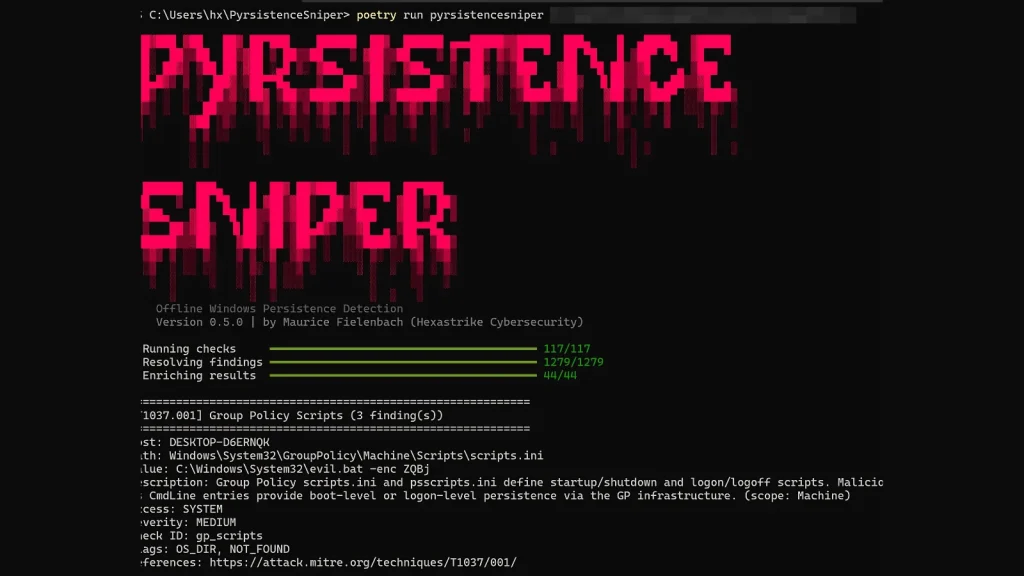
PyrsistenceSniper – Tool that Detects 117 Persistence Malware Techniques on Windows, Linux, and macOS
In the relentless battle against advanced persistent threats (APTs) and sophisticated malware, understanding and detecting persistence mechanisms is paramount. Adversaries consistently seek to maintain unauthorized access to compromised systems, making the ability to uncover these covert footholds a critical capability for any cybersecurity professional.
Enter PyrsistenceSniper – an innovative and robust tool designed to revolutionize how security analysts approach forensic analysis. This Python-based solution offers an unparalleled capacity to identify a staggering 117 distinct persistence techniques across Windows, Linux, and macOS platforms, providing a significant edge in the detection of stealthy malware.
What is PyrsistenceSniper?
PyrsistenceSniper is an advanced, open-source tool developed by Hexastrike, specifically engineered for the detection of offline persistence mechanisms. Unlike tools that require live system interaction, PyrsistenceSniper operates on forensic collections, enabling rapid and non-intrusive triage of system artifacts. This capability is invaluable for security teams dealing with incident response where touching the compromised system directly might alter crucial evidence or trigger further malicious activity.
Inspired by the foundational work of tools like Autoruns and the original PersistenceSniper, PyrsistenceSniper elevates the concept by offering multi-platform support and an extensive database of known persistence methods. Its Python-based architecture ensures flexibility, ease of integration, and a wide reach within the cybersecurity community.
Multi-Platform Persistence Detection
One of PyrsistenceSniper’s most compelling features is its comprehensive support for all major operating systems: Windows, Linux, and macOS. This universality addresses a significant gap in many existing persistence detection tools, which often specialize in a single OS. The ability to analyze diverse environments from a single tool streamlines the investigative process for organizations with heterogeneous IT infrastructures.
- Windows: Targets common and obscure persistence points, including Registry Run keys, Services, Scheduled Tasks, WMI event subscriptions, Logon scripts, and various auto-start extensibility points.
- Linux: Scrutinizes cron jobs, systemd units, bash startup files (.bashrc, .profile), symlinks, and other less-common areas where malware establishes persistence.
- macOS: Examines LaunchAgents, LaunchDaemons, Login Items, Safari extensions, and other macOS-specific locations utilized by adversaries for sustained presence.
Offline Analysis: A Game-Changer for Forensics
The capacity for offline analysis is a cornerstone of PyrsistenceSniper’s utility. In a typical incident response scenario, acquiring disk images or forensic artifacts is a common initial step. PyrsistenceSniper allows analysts to feed these collected data sets directly into the tool without needing to execute code on the compromised machine. This approach offers several critical advantages:
- Preservation of Evidence: Prevents alteration of the live system, ensuring the integrity of forensic data.
- Safety: Reduces the risk of encountering active malware or triggering defense mechanisms during analysis.
- Efficiency: Enables faster triage of multiple systems by processing forensic images in parallel or sequentially without direct system access overhead.
- Scalability: Facilitates large-scale investigations across numerous endpoints or servers.
How PyrsistenceSniper Works (According to Hexastrike)
While the detailed mechanics are proprietary to Hexastrike’s development, the core principle involves parsing configuration files, registry hives, filesystem metadata, and other system artifacts to identify entries that indicate an application or script is configured to execute automatically. The tool maps these findings against its extensive database of 117 known persistence techniques, flagging any matches as potential indicators of compromise. The power lies in its comprehensive mapping of these techniques, ranging from well-known methods to more esoteric ones that often evade less sophisticated scanners.
Remediation Actions
Detecting persistence is the first step; remediation is the follow-through. Once PyrsistenceSniper identifies a persistence mechanism, immediate action is required to remove the adversary’s foothold. Here are actionable steps:
- Isolate and Contain: Immediately disconnect the compromised system from the network to prevent further lateral movement or data exfiltration.
- Remove Persistence Entries: Based on PyrsistenceSniper’s report, meticulously remove all identified persistence entries. This might involve deleting Registry keys, altering cron jobs, removing malicious services, or disabling LaunchDaemons.
- Identify Root Cause: Determine how the initial compromise occurred. Was it a vulnerability (e.g., CVE-2023-23397 for Outlook privilege escalation) or a phishing attack? Understanding the entry point is crucial to prevent re-infection.
- Eradicate Malware: After removing persistence, locate and delete all associated malicious files and binaries. This often requires a more comprehensive endpoint detection and response (EDR) solution or manual forensic analysis.
- Patch and Update: Ensure all operating systems, applications, and security software are fully patched and up-to-date to close any known vulnerabilities.
- Monitor and Hunt: Implement enhanced monitoring on the affected system and network segments to detect any signs of renewed adversarial activity. Proactive threat hunting can uncover any remaining artifacts.
- Review and Strengthen Security Policies: Evaluate existing security policies, user privileges, and network segmentation to identify weaknesses that could be exploited.
Conclusion
PyrsistenceSniper represents a significant advancement in the realm of forensic analysis and incident response. Its ability to detect a vast array of persistence techniques across Windows, Linux, and macOS, coupled with its offline analysis capabilities, makes it an indispensable tool for cybersecurity professionals. By empowering analysts to quickly identify and neutralize adversarial persistence, PyrsistenceSniper strengthens our collective defense against the ever-evolving landscape of cyber threats. Integrating such a powerful utility into an organization’s security toolkit will undoubtedly lead to more efficient and effective incident response operations.




