
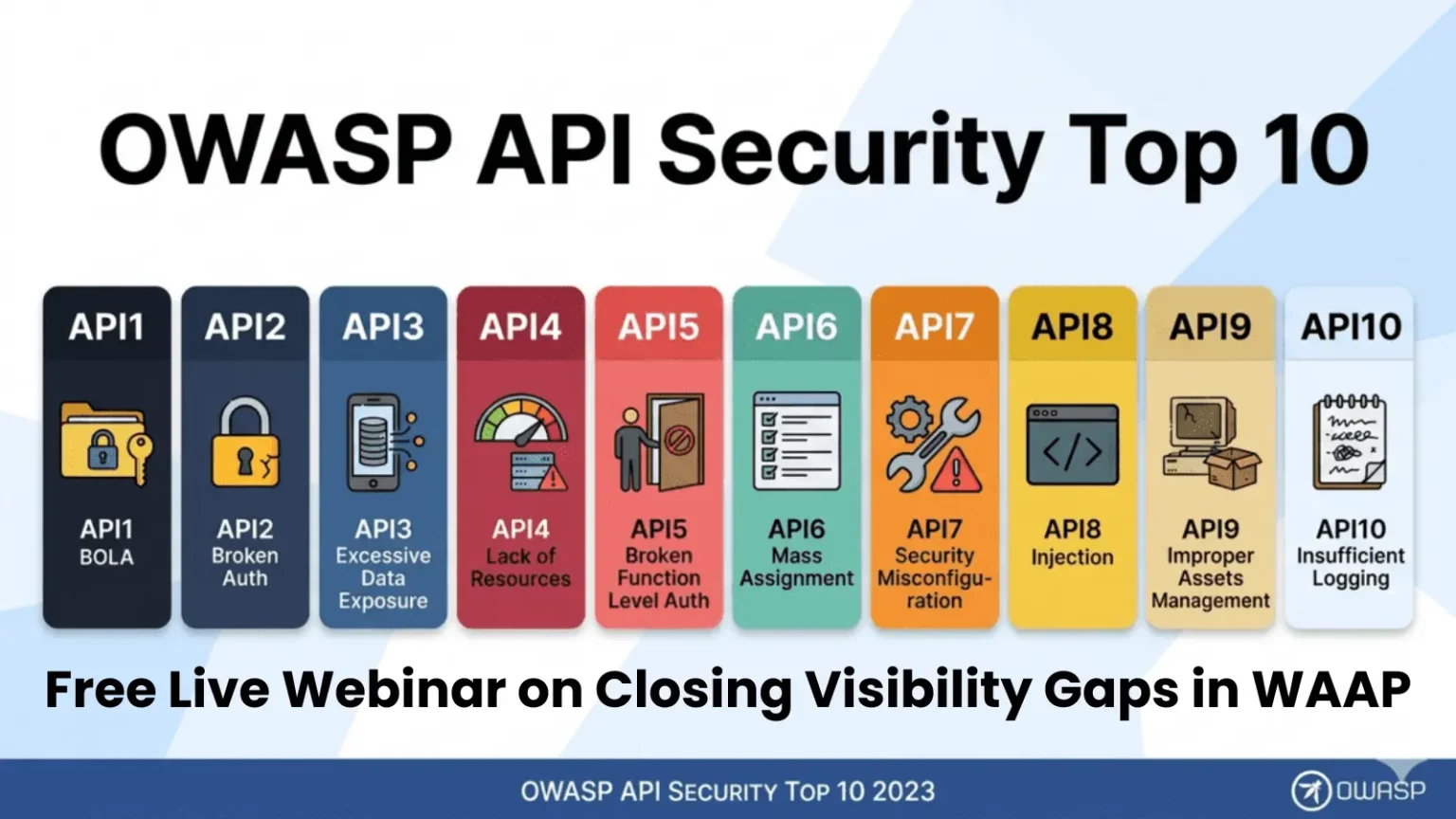
Web Application & API Attacks Are Rising: Are You Blind to Modern Web Attacks? Join WAAP Security Webinar
The Invisible Threat: Why Modern Web Application & API Attacks Demand a New Defense
In the digital landscape, web applications and APIs are the lifeblood of modern business. They power everything from e-commerce platforms and financial services to internal operations and mobile apps. Yet, they’ve also become prime targets for cyber attackers. The stark reality is that many organizations operate with a blind spot, failing to recognize the sophistication and scale of modern web application and API attacks. Traditional security measures, designed for an earlier era of the internet, are simply inadequate against today’s agile and persistent threats.
Attackers aren’t just probing for known vulnerabilities; they’re exploiting logical flaws, misconfigurations, and weaknesses in business logic that older security tools often miss. This isn’t just about data breaches; it’s about reputational damage, financial loss, and severe operational disruption. Understanding this evolving threat landscape is no longer optional – it’s crucial for survival.
The Evolution of Web Application and API Attack Vectors
The methods employed by attackers have advanced significantly beyond the scope of rudimentary intrusion attempts. They now leverage a blend of automated tools and human ingenuity to dissect and exploit modern web architectures. Key attack vectors include:
- Client-Side Attacks: These focus on manipulating the user’s browser, often through cross-site scripting (XSS) (e.g., CVE-2023-45678) or supply chain attacks targeting third-party scripts.
- API Exploitation: APIs, though fundamental for modern connectivity, present a vast attack surface. Attackers target misconfigured API endpoints, exploit broken object-level authorization (BOLA), insufficient rate limiting, and manipulate parameter inputs (e.g., CVE-2023-98765).
- Business Logic Abuse: This category is particularly insidious. Attackers identify flaws in how applications process transactions or handle data, leading to unauthorized access, resource manipulation, or even financial fraud. These often bypass traditional signature-based detection.
- Automated Bots and Credential Stuffing: Sophisticated botnets are used for credential stuffing, account takeover attempts, DDoS attacks, and even price scraping, overwhelming traditional defenses.
Why Legacy Security Tools Fall Short
Firewalls, intrusion detection systems (IDS), and conventional Web Application Firewalls (WAFs) were designed for a different threat landscape. Their limitations against modern attacks are becoming increasingly apparent:
- Signature-Based Limitations: Many legacy WAFs rely on signature databases, making them effective against known threats but blind to zero-day exploits and polymorphic attacks.
- Contextual Blindness: They often lack the ability to understand application logic and user behavior, failing to differentiate legitimate requests from malicious ones that mimic normal traffic.
- API Inadequacy: Traditional WAFs struggle to effectively secure the granular, often stateful interactions common in modern APIs, leaving large gaps in protection.
- Manual Management Burden: Maintaining rule sets and adapting to rapidly changing application environments with legacy tools is a constant, resource-intensive challenge.
Introducing WAAP: Web Application and API Protection
To combat the evolving threat landscape, organizations must adopt a more holistic and intelligent defense strategy. This is where Web Application and API Protection (WAAP) solutions come into play. WAAP integrates several critical security functionalities into a unified platform:
- Advanced WAF Capabilities: Beyond signature-based detection, modern WAFs within a WAAP employ behavioral analysis, machine learning, and advanced heuristics to identify and mitigate novel threats.
- API Security Gateway: Dedicated API security enforces granular access controls, validates API schemas, detects API-specific attacks, and provides deep visibility into API traffic.
- Bot Management: Sophisticated bot detection and mitigation capabilities distinguish between legitimate and malicious bot traffic, protecting against credential stuffing, scraping, and DDoS attacks.
- DDoS Protection: WAAP solutions often include robust DDoS protection to ensure application availability under large-scale attack.
Remediation Actions: Strengthening Your Web Application and API Security Posture
Adopting a WAAP solution is a crucial step, but it’s part of a broader strategy. Organizations must also implement proactive measures:
- Regular Security Audits and Penetration Testing: Conduct frequent assessments tailored to both web applications and APIs, including business logic testing.
- Secure Development Life Cycle (SDLC): Integrate security practices from the design phase through deployment. Implement threat modeling and secure coding standards.
- Input Validation and Output Encoding: Rigorously validate all user inputs and properly encode all output to prevent injection attacks and XSS.
- Access Control and Authentication: Implement strong multi-factor authentication (MFA) and enforce the principle of least privilege for all users and API access tokens.
- Incident Response Planning: Develop and test comprehensive incident response plans specifically for web application and API breaches.
- Employee Training: Educate developers and security teams on the latest web and API attack techniques and prevention strategies.
- Patch Management: Maintain a strict patching policy for all underlying infrastructure, frameworks, and libraries.
Tools for Detection, Scanning, and Mitigation
| Tool Name | Purpose | Link |
|---|---|---|
| OWASP ZAP | Web application vulnerability scanner (DAST) | https://www.zaproxy.org/ |
| Burp Suite Community/Pro | Web application security testing (proxy, scanner, intruder) | https://portswigger.net/burp |
| Postman | API development, testing, and vulnerability discovery | https://www.postman.com/ |
| Nessus | Vulnerability scanning for infrastructure and web applications | https://www.tenable.com/products/nessus |
| Snort | Network intrusion detection/prevention system (NIDS/NIPS) | https://www.snort.org/ |
Don’t Be Blind: Join Our WAAP Security Webinar
The time for passive security is over. If your organization relies on web applications and APIs, you cannot afford to be blind to the sophisticated and rapidly evolving threats targeting these critical assets. Understanding the deficiencies of older security paradigms and embracing robust WAAP solutions is a fundamental requirement for maintaining security and business continuity.
To gain deeper insights into these challenges and learn how to effectively protect your web applications and APIs, we urge you to join our upcoming WAAP Security Webinar. Experts will discuss the latest attack trends, demonstrate how modern defense mechanisms work, and provide actionable strategies to secure your digital footprint.
Secure your place today and ensure your organization isn’t caught unaware by the invisible threats lurking in plain sight.




