How Attackers Exploit Privileged Access and How to Lock Them Out
The Silent Saboteur: How Privileged Access Breeds Major Breaches
Every significant cybersecurity incident, from ransomware epidemics to massive data leaks, shares a common, often unpublicized, middle chapter. While headlines scream about the ultimate damage – the ransoms paid or the millions of customer records exposed – the granular details of how attackers achieve this outcome often remain in the shadows. This critical, silent phase almost invariably involves the compromise and exploitation of privileged access.
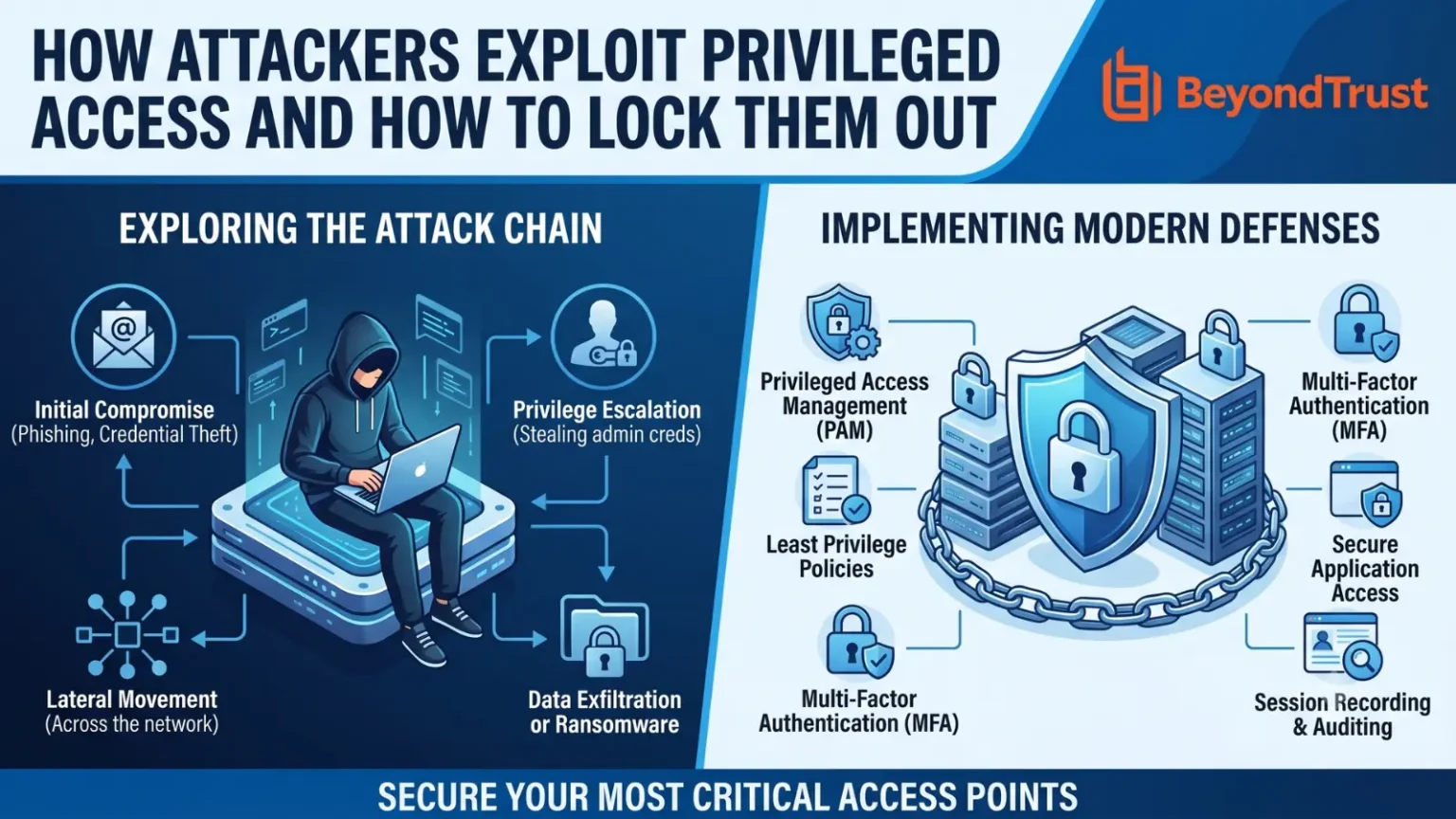
Attackers don’t typically break in and immediately achieve their objectives. Instead, they gain an initial foothold, often through phishing, unpatched vulnerabilities, or stolen credentials. Their next, and most crucial, step is to elevate their privileges, moving laterally through the network until they commandeer administrative accounts. This elevation of privileges gives them the keys to the kingdom, allowing them to extract sensitive data, deploy malware, or disrupt operations at will. Understanding this intrinsic link between privileged access and successful breaches is paramount to effective defense.
Understanding Privileged Access and Its Allure to Attackers
Privileged access refers to the elevated permissions granted to certain users or processes within an IT environment. These privileges allow for critical tasks such as system configuration, software installation, user management, and access to sensitive data. Examples include domain administrator accounts, local administrator accounts on servers and workstations, root accounts in Linux/Unix environments, and powerful service accounts.
For an attacker, a privileged credential is the ultimate prize. It allows them to bypass security controls, disable logging, create new user accounts, and access nearly any resource on the network. The source content highlights this perfectly: an attacker finds a privileged credential, uses it for lateral movement, escalates to administrator, and then proceeds with their malicious objectives. This sequence forms the backbone of countless sophisticated attacks.
Common Attack Vectors for Privileged Credential Exploitation
Attackers employ a variety of sophisticated techniques to compromise and exploit privileged access. Recognizing these methods is the first step toward robust protection:
- Phishing and Social Engineering: Still a top vector. Attackers craft convincing emails or messages designed to trick users, especially those with elevated privileges, into revealing their login credentials.
- Malware and Keyloggers: Once inside a system, malware can capture user keystrokes, extract credentials from memory, or deploy remote access tools that offer persistent privileged access.
- Vulnerability Exploitation: Unpatched software, operating systems, or network devices can provide an entry point. Attackers exploit known vulnerabilities (e.g., CVE-2021-44228, Log4Shell) to elevate privileges after an initial compromise.
- Pass-the-Hash/Pass-the-Ticket Attacks: Instead of cracking password hashes, attackers can reuse them directly to authenticate against other systems in the network, particularly prevalent in Windows environments and leveraging protocols like NTLM or Kerberos.
- Brute-Force and Dictionary Attacks: Attempting to guess weak privileged account passwords or using lists of commonly used passwords.
- Lateral Movement Techniques: Even with initial low-level access, attackers use tools like PsExec or WMI to move between systems, searching for unprotected administrative workstations or servers with cached privileged credentials.
- Default or Weak Configurations: Many systems come with default administrator accounts or weak default passwords that are rarely changed, offering an easy target for attackers.
Remediation Actions: Locking Attackers Out of Privileged Access
Protecting privileged access is not a single action but a comprehensive strategy. Organizations must implement a multi-layered approach to minimize the attack surface and detect exploitation attempts.
- Implement a Robust Privileged Access Management (PAM) Solution:
- Password Vaulting: Store and manage all privileged account credentials in a secure, centralized vault.
- Session Management: Monitor and record all privileged sessions. This provides an audit trail for forensic analysis and can prevent malicious activity.
- Just-in-Time (JIT) Access: Grant privileged access only when needed, for a limited duration, and for specific tasks.
- Automated Credential Rotation: Regularly rotate privileged account passwords automatically.
- Enforce Strong Authentication:
- Multi-Factor Authentication (MFA): Implement MFA for all privileged accounts, including administrators, service accounts (where technically feasible, using hardware tokens or certificates), and critical system access.
- Principle of Least Privilege (PoLP): Grant users only the minimum level of access required to perform their job functions. Regularly review and revoke unnecessary privileges.
- Segment Networks: Isolate critical systems and privileged access workstations (PAWs) on separate network segments. This limits an attacker’s ability to move laterally even if they compromise a low-privilege account.
- Regular Vulnerability Management and Patching:
- Scan regularly for vulnerabilities, including those related to privileged access (e.g., CVE-2021-34538, PrintNightmare).
- Prioritize patching critical vulnerabilities immediately, especially those affecting public-facing systems or core infrastructure components.
- Endpoint Detection and Response (EDR) & Security Information and Event Management (SIEM):
- Deploy EDR solutions on all endpoints to detect anomalous behavior and potential credential theft attempts.
- Integrate EDR logs with a SIEM system for centralized logging, correlation, and real-time alerting on suspicious activities related to privileged accounts. Look for unusual login times, failed login attempts, or access from unusual locations.
- Privileged Access Workstations (PAWs): Require administrators to perform privileged tasks from dedicated, hardened workstations that are isolated from the general user network and restricted from browsing the internet or checking email.
- Regular Audits and Reviews: Conduct periodic audits of privileged accounts, access rights, and configurations to identify and remediate dormant accounts, unauthorized privileges, or misconfigurations.
- User Training and Awareness: Educate users, especially administrators, about social engineering tactics, phishing risks, and the importance of strong password hygiene.
Tools for Privileged Access Management and Security
| Tool Name | Purpose | Link |
|---|---|---|
| CyberArk Privileged Access Security | Comprehensive PAM platform for vaulting, session management, and just-in-time access. | https://www.cyberark.com |
| Delinea Secret Server | Enterprise-grade PAM solution for managing and securing privileged accounts. | https://delinea.com |
| HashiCorp Vault | Open-source tool for managing secrets and protecting sensitive data, including privileged credentials. | https://www.vaultproject.io |
| Microsoft Azure AD Privileged Identity Management (PIM) | Manages, controls, and monitors access to important resources in Azure AD and other Microsoft cloud services. | https://azure.microsoft.com/en-us/products/active-directory/privileged-identity-management |
| BloodHound | Open-source Red Team tool used to map complex attack paths in Active Directory environments, often identifying privilege escalation opportunities. | https://bloodhound.readthedocs.io/en/latest/ |
Conclusion
The path to a devastating cyberattack frequently begins with a compromised privileged credential. This “middle chapter” of a breach is where attackers gain the critical leverage needed for their ultimate objectives. By implementing robust privileged access management strategies, enforcing strong authentication, continuously patching vulnerabilities, and monitoring diligently, organizations can significantly reduce the risk of attackers exploiting their most sensitive accounts. Focusing on hardening this critical attack surface is not just a best practice; it’s a fundamental requirement for defending against today’s sophisticated threats.