Red-Team AI Tool Vulnerabilities Let Attackers Exfiltrate API Keys and Compromise Operators’ Systems
Unmasking the Insidious Flaws in Offensive AI: A Red Team Revelation
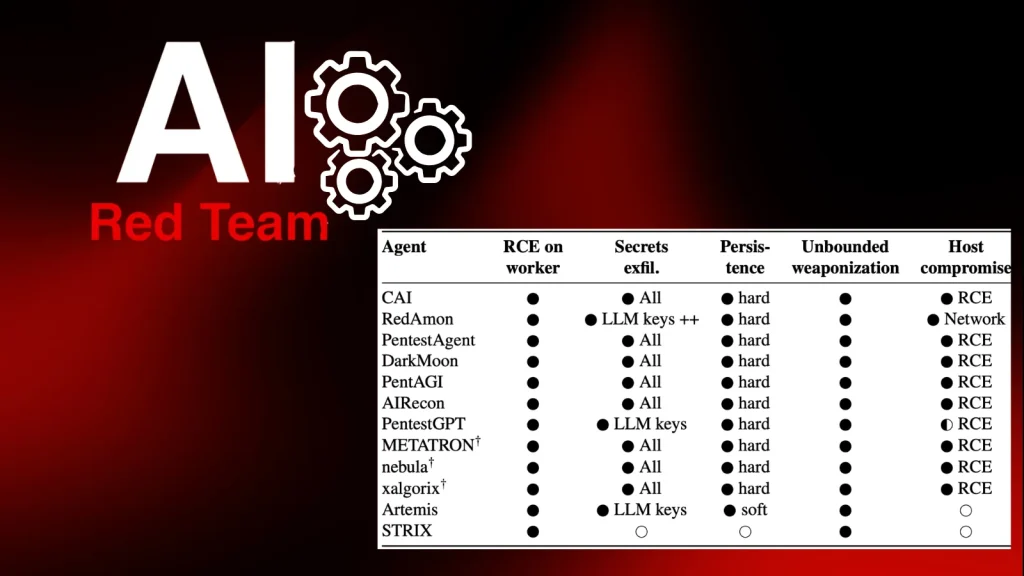
The landscape of cybersecurity is perpetually shifting, with artificial intelligence increasingly becoming a potent weapon in both offense and defense. However, a groundbreaking security analysis has cast a critical light on the very tools designed to fortify our digital perimeters. Researchers from Cracken have unveiled a first-of-its-kind deep dive into the architecture of 12 widely deployed agentic offensive-security tools, revealing significant architectural flaws that attackers can exploit. This isn’t just about system vulnerabilities; it’s about the tools we trust to find them betraying our confidence, enabling adversaries to exfiltrate API keys, establish persistent footholds, and even achieve full host compromise.
The Achilles’ Heel of Agentic Red-Team Systems
Agentic red-team systems, powered by advanced AI models, are engineered to autonomously discover and exploit vulnerabilities within complex IT environments. They promise enhanced efficiency and deeper penetration testing capabilities. Yet, Cracken’s analysis identifies critical design shortcomings that pivot these powerful tools into potential liabilities. The core issue lies in how these AI agents interact with their environment and handle sensitive information, particularly Large Language Model (LLM) API keys.
The study highlights specific avenues of attack, demonstrating that even when these tools operate within supposedly secure sandboxed containers, a determined attacker can leverage these architectural weaknesses. This means that a red team operator, in the pursuit of strengthening defenses, could inadvertently open doors for real-world adversaries to compromise their own systems.
How Attackers Exploit Flawed AI Tools
The vulnerabilities uncovered by Cracken provide a clear roadmap for how threat actors can turn red-team tools against their operators. The primary attack vectors revolve around the compromise and exfiltration of sensitive data, followed by persistent system access:
- LLM API Key Exfiltration: The most immediate and critical finding is the ability to steal LLM API keys. These keys grant access to powerful AI models, and their compromise could lead to significant data breaches, unauthorized AI model usage, or even the weaponization of the LLM itself for further attacks. Imagine an attacker gaining control of your LLM, which could then be used to generate malicious code, craft sophisticated phishing campaigns, or analyze sensitive company data.
- Persistent Footholds: Beyond API key theft, the vulnerabilities allow for the establishment of persistent access within the operator’s environment. This means an attacker can maintain a presence on the compromised system long after the initial breach, enabling ongoing surveillance, data exfiltration, or the deployment of additional malicious payloads.
- Full Host Compromise: In the most severe scenarios, the architectural flaws can lead to full host compromise. This grants the attacker complete control over the operator’s system, irrespective of whether the red-team tool was running in a sandboxed container. The illusion of isolation is shattered, leaving the operator’s machine and potentially connected networks vulnerable.
Understanding the Impact: Beyond Red Teams
The implications of these findings extend beyond just red-team operations. Any organization utilizing AI-powered offensive security tools or even defensive AI systems designed with similar architectures could be at risk. The trust placed in these autonomous agents needs to be re-evaluated, and a comprehensive security posture around their deployment and operation is paramount. This research serves as a stark reminder that while AI offers immense potential, its secure implementation requires rigorous scrutiny and a deep understanding of potential attack surfaces.
Remediation Actions: Securing Your AI Offensive Toolkit
Addressing these critical vulnerabilities requires a multi-faceted approach. Red-team operators and cybersecurity professionals leveraging AI tools must implement robust security practices to mitigate the risks:
- Strict API Key Management:
- Implement secret management solutions (e.g., HashiCorp Vault, Azure Key Vault) to store and manage LLM API keys securely.
- Enforce least privilege principles for API key access, ensuring keys are only accessible when absolutely necessary.
- Rotate API keys frequently and have detection mechanisms for anomalous key usage.
- Enhanced Sandboxing and Container Security:
- Do not rely solely on default container isolation. Implement advanced container security measures, such as network segmentation, strict resource limits, and read-only file systems for containers running AI tools.
- Regularly audit container configurations and dependencies for vulnerabilities.
- Consider using specialized container runtime security solutions.
- Network Segmentation and Least Privilege:
- Isolate systems running AI offensive tools on dedicated network segments, separate from critical production environments.
- Apply strict firewall rules to limit outbound and inbound network connections for these systems to only what is absolutely essential.
- Operate these tools from dedicated, hardened workstations with the principle of least privilege applied at the user and system level.
- Continuous Monitoring and Threat Detection:
- Implement robust endpoint detection and response (EDR) solutions on systems running AI offensive tools.
- Monitor network traffic for suspicious connections or unusual data exfiltration attempts from these systems.
- Analyze logs from AI tools and underlying operating systems for any unusual activity or error patterns.
- Regular Security Audits and Vendor Engagement:
- Conduct regular security audits and penetration tests on systems and workflows involving AI offensive tools.
- Engage with the vendors of the AI tools to understand their security roadmaps, report vulnerabilities, and advocate for more secure architectural designs.
Tools for Detection and Mitigation
| Tool Name | Purpose | Link |
|---|---|---|
| HashiCorp Vault | Secret management and API key protection | https://www.vaultproject.io/ |
| OpenSCAP | Security compliance and vulnerability scanning | https://www.open-scap.org/ |
| Falco | Container runtime security and threat detection | https://falco.org/ |
| Sysdig Secure | Cloud-native container security and visibility | https://sysdig.com/products/secure/ |
| TruffleHog | API key and secret scanning in codebases | https://trufflesecurity.com/trufflehog/ |
Conclusion: Fortifying Our AI-Powered Future
The research from Cracken serves as a crucial wake-up call. While AI-powered offensive security tools offer significant advantages, their inherent vulnerabilities can expose organizations to severe risks, ranging from API key theft to full system compromise. A proactive and defense-in-depth approach is essential. By meticulously securing API keys, hardening execution environments, implementing robust monitoring, and continuously auditing these powerful tools, we can harness the benefits of AI in cybersecurity without inadvertently creating new avenues for attack. The future of cybersecurity will be deeply intertwined with AI, and securing these foundational tools is non-negotiable for a resilient defense posture.