A Weaponized Google Ad Install Malicious Claude Code to Hijack Entire macOS
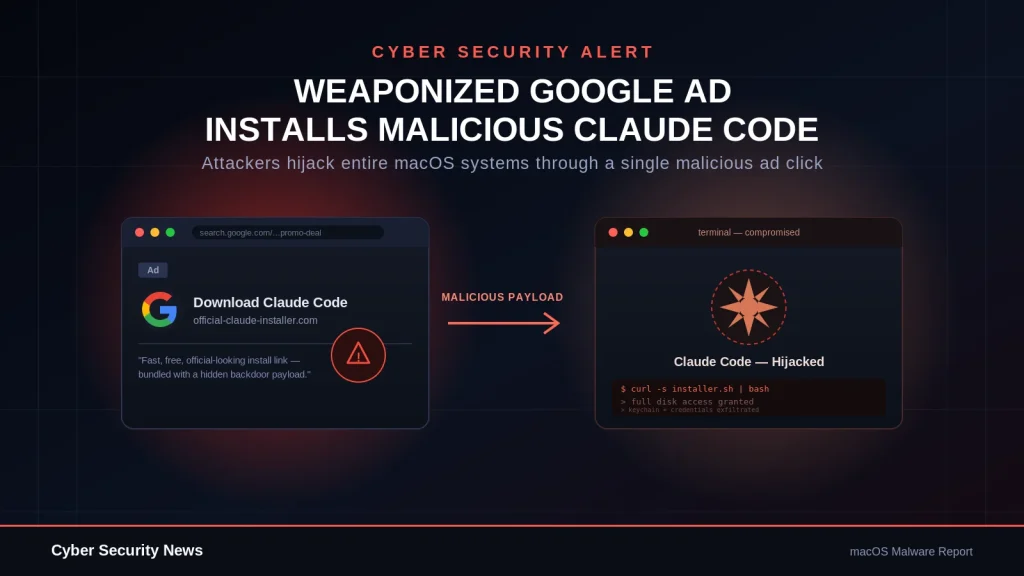
The digital landscape often conceals hidden dangers, and a recent discovery by Beelzebub Labs has illuminated a particularly insidious threat targeting macOS users. A weaponized Google ad, masquerading as a legitimate Claude Code Command Line Interface (CLI), has been observed distributing “MacSync Stealer.” This sophisticated credential harvester not only pilfers sensitive user data but also ingeniously compromises Ledger Live and Ledger Wallet applications to exfiltrate cryptocurrency seed phrases.
The Deceptive Google Ad: A Lure for macOS Users
In a cunning act of impersonation, threat actors leveraged Google’s advertising platform to promote a malicious download. The advertisement meticulously mimicked Anthropic’s legitimate Claude Code CLI, a tool that developers might readily seek. This tactic, known as malvertising, exploits user trust in widely recognized brands and platforms. The attackers’ objective was clear: to entice unwary macOS users into downloading what they believed was a productivity tool, but was in fact a conduit for malware.
MacSync Stealer: A Multifaceted Threat to macOS
Upon execution, the seemingly innocuous Claude Code CLI installer unleashed MacSync Stealer. Beelzebub Labs’ comprehensive reverse-engineering efforts, facilitated by their agentic threat-intel platform Caronte, revealed the stealer’s dual functionality:
- Credential Harvesting: MacSync Stealer is engineered to systematically extract various credentials stored on the compromised macOS system. This can include browser data, saved passwords, authentication tokens, and potentially sensitive files.
- Cryptocurrency Theft via Ledger Compromise: A particularly concerning aspect of MacSync Stealer is its ability to silently “trojan” legitimate Ledger Live and Ledger Wallet applications. This means the malware modifies or integrates with these applications to intercept and exfiltrate cryptocurrency seed phrases, granting attackers full control over a victim’s digital assets. This highlights the growing trend of malware specifically targeting cryptocurrency holders. While this specific campaign does not have a public CVE associated with the malware itself, the methods employed, such as social engineering and credential harvesting, intersect with broader threat categories.
The Modus Operandi: How the Attack Unfolds
The attack chain is a testament to the attackers’ calculated approach:
- Initial Compromise: A user searching for “Claude Code CLI” or similar terms on Google encounters the weaponized advertisement.
- Malicious Download: Believing the ad to be legitimate, the user clicks the link and downloads the seemingly authentic installer.
- Stealer Deployment: Upon running the installer, MacSync Stealer is discreetly installed on the macOS system.
- Data Exfiltration: The stealer then scans for and harvests credentials, simultaneously targeting and compromising Ledger-related applications to steal vital seed phrases.
Remediation Actions and Proactive Defense
Defending against sophisticated threats like MacSync Stealer requires a multi-layered approach. For IT professionals, security analysts, and developers, the following actions are crucial:
- Verify Software Sources: Always download software directly from official vendor websites. Be extremely wary of sponsored links, even on trusted platforms like Google, especially when downloading executables. Scrutinize URLs for any discrepancies.
- Utilize Ad Blockers and Browser Extensions: Employ reputable ad blockers to minimize exposure to malicious advertisements. Browser extensions that check for suspicious links can also add a layer of protection.
- Implement Endpoint Detection and Response (EDR): EDR solutions are critical for detecting and responding to active threats on macOS endpoints. They can identify anomalous process behavior, file modifications, and network connections indicative of malware.
- Regularly Update Software: Keep macOS, all applications, and security software up to date. Patches often address vulnerabilities that could be exploited by attackers. While no specific CVE is associated with MacSync Stealer’s initial exploit, CVEs related to operating system or common application vulnerabilities could be exploited by future variations.
- Hardware Wallet Security Best Practices: For cryptocurrency users, always follow the stringent security guidelines for hardware wallets. Never enter your seed phrase onto a computer or into any software unless explicitly required by the official, verified hardware wallet application during setup, and even then, exercise extreme caution. Consider using a dedicated, air-gapped machine for managing cold storage.
- Multi-Factor Authentication (MFA): Enable MFA wherever possible, especially for sensitive accounts and cryptocurrency exchanges. This adds a critical layer of security even if credentials are compromised.
- Educate Users: Conduct regular security awareness training emphasizing the dangers of phishing, malvertising, and the importance of verifying download sources.
Tools for Detection and Mitigation
Leveraging appropriate tools is essential for identifying and combating threats like MacSync Stealer:
| Tool Name | Purpose | Link |
|---|---|---|
| Virustotal | File and URL analysis for malware detection | https://www.virustotal.com/ |
| Packet Capture Tools (e.g., Wireshark) | Network traffic analysis to detect suspicious outbound connections | https://www.wireshark.org/ |
| Objective-See Tools | macOS security tools for monitoring file system changes and network connections (e.g., LuLu, BlockBlock) | https://objective-see.com/products.html |
| EDR Solutions | Endpoint Detection and Response for comprehensive threat monitoring and response (e.g., CrowdStrike, SentinelOne) | (Vendor Specific) |
Conclusion: Heightened Vigilance in a Treacherous Digital Age
The discovery of MacSync Stealer, propagated through weaponized Google ads, underscores the persistent and evolving nature of cyber threats. Attackers are increasingly sophisticated, employing social engineering and technical ingenuity to compromise even security-conscious users. For macOS users, especially those involved in cryptocurrency, vigilance is paramount. Strict adherence to security best practices, coupled with the strategic deployment of defensive tools and continuous user education, forms the bedrock of a robust cybersecurity posture against such cunning adversaries.