Banana RAT Uses Exposed Payload Generator to Create Polymorphic Banking Malware Variants
The landscape of cybercrime is continually shifting, and banking fraud, in particular, has seen threat actors evolve their tactics to bypass traditional security measures. A recent and concerning development involves a campaign leveraging the Banana RAT, a notorious remote access trojan primarily associated with Brazilian banking fraud. This sophisticated campaign has introduced a significant threat by employing an exposed backend server capable of generating polymorphic banking malware variants on demand. This advancement means the malware can continuously change its signature, making detection and defense increasingly challenging for cybersecurity teams.
The Evolution of Banking Malware: Banana RAT’s Polymorphic Threat
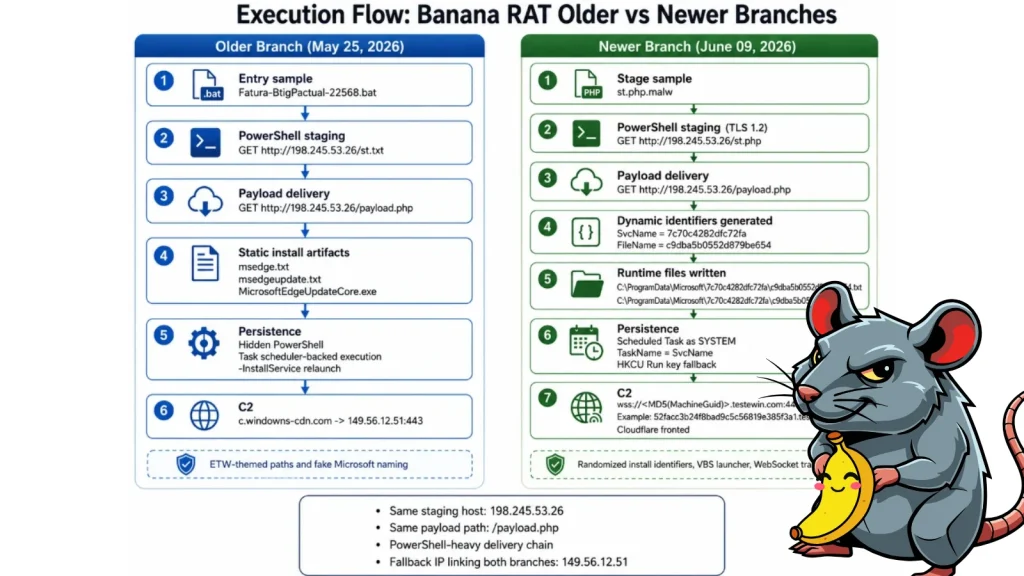
For years, the Banana RAT (Remote Access Trojan) has been a persistent nuisance in the cybersecurity world, particularly within the financial sector in Brazil. Its traditional modus operandi involved facilitating remote access to compromised systems, enabling fraudsters to steal sensitive banking credentials and execute fraudulent transactions. However, the discovery of an exposed payload generator linked to ongoing Banana RAT campaigns marks a stark escalation in the capabilities of these threat actors.
This generator doesn’t just host static malicious files; it actively constructs new, unique malware binaries. This ‘on-demand’ generation creates polymorphic banking malware, meaning each variant has a different signature, rendering signature-based detection mechanisms less effective. This strategy significantly enhances the malware’s ability to evade endpoint detection and response (EDR) systems, antivirus software, and other security solutions that rely on identifying known malicious patterns.
Understanding the Exposed Payload Generator
The core of this advanced threat lies in the exposed backend server. This server functions as an automated factory for malware, allowing its operators to churn out an endless stream of customized Banana RAT variants. The exposure of this server presents a unique opportunity for security researchers to analyze the inner workings of such a system, but it also underscores the growing sophistication of cybercriminal infrastructure.
The ability to generate polymorphic variants on the fly drastically reduces the lifecycle of any given malware signature, forcing security teams into a constant uphill battle. This is a critical development for anyone involved in defending against financial fraud, as it necessitates a shift from reactive, signature-based defense to more proactive, behavior-based detection and threat intelligence.
Impact on Financial Institutions and Users
The implications of polymorphic banking malware generated by an exposed server are severe for both financial institutions and their customers. For banks, increased fraudulent transactions, reputational damage, and significant recovery costs are potential outcomes. Detecting these evolving threats requires more advanced threat hunting capabilities and deeper integration of threat intelligence into security operations.
For individual users, the risk of having their banking credentials compromised and accounts drained increases. Phishing campaigns become even more potent when the attached malware can bypass security solutions with ease. This emphasizes the need for robust security practices at every level, from the end-user to enterprise security architectures.
Remediation Actions and Proactive Defense
Combating a polymorphic threat like the new variants of Banana RAT requires a multi-layered and adaptive cybersecurity strategy. Organizations cannot rely solely on traditional detection methods.
- Enhanced Endpoint Protection: Implement advanced EDR and next-generation antivirus (NGAV) solutions that leverage behavioral analysis, machine learning, and artificial intelligence to detect anomalous activities, rather than just known signatures.
- Network Traffic Analysis: Deploy robust network detection and response (NDR) tools to monitor for suspicious outbound connections and command-and-control (C2) communications often associated with RATs.
- Threat Intelligence Integration: Continuously feed up-to-date threat intelligence into security information and event management (SIEM) systems and security orchestration, automation, and response (SOAR) platforms. This includes intelligence on known Banana RAT tactics, techniques, and procedures (TTPs).
- Email Security Gateway: Strengthen email security with advanced phishing detection, sandboxing, and URL reputation checks to prevent the initial infection vector.
- User Education and Awareness: Regularly train employees and customers about phishing, social engineering, and the importance of strong, unique passwords and multi-factor authentication (MFA).
- Regular Security Audits and Penetration Testing: Proactively identify vulnerabilities in systems and applications that could be exploited by such malware.
Tools for Detection and Mitigation
| Tool Name | Purpose | Link |
|---|---|---|
| Osquery | Endpoint visibility and behavioral monitoring for suspicious processes. | https://osquery.io/ |
| Suricata | Intrusion detection (IDS) and prevention (IPS) for network traffic analysis. | https://suricata-ids.org/ |
| YARA | Pattern matching for malware identification (useful for behavior-based rules). | https://virustotal.github.io/yara/ |
| Cuckoo Sandbox | Automated malware analysis for dynamic behavior assessment. | https://cuckoosandbox.org/ |
Conclusion
The emergence of Banana RAT leveraging an exposed payload generator to create polymorphic banking malware variants represents a significant challenge to conventional cybersecurity defenses. This campaign underscores the imperative for organizations to shift towards proactive, behavior-based detection and robust threat intelligence integration. Staying vigilant, employing advanced security tools, and fostering a strong security culture are essential to mitigate the evolving threat of financial cybercrime.