
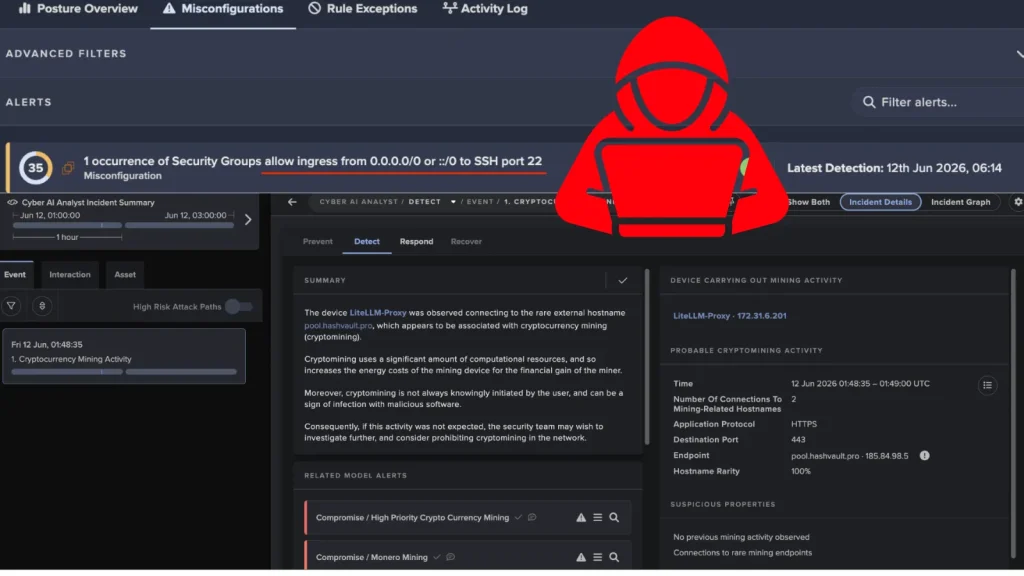
Hackers are Turning AI Gateways as Attack Surfaces to Compromise Enterprise Networks
The landscape of enterprise cybersecurity is undergoing a significant shift, with sophisticated adversaries constantly identifying and exploiting new vectors. A particularly concerning trend emerging is the targeting of Artificial Intelligence (AI) gateways, transforming them into critical attack surfaces for compromising entire enterprise networks. As organizations increasingly integrate generative AI applications with cloud services like Amazon Bedrock, these gateways, designed to facilitate communication between users, business applications, and large language models (LLMs), have become highly attractive entry points for malicious actors.
The Rise of AI Gateways as Attack Surfaces
AI gateways inherently occupy a privileged position within IT infrastructure. They act as intermediaries, processing sensitive queries, managing API access, and often handling authentication for powerful generative AI models. This central role makes them an ideal target. A successful compromise of an AI gateway can grant attackers profound access, not only to the AI models themselves but also to the underlying cloud infrastructure, sensitive data processed by the AI, and potentially the broader enterprise network.
Consider the architecture: users submit requests through the gateway, which then translates and forwards them to LLMs hosted on cloud platforms. The responses are routed back through the gateway to the user. This flow means the gateway is privy to both the input (potentially confidential business data or personally identifiable information) and the output. Furthermore, the gateway often holds credentials or tokens necessary to interact with cloud services, presenting a goldmine for attackers.
“LiteLLM-Proxy” Incident: A Case Study
Recent investigations by cybersecurity firm Darktrace highlight this escalating threat. They uncovered a compromised Amazon Web Services (AWS) EC2 instance named “LiteLLM-Proxy.” While the full details of the compromise are still under analysis, the very name points to its function: acting as a proxy or gateway for an LLM. Such an instance would typically be responsible for managing access, rate limiting, and potentially logging interactions with a generative AI model.
The compromise of “LiteLLM-Proxy” underscores the critical vulnerabilities within these gateway deployments. An attacker gaining control of such an instance could:
- Intercept Sensitive Data: Capture prompts and responses flowing through the LLM, potentially revealing proprietary business information or customer data.
- Manipulate AI Behavior: Inject malicious prompts or alter configurations to steer the LLM’s responses, leading to data leakage, misinformation, or other adversarial outcomes.
- Lateral Movement: Utilize the compromised instance’s credentials and network access to explore and exploit other connected AWS services, potentially escalating privileges and broadening their foothold within the enterprise cloud environment.
- Resource Abuse: Hijack the instance to launch other attacks, mine cryptocurrency, or host malicious content, incurring significant costs and reputational damage for the victim organization.
Remediation Actions for Securing AI Gateways
Given the strategic importance and inherent risks associated with AI gateways, robust security measures are paramount. Organizations must adopt a proactive and multi-layered approach to protect these critical components.
- Implement Strict Access Controls (IAM): Apply the principle of least privilege to all AI gateway components. Ensure that the EC2 instances, containers, or services hosting your AI gateway only have the absolute minimum necessary permissions to perform their function. Regularly audit IAM roles and policies.
- Network Segmentation and Microsegmentation: Isolate AI gateways within dedicated network segments. Use security groups, Virtual Private Clouds (VPCs), and network access control lists (NACLs) to restrict ingress and egress traffic. Only allow necessary ports and protocols.
- Regular Patching and Vulnerability Management: Keep all underlying operating systems, libraries, and application dependencies for your AI gateway up-to-date. Implement a rigorous patching schedule. Conduct regular vulnerability scans and penetration tests against your gateway infrastructure.
- API Security Best Practices: For gateways exposing APIs, enforce strong API authentication (e.g., OAuth 2.0, API keys with proper rotation). Implement rate limiting, input validation, and robust error handling to prevent common API attacks like injection or denial-of-service.
- Comprehensive Logging and Monitoring: Enable detailed logging for all API calls, access attempts, and system events on your AI gateway. Integrate these logs with a Security Information and Event Management (SIEM) system for real-time analysis and anomaly detection. Monitor for unusual traffic patterns, failed login attempts, or unauthorized configuration changes.
- Source Code Security (for custom gateways): If you develop custom AI gateways, conduct static application security testing (SAST) and dynamic application security testing (DAST) on the codebase. Implement secure coding practices to prevent common web application vulnerabilities (e.g., SQL injection, cross-site scripting).
- Runtime Protection: Consider employing Cloud Workload Protection Platforms (CWPPs) or Runtime Application Self-Protection (RASP) solutions for your gateway instances to detect and block attacks in real-time.
- DDoS Mitigation: Implement measures to protect your AI gateway from Distributed Denial of Service (DDoS) attacks, which could be used as a diversion or to simply take the service offline.
Tools for Detection and Mitigation
Implementing the remediation actions requires leveraging appropriate security tools. Here’s a selection of categories and examples:
| Tool Category | Purpose | Link (Example) |
|---|---|---|
| Cloud Security Posture Management (CSPM) | Identifies misconfigurations in cloud environments (e.g., AWS EC2, S3 buckets, IAM roles). | AWS Security Hub |
| Cloud Workload Protection Platform (CWPP) | Secures compute workloads (VMs, containers) at runtime from threats. | Palo Alto Networks Prisma Cloud |
| API Security Gateway | Enforces security policies, rate limiting, and authentication for APIs. | Kong Gateway |
| Vulnerability Scanners | Automated tools to identify known vulnerabilities in code, dependencies, and infrastructure. | Tenable Nessus |
| SIEM / XDR Solutions | Collect, correlate, and analyze security logs for threat detection and response. | Splunk Enterprise Security |
Conclusion
AI gateways are rapidly becoming critical infrastructure for enterprises leveraging generative AI. Their strategic placement and access to sensitive data and cloud resources make them compelling targets for attackers. The “LiteLLM-Proxy” incident serves as a stark reminder of the tangible risks involved. Organizations must recognize the elevated threat landscape surrounding these gateways and proactively implement robust security measures, focusing on stringent access controls, network segmentation, continuous vulnerability management, and comprehensive monitoring. Securing AI gateways is not merely an IT task; it is a fundamental pillar of maintaining overall enterprise cybersecurity posture in an AI-driven world.




