
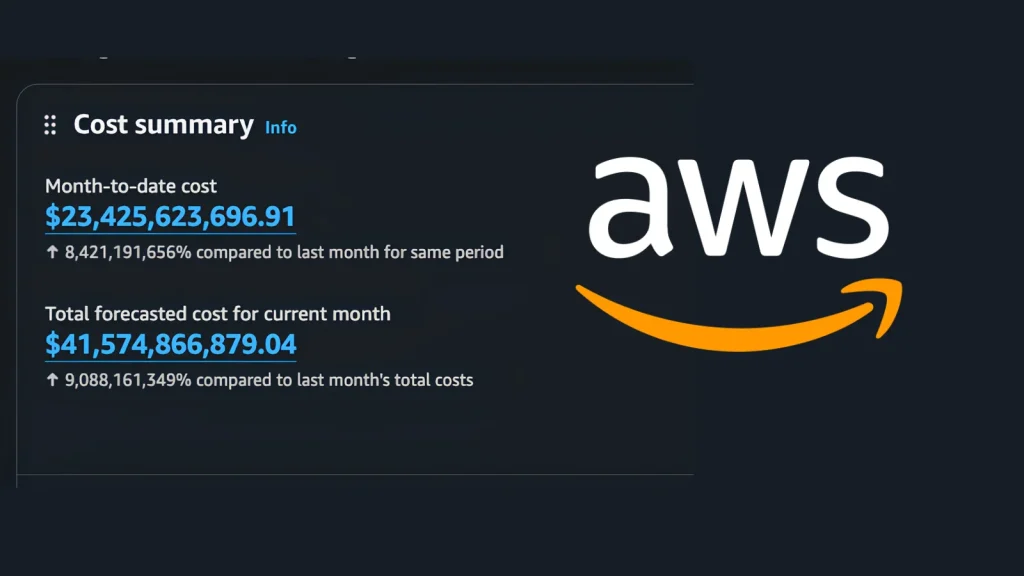
AWS Cost Explorer Bug Shows Trillion-Dollar Billing Estimates
Imagine logging into your AWS console to check your monthly cloud bill and finding an estimated cost in the trillions of dollars. For many AWS customers worldwide, this alarming scenario became a reality recently, triggering widespread concern and questioning the integrity of their cloud expenditure tracking. This wasn’t a sudden surge in usage or a sophisticated billing scam; it was an unexpected and dramatic bug within AWS’s own cost management tools.
The Trillion-Dollar Glitch: What Happened?
The incident, as reported by Cybersecurity News, involved the AWS Billing and Cost Management Console and the Cost Explorer tool displaying wildly inflated projected cloud costs. Organizations, from startups to enterprises, were confronted with estimated monthly bills that soared into the trillions of dollars. This wasn’t merely a visual anomaly; these figures directly impacted budget alerts, leading to immediate alarm over potential unauthorized AWS usage or a catastrophic misconfiguration.
The sudden appearance of such astronomical figures naturally led to a flurry of support tickets and internal investigations among affected companies. The immediate fear was that these projections reflected actual, albeit erroneously high, charges, potentially bankrupting businesses or at least severely disrupting financial planning.
AWS Acknowledges the Anomaly
Fortunately, the situation was not a breach or an actual billing error that would translate into real charges. AWS quickly acknowledged the issue through its official Health Dashboard and AWS Support channels. This confirmation provided a degree of relief, clarifying that the projected costs were indeed a display bug, not indicative of actual spending or security compromise. While the specific root cause was not publicly detailed, such incidents often stem from anomalies in data aggregation, calculation logic, or presentation layers within complex distributed systems.
While this particular incident did not have a CVE assigned, as it was a display bug rather than a security vulnerability in the traditional sense, its impact on operational visibility and trust was significant. It underscores the critical importance of reliable financial monitoring in cloud environments.
Impact on AWS Customers
The primary impact of this bug was a temporary but significant disruption to operational confidence and financial planning. Organizations rely heavily on tools like Cost Explorer for:
- Budgeting and Forecasting: Instantaneously skewed projections can derail budget allocations and financial forecasts.
- Anomaly Detection: Legitimate spikes in usage might be overlooked if the baseline is frequently displaying absurdly high figures.
- Trust and Transparency: Such errors can erode user trust in the accuracy and reliability of essential cloud management tools.
- Operational Overhead: Security and finance teams expended valuable time investigating what appeared to be critical billing discrepancies.
Remediation and Best Practices for Cost Management
While AWS addressed this specific display bug, the incident serves as a pertinent reminder for organizations to maintain robust cloud financial management (FinOps) practices and not solely rely on a single source for cost validation.
Here are several remediation actions and best practices:
- Diversify Cost Monitoring Tools: While AWS Cost Explorer is powerful, consider integrating third-party FinOps tools that offer alternative views and reporting capabilities.
- Set Up Granular Billing Alerts: Configure alerts not just for projected costs but also for actual accrued costs, specific service usage thresholds, and budget overruns within AWS Budgets.
- Regularly Review IAM Policies: Ensure that AWS Identity and Access Management (IAM) policies restrict access to billing information and resource provisioning to only authorized personnel. This prevents actual unauthorized spending, which can often be mistaken for billing errors.
- Implement Tagging Strategies: Consistently tag resources to easily attribute costs to specific projects, departments, or environments. This aids in identifying legitimate cost driversversus anomalies.
- Educate Teams on FinOps Principles: Foster a culture of cost awareness among development and operations teams. Encourage them to optimize resources and understand the cost implications of their architectural decisions.
- Monitor AWS Health Dashboard: Regularly check the AWS Health Dashboard for service-wide issues and announcements. This is often the first place AWS will communicate about broad platform problems.
Tools for Enhanced Cloud Cost Management
Adopting specialized tools can significantly enhance an organization’s ability to monitor, optimize, and manage cloud spending effectively.
| Tool Name | Purpose | Link |
|---|---|---|
| AWS Budgets | Set custom budgets to track your costs and usage, and receive alerts when actual or forecasted costs exceed your defined thresholds. | https://aws.amazon.com/aws-cost-management/aws-budgets/ |
| AWS Cost Anomaly Detection | Uses machine learning to detect unusual spending patterns in your AWS account and sends alerts. | https://aws.amazon.com/aws-cost-management/aws-cost-anomaly-detection/ |
| CloudHealth by VMware | Multi-cloud management platform for cost, usage, security, and performance optimization. | https://cloudhealth.vmware.com/ |
| Apptio Cloudability | Cloud financial management platform offering visibility, optimization, and governance for cloud spending. | https://www.apptio.com/products/cloudability/ |
| Kubecost | Open-source tool for Kubernetes cost monitoring and management in real-time. | https://www.kubecost.com/ |
Key Takeaways
The AWS Cost Explorer bug, while resolved, highlights the critical need for a resilient and multi-faceted approach to cloud financial management. Relying solely on automated tools, even from a hyperscaler, carries inherent risks. Organizations must implement their own layers of validation, maintain strict budgeting and alerting mechanisms, and leverage a combination of first-party and third-party tools to ensure complete visibility and control over their cloud expenditure. This incident underscores that even minor glitches in mission-critical systems can cause significant operational friction and underscore the importance of robust FinOps practices.




