GitLab Fixes Claude AI Agent Flaw That Could Execute Arbitrary Commands in CI Pipeline
The convergence of artificial intelligence and continuous integration/continuous deployment (CI/CD) pipelines offers immense potential for accelerating software development. However, this powerful integration also introduces new security challenges. Recently, GitLab identified and patched a high-severity vulnerability within its Duo Claude AI agent, a flaw that could have allowed authenticated developers to execute arbitrary commands within critical CI pipeline contexts. This incident serves as a stark reminder of the continuous need for vigilance and robust security practices in the evolving landscape of AI-driven development.
Understanding the GitLab Duo Claude AI Agent Vulnerability
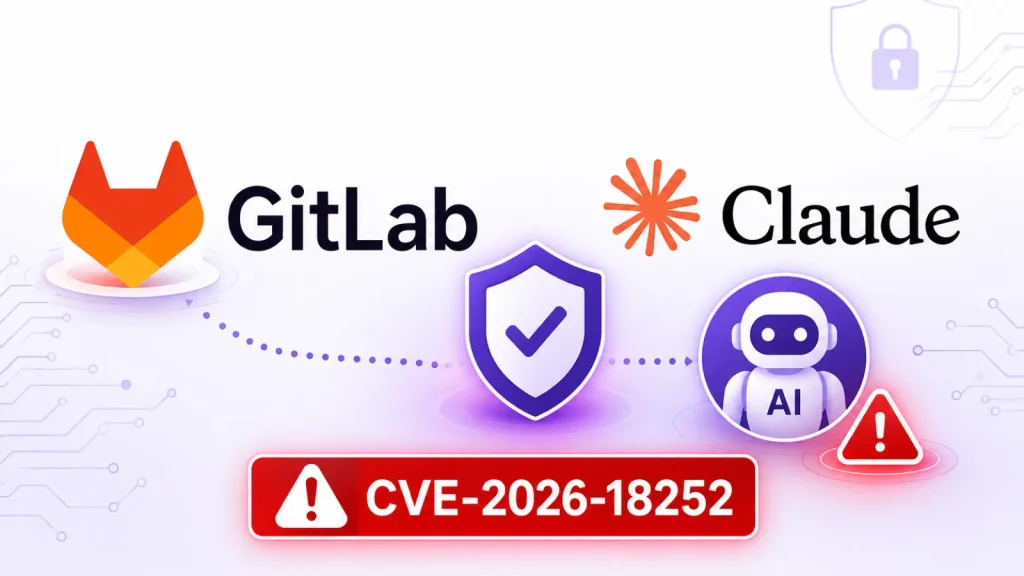
GitLab’s Duo Claude AI agent, designed to enhance developer productivity, was found to harbor a significant security vulnerability. Tracked as CVE-2026-18252, this flaw carried a CVSS score of 7.3, categorizing it as high severity. The core issue allowed authenticated developers to execute arbitrary commands within the CI pipeline. This capability is particularly concerning as CI pipelines often operate with elevated privileges, handling sensitive code, credentials, and deployment processes. An attacker exploiting such a vulnerability could potentially compromise source code, inject malicious code into deployed applications, or gain unauthorized access to an organization’s infrastructure.
The vulnerability specifically affected GitLab Enterprise Edition installations. The ability for an authenticated developer, even one with legitimate access, to inject and execute arbitrary commands bypasses established security controls and could lead to supply chain attacks or internal data breaches. This highlights the importance of not just external threat vectors, but also internal security postures and the principle of least privilege.
Impact on CI Pipeline Security
CI pipelines are the backbone of modern software development, automating tasks from code compilation and testing to deployment. Compromising these pipelines can have severe repercussions:
- Code Tampering: Malicious commands could modify or inject code directly into the codebase, leading to backdoors or compromised applications.
- Data Exfiltration: Sensitive data, such as API keys, database credentials, or proprietary source code, often flows through CI pipelines. Arbitrary command execution could allow an attacker to exfiltrate this information.
- Infrastructure Compromise: CI/CD environments frequently interact with development, staging, and production infrastructure. Exploitation could provide a foothold for further attacks against these environments.
- Supply Chain Attacks: If malicious code is injected into the build process, it can then be distributed to users or customers, leading to a widespread supply chain attack.
- Disruption of Operations: Attackers could halt or disrupt CI/CD processes, significantly impacting development cycles and business continuity.
Remediation Actions
GitLab has promptly addressed CVE-2026-18252 by releasing security updates. Organizations utilizing GitLab Enterprise Edition must prioritize these updates to mitigate the risk posed by this vulnerability.
- Immediate Patching: Upgrade your GitLab Enterprise Edition instances to the patched versions: GitLab 19.3.1, 19.2.5, or later. These versions contain the necessary fixes for the Duo Claude AI agent flaw.
- Regular Security Updates: Establish a routine for monitoring GitLab security advisories and applying updates promptly. This vulnerability underscores the dynamic nature of software security.
- Principle of Least Privilege: Review and enforce the principle of least privilege for all users and services interacting with your CI/CD pipelines. Ensure that developers and automated agents only have the minimum necessary permissions to perform their tasks.
- CI/CD Security Best Practices: Implement robust security practices for your CI/CD pipelines, including static application security testing (SAST), dynamic application security testing (DAST), dependency scanning, and secret management.
- Monitoring and Logging: Enhance logging and monitoring within your CI/CD environment to detect unusual activity or unauthorized command execution. Implement alerts for suspicious events.
Recommended Tools for CI/CD Security
Securing CI/CD pipelines requires a multi-layered approach. Various tools can assist in detecting, scanning, and mitigating vulnerabilities like the one found in GitLab’s AI agent:
| Tool Name | Purpose | Link |
|---|---|---|
| GitLab SAST | Static Application Security Testing – analyzes source code for vulnerabilities. | GitLab SAST Docs |
| GitLab DAST | Dynamic Application Security Testing – analyzes running applications for vulnerabilities. | GitLab DAST Docs |
| Trivy | Vulnerability scanner for container images, filesystems, and Git repositories. | Trivy |
| OWASP ZAP | Leading open-source web application security scanner for DAST. | OWASP ZAP |
| Vault by HashiCorp | Securely stores and manages sensitive data like API keys and credentials. | HashiCorp Vault |
Conclusion
The swift action by GitLab to patch the Duo Claude AI agent flaw highlights the critical importance of proactive security measures in the rapidly evolving technology landscape. As AI agents become more integrated into core development workflows, their security will be paramount. Organizations must remain vigilant, apply security updates without delay, and adopt comprehensive CI/CD security strategies to protect against both known and emerging threats. This incident serves as a crucial reminder that even sophisticated AI tools require rigorous security scrutiny to prevent potential avenues for exploitation.