Multiple TeamViewer Vulnerabilities Enable Remote Code Execution Attacks
Unpacking the Critical TeamViewer Vulnerabilities: A Call to Action
Remote access tools are indispensable for modern IT operations, facilitating everything from help desk support to managing distributed infrastructure. Among these, TeamViewer stands out as a widely adopted solution. However, its widespread use also makes it a prime target for malicious actors. Recent discoveries of high-severity vulnerabilities within TeamViewer highlight the persistent security challenges facing organizations reliant on such software. This analysis delves into the specifics of these critical flaws, explaining their potential impact and outlining immediate remediation steps.
CVE-2026-16444: Remote Code Execution via Improper Validation
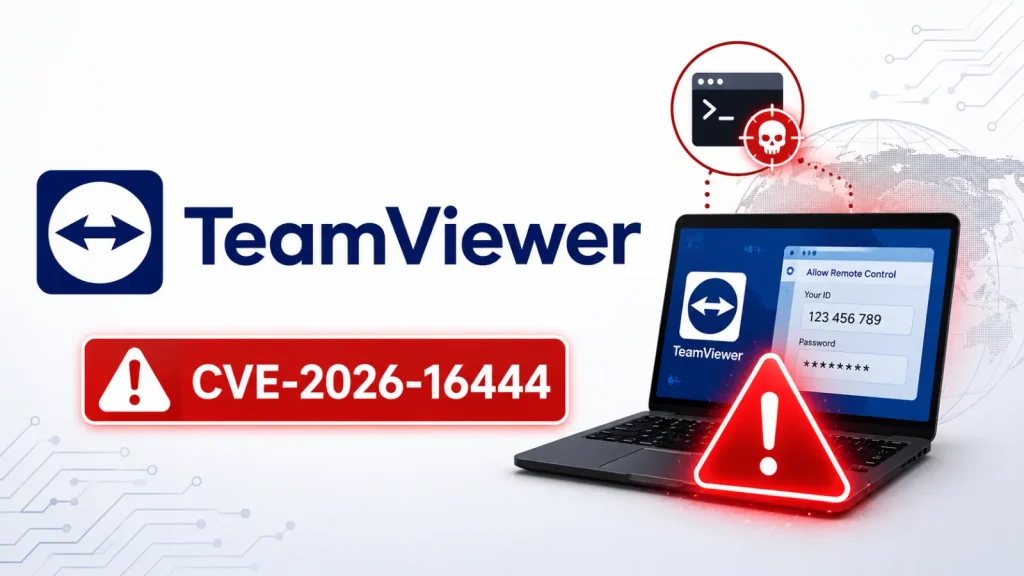
TeamViewer recently patched a significant vulnerability, tracked as CVE-2026-16444. This high-severity flaw enables an authenticated attacker within a remote session to write files to unintended locations on a target system. Critically, this capability can be leveraged to achieve arbitrary code execution with user privileges. The implications of such an attack are severe, potentially leading to full system compromise, data exfiltration, or the deployment of further malware.
As detailed in TeamViewer security bulletin TV-2026-1008, published on August 26, 2026, the root cause of CVE-2026-16444 lies in an improper validation mechanism within TeamViewer’s desktop client components. This allows an attacker to bypass intended file system restrictions, turning what might seem like a benign file transfer operation into a dangerous exploit vector. The vulnerability impacts various TeamViewer deployments, including TeamViewer Remote, TeamViewer Tensor, and TeamViewer ONE, underscoring the broad potential attack surface.
Understanding the Attack Vector and Impact
The attack scenario for CVE-2026-16444 is particularly concerning because it requires an authenticated remote session. This means an attacker would first need to gain access to a legitimate TeamViewer session, perhaps through stolen credentials, social engineering, or by exploiting other vulnerabilities to gain initial access. Once authenticated, the improper validation flaw allows them to elevate their privileges by writing malicious files to critical system directories or startup locations, leading to remote code execution (RCE).
The successful exploitation of such a vulnerability could result in:
- Full System Compromise: An attacker could gain complete control over the compromised machine.
- Data Exfiltration: Sensitive data stored on the system could be stolen.
- Malware Deployment: The vulnerability could be used to install ransomware, spyware, or other malicious software.
- Lateral Movement: The compromised system could serve as a launchpad for further attacks within the network.
Remediation Actions: Securing Your TeamViewer Deployments
Given the critical nature of these vulnerabilities, immediate action is paramount for all organizations utilizing TeamViewer. Here are the essential steps to mitigate the risks:
- Update TeamViewer Immediately: The most crucial step is to update all affected TeamViewer installations to the latest patched version. Refer to TeamViewer’s official security bulletin TV-2026-1008 for specific version recommendations. Regular patch management is fundamental to cybersecurity hygiene.
- Implement Strong Authentication: Ensure all TeamViewer accounts use strong, unique passwords and, wherever possible, enable multi-factor authentication (MFA). MFA significantly reduces the risk of credential compromise.
- Principle of Least Privilege: Grant TeamViewer users only the minimum necessary permissions required for their tasks. Avoid using administrator accounts for routine remote access.
- Network Segmentation: Isolate critical systems on separate network segments. This limits an attacker’s ability to move laterally even if a TeamViewer session is compromised.
- Monitor Logs: Regularly monitor TeamViewer connection logs and system event logs for unusual activity, unauthorized file transfers, or suspicious process executions.
- Endpoint Detection and Response (EDR): Deploy EDR solutions to detect and respond to suspicious activities on endpoints, including those initiated via remote access tools.
Detection and Mitigation Tools
Proactive security measures and the right tools can significantly enhance your defense against vulnerabilities like CVE-2026-16444.
| Tool Name | Purpose | Link |
|---|---|---|
| TeamViewer Management Console | Centralized update management and policy enforcement for TeamViewer deployments. | https://www.teamviewer.com/en/features/management-console/ |
| Vulnerability Scanners (e.g., Nessus, Qualys, OpenVAS) | Identify outdated software versions and missing security patches on endpoints. | https://www.tenable.com/products/nessus |
| Endpoint Detection and Response (EDR) Solutions | Detect and respond to malicious activity, including unauthorized file writes and process execution. | (Vendor-specific, e.g., CrowdStrike, SentinelOne) |
| Security Information and Event Management (SIEM) | Aggregate and analyze logs from TeamViewer and other systems for anomalous behavior. | (Vendor-specific, e.g., Splunk, IBM QRadar) |
Conclusion
The discovery and patching of CVE-2026-16444 serve as a critical reminder that even widely trusted software can harbor significant security flaws. Organizations must prioritize immediate patching and reinforce their overall security posture to defend against potential remote code execution attacks. By implementing strong authentication, least privilege principles, and leveraging robust security tools, businesses can significantly reduce their exposure to such threats and maintain the integrity of their IT infrastructure.