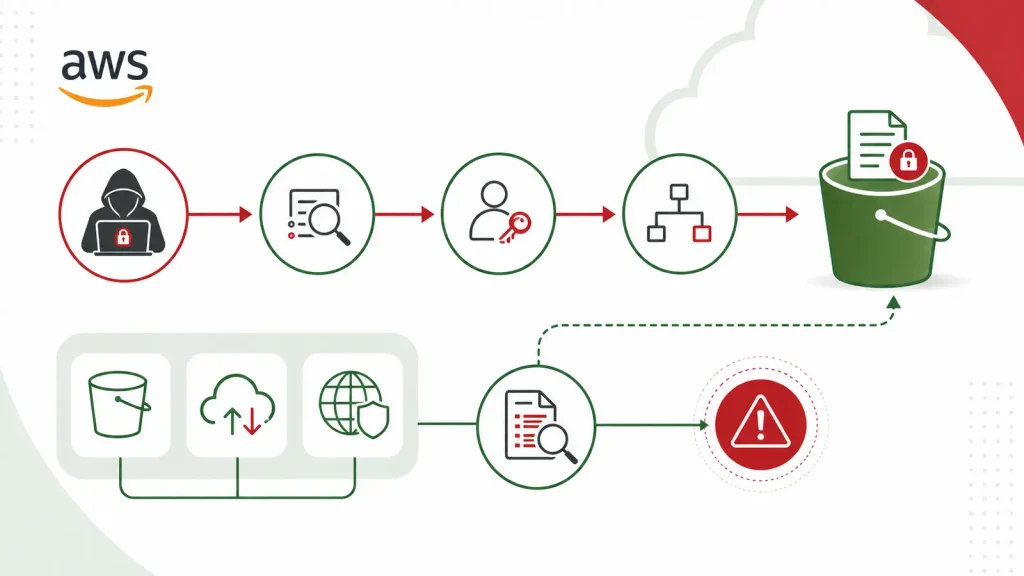
AWS Shows How Hackers Can Turn Stolen Cloud Credentials Into Full-Scale Attacks
Cloud environments offer unparalleled flexibility and scalability, but this power comes with inherent security risks. A seemingly minor incident—the compromise of a single cloud credential—can rapidly escalate into a full-blown organizational crisis. Recent insights from AWS underscore a critical reality: stolen cloud credentials are not just an entry point; they are often the launchpad for sophisticated, multi-stage attacks that target sensitive data and critical infrastructure.
The Escalation: From Stolen Key to Full-Scale Breach
The journey from a compromised credential to a widespread attack is alarmingly swift and often follows a predictable pattern. An attacker who successfully acquires a valid AWS access key, secret key, or temporary session token gains immediate, authenticated access to your cloud environment. This isn’t merely an unauthorized entry; it’s an impersonation of an approved user, allowing the attacker to navigate systems with legitimate privileges.
The initial phase often involves reconnaissance. Attackers will leverage the stolen credentials to perform a series of cloud checks, mapping out the environment. This includes identifying critical services, understanding network configurations, and locating sensitive data stores. This phase is crucial for planning subsequent moves and identifying high-value targets. Once identified, attackers can move to data exfiltration, service disruption, or even the deployment of persistent backdoors to maintain access long after the initial compromise is detected. This persistence can prolong the attack and complicate remediation efforts significantly.
Tactics of Credential Compromise
Understanding how AWS credentials are stolen is the first step in prevention. Common attack vectors include:
- Phishing and Social Engineering: Deceptive emails or websites designed to trick users into revealing their AWS credentials.
- Weak or Default Passwords: Easily guessable or unchanged default credentials provide a direct path for attackers.
- Lack of Multi-Factor Authentication (MFA): Without MFA, a stolen username and password are often enough for complete access.
- Compromised Developer Workstations: If a developer’s machine is infected with malware, attackers can steal stored credentials or intercept new ones.
- Insecure Code Repositories: Hardcoded credentials in public or poorly secured code repositories are a common, yet preventable, vulnerability.
- Supply Chain Attacks: Compromise of third-party tools or services used within the AWS ecosystem can expose credentials.
Remediation Actions and Best Practices for AWS Security
Mitigating the risk of stolen credentials and preventing subsequent attacks requires a multi-layered security approach. Organizations must prioritize proactive measures and swift incident response capabilities.
Proactive Security Measures:
- Enforce Multi-Factor Authentication (MFA): Mandate MFA for all AWS users, especially root accounts and IAM users with administrative privileges. This significantly reduces the impact of stolen passwords.
- Principle of Least Privilege: Grant only the minimum necessary permissions to users and services. Regularly review and audit IAM policies to ensure they align with this principle.
- Regular Credential Rotation: Implement automated processes for rotating access keys and passwords. AWS recommends rotating access keys regularly, even if there’s no indication of compromise.
- AWS Identity and Access Management (IAM) Best Practices:
- Avoid using root user credentials for daily tasks.
- Utilize IAM roles for applications and services instead of long-lived access keys.
- Implement strong password policies with complexity requirements and regular expiry.
- Monitor AWS CloudTrail logs for suspicious IAM activities, such as unusual API calls or failed login attempts.
- Vulnerability Management: Regularly scan your applications and infrastructure for vulnerabilities that could lead to credential exposure. (e.g., CVE-2023-XXXXX – example of how to link a CVE to its official database: CVE-2023-XXXXX)
- Security Awareness Training: Educate employees about phishing, social engineering, and the importance of secure credential handling.
- Network Segmentation and Endpoint Security: Protect developer workstations and access points with robust endpoint detection and response (EDR) solutions and network segmentation.
- AWS GuardDuty and Security Hub: Leverage AWS native security services to detect anomalous behavior, potential threats, and security configuration deviations.
Incident Response for Credential Compromise:
- Immediate Credential Revocation: If credentials are suspected of being compromised, revoke them immediately.
- Isolate Affected Resources: Temporarily isolate or restrict access to resources that may have been accessed or compromised.
- Forensic Investigation: Conduct a thorough forensic analysis using AWS CloudTrail, VPC Flow Logs, and other relevant logs to understand the scope and impact of the breach.
- Identify and Mitigate Root Cause: Determine how the credentials were stolen and implement measures to prevent recurrence.
- Communicate and Document: Inform relevant stakeholders and meticulously document the incident, its resolution, and lessons learned.
Essential Tools for Cloud Security
Effective cloud security relies on a robust set of tools for monitoring, detection, and response. Here are some essential categories and examples:
| Tool Name | Purpose | Link |
|---|---|---|
| AWS CloudTrail | Logging and auditing of AWS API calls and account activity. Critical for forensic analysis. | AWS CloudTrail |
| AWS Config | Continuous monitoring of AWS resource configurations and compliance. | AWS Config |
| AWS GuardDuty | Intelligent threat detection service that monitors for malicious activity and unauthorized behavior. | AWS GuardDuty |
| AWS Security Hub | Centralized view of security alerts and security posture across AWS accounts. | AWS Security Hub |
| AWS IAM Access Analyzer | Helps identify unintended access to your external entities to resources. | AWS IAM Access Analyzer |
| AWS Inspector | Automated security assessment service that helps improve the security and compliance of applications deployed on AWS. | AWS Inspector |
Conclusion
The insights from AWS serve as a stark reminder: the compromise of cloud credentials is a severe threat that can rapidly evolve into a comprehensive attack. Security teams must prioritize strong identity and access management, enforce multi-factor authentication, and maintain continuous vigilance through robust monitoring and logging. By adopting a proactive security posture and understanding the full lifecycle of a credential-based attack, organizations can significantly reduce their attack surface and protect their valuable cloud assets from sophisticated adversaries.