Russian Hackers Use New HOOKEDGE Malware to Spy on European Defense and Diplomatic Targets
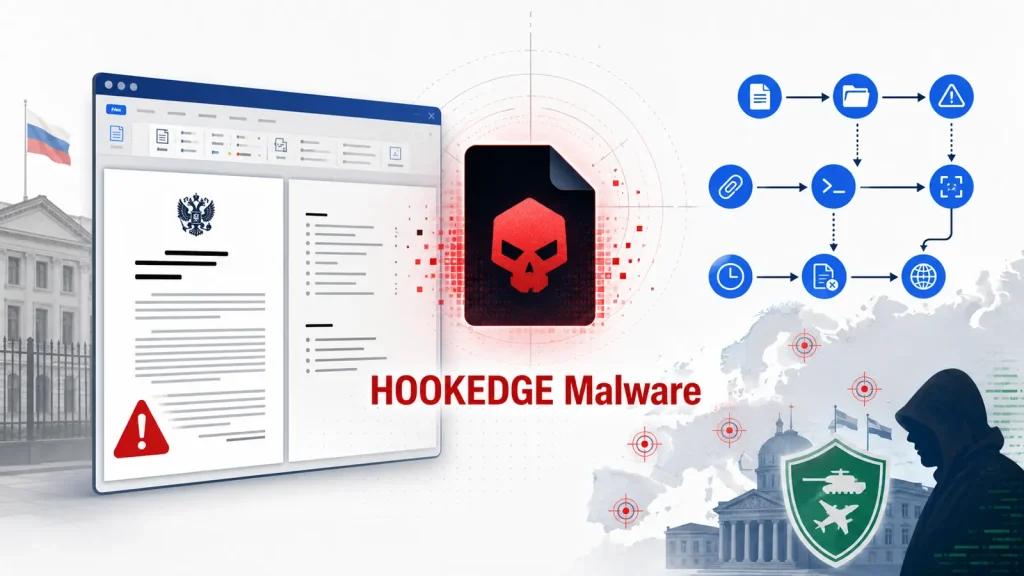
A new and concerning cyber espionage campaign has emerged, targeting critical defense and diplomatic entities across Europe. Russian state-sponsored threat actors have unleashed a sophisticated new backdoor, dubbed HOOKEDGE, to infiltrate organizations in Romania, Spain, and Türkiye. This campaign leverages a deceptively simple yet highly effective tactic: weaponizing everyday Word documents to gain initial access, transforming routine office files into dangerous entry points for intelligence gathering.
The implications of this activity are substantial, highlighting the persistent threat posed by advanced persistent threat (APT) groups and the continuous need for robust cybersecurity defenses within strategic sectors.
HOOKEDGE Malware: A New Tool in the Espionage Arsenal
The HOOKEDGE backdoor represents a fresh addition to the toolkit of Russian-backed hackers. Its primary function is to establish a covert channel for espionage, enabling threat actors to exfiltrate sensitive data and maintain persistent access to compromised networks. While the full technical specifications of HOOKEDGE are still under analysis, its deployment against high-value targets underscores its potency and the strategic intent behind its use.
This malware campaign focuses on intelligence collection from entities crucial to national security and international relations. The choice of targets—defense manufacturers, government bodies, and diplomatic organizations—is a clear indicator of the geopolitical motivations driving these cyber operations.
Deceptive Tactics: The Lure of Legitimate Documents
The initial compromise vector for the HOOKEDGE campaign is a classic yet consistently effective technique: macro-enabled Word documents. Victims receive documents crafted to appear routine or official, designed to lower their guard and encourage interaction. Upon opening these documents, users are prompted to “enable macros,” a seemingly innocuous action that, in this context, triggers the execution of malicious code. This social engineering tactic exploits human trust and institutional routines, turning a familiar office workflow into a critical vulnerability.
The use of such seemingly benign documents for initial access, often referred to as spear-phishing, remains a prevalent method for sophisticated threat actors. It bypasses many traditional perimeter defenses that focus on blocking known malicious files, as the initial attachment itself might not be flagged as overtly malicious until the macros are enabled.
Targeted Nations: Romania, Spain, and Türkiye
The geographical scope of this HOOKEDGE campaign is significant, focusing on key European nations: Romania, Spain, and Türkiye. These countries hold strategic importance within NATO and the broader European political landscape. Targeting their defense and diplomatic sectors could provide adversaries with critical intelligence regarding military capabilities, political negotiations, and strategic alliances.
- Romania: A frontline NATO state in Eastern Europe, bordering Ukraine, making its defense and diplomatic intelligence highly valuable.
- Spain: A key NATO member with significant military and economic influence in Western Europe.
- Türkiye: A pivotal NATO ally at the crossroads of Europe and Asia, with a unique geopolitical position and extensive diplomatic engagements.
The selection of these specific targets reinforces the assessment that the campaign is driven by state-sponsored objectives related to intelligence gathering and geopolitical maneuvering.
Remediation Actions and Proactive Defense
Organizations, particularly those in defense, government, and diplomatic sectors, must take immediate and decisive action to mitigate the risks posed by campaigns like the HOOKEDGE malware. Proactive measures are crucial to prevent initial compromise and to detect and respond effectively to any breaches.
- Macro Security Best Practices:
- Disable macros by default for all documents originating from external sources.
- Educate users extensively on the dangers of enabling macros, especially when prompted by unsolicited or suspicious documents.
- Implement strict group policies to control macro execution across the organization.
- Enhanced Email Security:
- Deploy advanced email security gateways that include robust anti-phishing and attachment scanning capabilities.
- Implement DMARC, DKIM, and SPF records to prevent email spoofing.
- Conduct regular phishing simulation exercises to train employees to identify and report suspicious emails.
- Endpoint Detection and Response (EDR):
- Utilize EDR solutions to monitor endpoints for suspicious activity, including the execution of unknown processes or unusual file modifications.
- Ensure EDR agents are up-to-date and configured to provide comprehensive visibility.
- Network Segmentation and Least Privilege:
- Segment networks to limit the lateral movement of threat actors if a breach occurs.
- Implement the principle of least privilege for all users and systems, minimizing the potential impact of a compromised account.
- Threat Intelligence Integration:
- Integrate threat intelligence feeds into security operations to stay informed about emerging threats, TTPs (Tactics, Techniques, and Procedures), and indicators of compromise (IOCs) related to groups using malware like HOOKEDGE.
- Regular Patches and Updates:
- Ensure all operating systems, applications, and security software are regularly patched and updated to remediate known vulnerabilities.
Conclusion
The emergence of the HOOKEDGE malware campaign against European defense and diplomatic targets serves as a stark reminder of the persistent and evolving threat landscape. Russian state-sponsored actors continue to develop new tools and refine their social engineering tactics to achieve their intelligence objectives. By understanding their methods—particularly the reliance on seemingly benign documents for initial access—organizations can strengthen their defenses. Prioritizing robust macro security, advanced email protection, vigilant user education, and comprehensive endpoint monitoring are not merely best practices; they are essential safeguards against sophisticated cyber espionage.