GitSpawn Flaws Let Malicious Repositories Execute Code in Claude Code, Codex, Cursor, and Grok
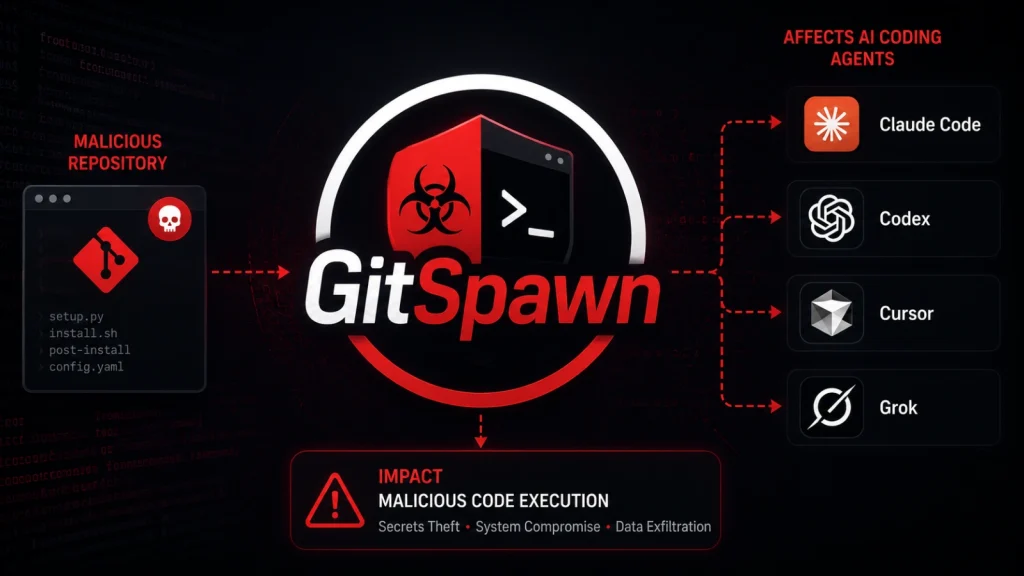
The promise of AI-powered coding assistants is immense: faster development, fewer errors, and increased productivity. Yet, a new class of vulnerabilities, aptly named GitSpawn, casts a significant shadow on this promise. Security researchers at Manifold Security have uncovered critical flaws that allow malicious Git repositories to execute code silently on a developer’s machine the instant they are opened with popular AI coding agents like Claude Code, Codex, Cursor, and Grok. This isn’t about tricked prompts or accidental clicks; it’s about code execution before authentication, sometimes even before the user fully comprehends what’s happening. The implications for developer security and supply chain integrity are profound.
Understanding the GitSpawn Vulnerability
GitSpawn vulnerabilities exploit the way AI coding agents process and interact with Git repositories. Unlike traditional code editors that might require explicit user interaction to run scripts or open specific files, these AI agents often perform automated, deep analysis of repository contents upon loading. This analysis can inadvertently trigger malicious scripts embedded within the repository structure itself.
The core danger lies in the “silent execution” aspect. A developer might clone a seemingly innocuous repository, open it with their preferred AI assistant, and without typing a single prompt or clicking any approval dialog, malicious code could be running in the background. This bypasses many standard security controls and user awareness mechanisms, making it an extremely potent attack vector. The speed and stealth of these attacks make them particularly dangerous for individual developers and organizations alike.
Impact on Leading AI Coding Agents
The Manifold Security research specifically calls out several prominent AI coding agents as susceptible to GitSpawn flaws:
- Claude Code: A powerful AI assistant for code generation and analysis.
- Codex: OpenAI’s AI model that powers tools like GitHub Copilot.
- Cursor: An AI-first code editor designed to accelerate development.
- Grok: An AI assistant from xAI, known for its real-time knowledge access.
The vulnerability’s presence across such a diverse range of widely used tools indicates a systemic issue in how these agents handle untrusted code and repository structures. It highlights a critical need for enhanced security paradigms within the AI development tool ecosystem.
The Attack Vector: Booby-Trapped Repositories
An attacker would craft a “booby-trapped” Git repository. This repository might appear legitimate, perhaps a useful library, a sample project, or even a dependency for another project. However, it contains carefully placed malicious files or configurations that the AI coding agent will automatically process and execute. This could involve:
- Pre/Post-Commit Hooks: Malicious scripts disguised as Git hooks that are automatically triggered by the AI agent’s internal Git operations.
- Configuration Files: Exploiting how AI agents interpret project configuration files to inject and execute commands.
- Specialized File Types: Leveraging unique file types or project structures that the AI agent attempts to parse or build, leading to code execution.
The key takeaway is the lack of user interaction. This is not a phishing attack or a social engineering trick that requires a click. It’s an automatic execution simply by opening the repository.
Potential Consequences of a GitSpawn Attack
The ramifications of a successful GitSpawn attack can be severe:
- Data Exfiltration: Sensitive information, API keys, and intellectual property could be stolen from the developer’s machine.
- Malware Installation: Attackers could install ransomware, keyloggers, or other malicious software.
- Supply Chain Compromise: A developer’s compromised machine could be used as a stepping stone to inject malicious code into legitimate software projects, impacting downstream users.
- Credential Theft: Access tokens, SSH keys, and cloud credentials stored on the developer’s system could be compromised.
- Remote Code Execution (RCE): Full control over the developer’s workstation, enabling further lateral movement within an organization’s network.
Remediation Actions and Best Practices
Addressing GitSpawn vulnerabilities requires a multi-faceted approach from both AI tool vendors and developers.
For AI Coding Agent Vendors:
- Enhanced Sandboxing: Implement robust sandboxing mechanisms to isolate repository processing from the host system.
- Pre-Execution Analysis: Develop and deploy sophisticated static and dynamic analysis tools to detect malicious code patterns before execution.
- Explicit User Consent: Require explicit user consent before executing any scripts or commands found within a newly opened repository, especially from untrusted sources.
- Secure Default Configurations: Ship AI agents with the most secure settings enabled by default, prioritizing security over convenience where execution of untrusted code is concerned.
- Regular Security Audits: Conduct frequent and thorough security audits of their code analysis and repository handling pipelines.
For Developers and Organizations:
- Source Vigilance: Be extremely cautious about the source of Git repositories. Only clone repositories from trusted and verified sources.
- Limit Privileges: Run AI coding agents and development environments with the principle of least privilege. Avoid running them as an administrator.
- Network Segmentation: Isolate development environments from critical production infrastructure where possible.
- Endpoint Detection and Response (EDR): Utilize EDR solutions to monitor developer machines for suspicious activity and unauthorized code execution.
- Stay Updated: Keep all AI coding agents, operating systems, and development tools updated to their latest versions to benefit from security patches.
- Code Review Best Practices: Even when using AI tools, maintain rigorous code review processes, especially for code pulled from external sources.
Detection and Mitigation Tools
| Tool Name | Purpose | Link |
|---|---|---|
| Git-Hound | Scans Git repositories for sensitive information exposure. | GitHub – Git-Hound |
| TruffleHog | Searches Git repositories for high-entropy strings, indicative of exposed secrets. | TruffleHog |
| ClamAV | Open-source antivirus engine for detecting trojans, viruses, malware, and other malicious threats. | ClamAV |
| OWASP Dependency-Check | Identifies project dependencies and checks for known, publicly disclosed vulnerabilities. | OWASP Dependency-Check |
Conclusion
The GitSpawn vulnerabilities represent a significant evolution in attack vectors targeting developers. The ability to execute malicious code silently and automatically, simply by opening a repository with an AI coding agent, bypasses traditional security assumptions and demands immediate attention. As AI tools become increasingly integrated into the software development lifecycle, understanding and mitigating these novel threats is paramount. Developers must exercise extreme caution regarding repository sources, and AI tool vendors must prioritize robust security safeguards, sandboxing, and user consent mechanisms to safeguard the integrity of the development ecosystem.