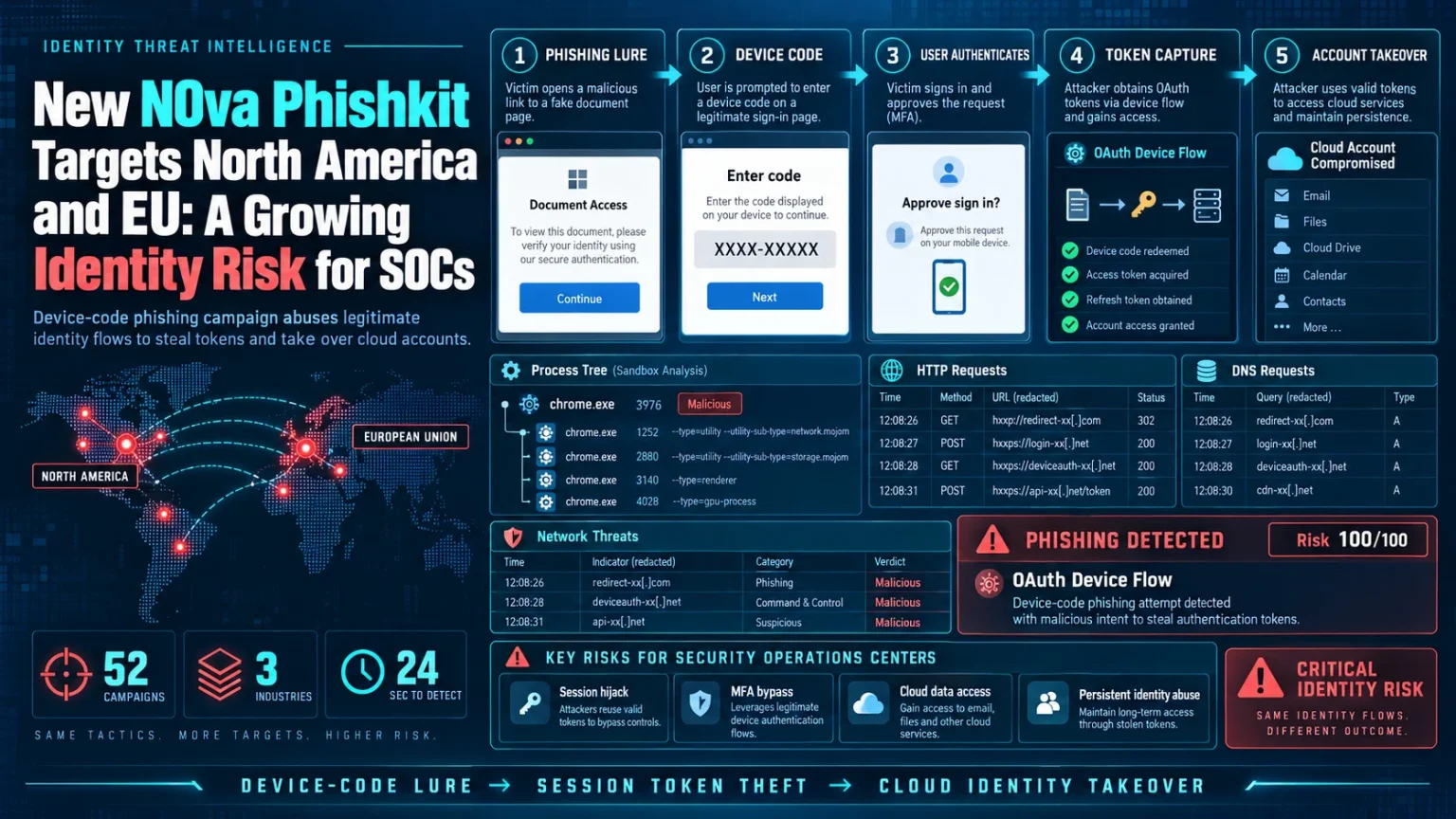
New N0va Phishkit Targets North America and EU: A Growing Identity Risk for SOCs
The N0va Phishkit: A New Identity Threat for North American and EU Organizations
Security Operations Centers (SOCs) in North America and the EU face a rapidly evolving threat landscape. A new phishkit, dubbed N0va, has emerged, posing a significant identity risk to a diverse range of sectors, including government, technology, consulting, and healthcare. Uncovered by ANY.RUN researchers, N0va’s sophisticated multi-layered attack methodology demands immediate attention and a refined defensive strategy from security professionals.
Understanding N0va’s Multi-Layered Attack Strategy
What sets N0va apart from more simplistic phishing campaigns is its intelligent approach to compromising credentials. Rather than relying on a single vector, N0va orchestrates an attack across several interdependent layers, making detection and mitigation challenging for traditional security mechanisms that often focus on isolated incidents.
- Legitimate Authentication Integration: N0va cleverly leverages perceived legitimate authentication flows, making its phishing attempts appear more convincing and less suspicious to end-users. This often involves mimicking known login portals or integrating with actual authentication processes.
- Trusted Brand Lures: The phishkit exploits the trust users place in well-known brands. By impersonating these reputable entities, N0va increases the likelihood of users divulging sensitive information without hesitation.
- Compromised Websites as Launchpads: Instead of relying solely on newly registered malicious domains, N0va utilizes already compromised legitimate websites. This tactic allows the attackers to bypass reputation-based filtering and blend in with regular web traffic.
- Cloud Infrastructure Exploitation: The use of cloud infrastructure further complicates attribution and takedown efforts. Attackers can quickly spin up and tear down resources, evading detection and maintaining persistence.
This distributed approach means that individual security tools might only capture fragments of the attack, leaving SOC teams with an incomplete picture of the overall campaign. A holistic view, integrating threat intelligence and correlating events across different security layers, is crucial for effective defense against N0va.
The Growing Identity Risk and Its Implications for SOCs
The primary objective of N0va, like many phishkits, is credential theft. However, its sophisticated delivery mechanisms amplify the identity risk. Stolen credentials are the gateway to a myriad of follow-on attacks, including:
- Account Takeovers (ATOs): Gaining control of legitimate user accounts, leading to unauthorized access to sensitive data and systems.
- Data Breaches: Exfiltrating proprietary information, personal data, and intellectual property.
- Ransomware Deployment: Using compromised accounts to spread malware or encrypt critical systems.
- Supply Chain Attacks: Leveraging access to pivot into partner organizations or suppliers.
- Business Email Compromise (BEC): Impersonating executives or trusted contacts to initiate fraudulent financial transactions.
For SOCs, this translates into increased alert fatigue, difficulty in prioritizing threats, and a heightened need for robust identity and access management (IAM) controls. The ability to quickly identify and respond to compromised credentials is paramount.
Remediation Actions for Mitigating N0va and Similar Threats
Addressing the N0va phishkit and similar sophisticated phishing campaigns requires a multi-faceted defense strategy. SOCs should focus on proactive measures and swift response capabilities.
- Enhanced Email Security Gateways (ESGs): Implement advanced ESGs with strong anti-phishing capabilities, including URL rewriting, attachment sandboxing, and AI-driven anomaly detection to identify malicious links and spoofed sender addresses.
- Multi-Factor Authentication (MFA) Everywhere: Enforce MFA across all critical systems and applications. Even if credentials are stolen, MFA acts as a strong secondary defense layer. Consider stronger forms of MFA, such as FIDO2 security keys, over SMS-based methods.
- User Awareness Training: Regularly train employees on how to identify phishing attempts, including sophisticated lures and subtle indicators of compromise. Emphasize the importance of reporting suspicious emails. Conduct simulated phishing exercises to test effectiveness.
- Endpoint Detection and Response (EDR) and Extended Detection and Response (XDR): Deploy EDR/XDR solutions to monitor endpoints for suspicious activity post-compromise, such as attempts to access unauthorized resources or install malicious software. These tools can help detect lateral movement even if initial credential theft is successful.
- Threat Intelligence Integration: Subscribe to and integrate high-fidelity threat intelligence feeds, especially those focused on emerging phishing kits and attack campaigns targeting your specific industry or region. This allows for proactive blocking of known malicious indicators.
- Continuous Vulnerability Management: Regularly scan for and patch vulnerabilities in web applications and cloud infrastructure that could be exploited to host phishing pages or facilitate attacks. While not directly a N0va vulnerability, maintaining a strong security posture reduces overall attack surface.
- Identity and Access Management (IAM) Review: Regularly audit user accounts, permissions, and access policies. Implement principle of least privilege and remove dormant accounts to minimize potential attack vectors.
- DNS Filtering and Web Content Filtering: Block access to known malicious domains and categorized phishing sites at the network perimeter.
Conclusion
The N0va phishkit represents a concerning evolution in identity-based attacks, demonstrating a sophisticated approach that leverages multiple layers of deception. For organizations operating in North America and the EU, understanding N0va’s tactics and implementing robust, layered defenses is no longer optional—it is critical. By prioritizing advanced email security, pervasive MFA, continuous user education, and integrated threat intelligence, SOCs can significantly strengthen their resilience against this growing identity risk and protect their valuable assets from compromise. Staying informed on emerging threats like N0va, detailed by researchers at ANY.RUN, is paramount for maintaining a proactive and effective cybersecurity posture. Further technical details can be found in the original report: Cyber Security News.