
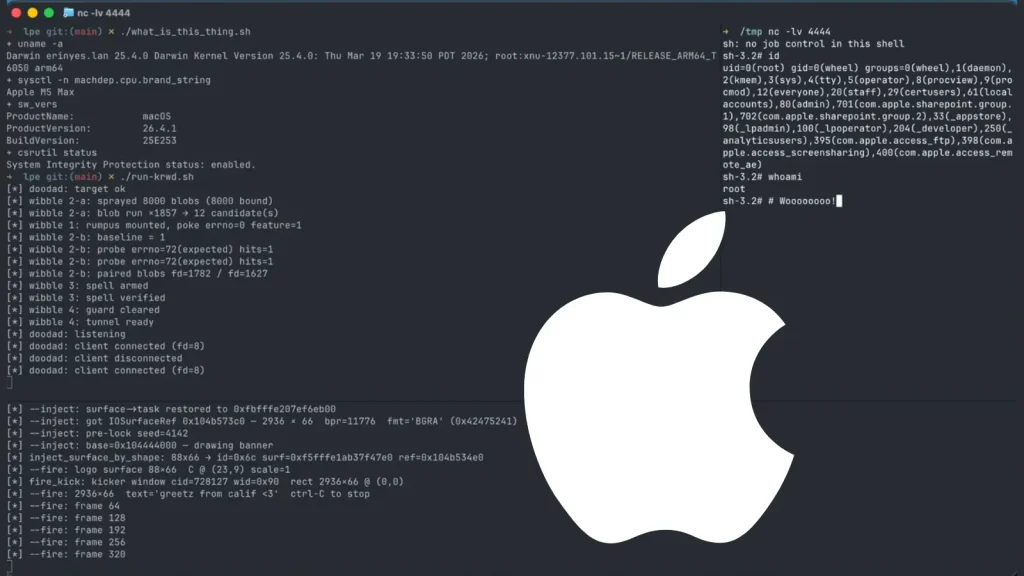
First Public macOS Kernel Exploit on Apple M5 Prepared Using Mythos Preview in Five Days
A recent development has sent ripples through the cybersecurity community, demonstrating that even the most robust security architectures can be challenged. Apple’s M-series silicon, long praised for its integrated security features, has witnessed its first public macOS kernel exploit. This isn’t just another vulnerability; it represents a successful bypass of hardware-level memory protection on the M5 chip, a significant milestone for offensive security research and a critical point of concern for IT professionals and developers alike.
The Genesis of the M5 Kernel Exploit
The security landscape for Apple’s M-series Macs recently shifted with the revelation of the first public macOS kernel memory corruption attack on an M5 chip. This groundbreaking exploit was developed by a team of researchers: Calif, Bruce Dang, Dion Blazakis, and Josh Maine. Their work culminated in a working kernel local privilege escalation (LPE) exploit, specifically targeting macOS 26.4.1 (25E253) on bare-metal M5 hardware.
What makes this particularly noteworthy is the successful circumvention of Apple’s vaunted hardware-level memory protection. Apple has invested heavily in integrating security deep into its silicon, making such a bypass a significant technical achievement for the attackers and a stark reminder of the continuous arms race in cybersecurity.
Mythos Preview: A Catalyst for Rapid Exploit Development
The speed at which this exploit was developed is equally striking. The researchers managed to prepare the exploit using “Mythos Preview” in a mere five days. While the article doesn’t elaborate on the specifics of Mythos Preview, its role as an accelerator in identifying and weaponizing this vulnerability is clear. This underscores the increasing sophistication of tools available to security researchers (and by extension, potential adversaries), enabling rapid analysis and exploitation of complex systems.
The ability to rapidly develop a kernel LPE exploit in such a short timeframe highlights the importance of proactive security measures and continuous vulnerability assessment, even on platforms previously considered highly secure.
Understanding Kernel Local Privilege Escalation (LPE)
A kernel local privilege escalation (LPE) exploit is a severe class of vulnerability. It allows an attacker who already has basic access to a system (local access) to gain elevated privileges, typically to the level of the operating system kernel. The kernel is the core of the operating system, with complete control over the hardware and all software running on the machine.
- Impact of LPE: Gaining kernel-level access grants an attacker the ability to:
- Install rootkits.
- Modify system files.
- Bypass security controls.
- Access sensitive data.
- Persist on the system even after reboots.
This type of exploit represents a significant threat because it can turn a seemingly benign infection or a low-privilege compromise into complete system control, making it a critical component of advanced persistent threats (APTs).
Hardware-Level Memory Protection on Apple M5
Apple’s M-series chips integrate advanced security features directly into the silicon. One such feature is hardware-level memory protection, designed to prevent memory corruption vulnerabilities from being exploited. This often involves memory tagging or other architectural safeguards that make it difficult for attackers to achieve reliable code execution through memory manipulation.
The successful bypass of this protection on the M5 chip indicates that the researchers found a novel method to sidestep these safeguards, exploiting a flaw that circumvented the expected behavior of the hardware-enforced memory safety mechanisms. This kind of bypass is particularly challenging to achieve and signifies a deep understanding of the underlying hardware architecture.
Remediation Actions for macOS Users and Organizations
While the full details of the specific vulnerability (e.g., a CVE number) are not yet publicly linked in the provided source, the general implications of such an exploit demand proactive measures.
- Stay Updated: Always ensure your macOS systems are running the latest version. Apple regularly releases security updates to patch discovered vulnerabilities. Given the target macOS version (26.4.1), ensure you are on a more recent, patched version.
- Principle of Least Privilege: Enforce the principle of least privilege for all users and applications. Restrict user accounts to the minimum necessary permissions to perform their tasks.
- Security Software: Utilize reputable endpoint detection and response (EDR) or antivirus solutions that offer behavioral analysis capabilities, as these may help detect anomalous activity even without a specific signature for this exploit.
- Regular Audits: Conduct regular security audits and penetration testing to identify and remediate potential weaknesses in your environment.
- Developer Awareness: For developers, practice secure coding principles, particularly when dealing with memory management and system-level interactions, to prevent similar classes of vulnerabilities in your own applications.
Tools for macOS Security Assessment
While this particular exploit was a deep-dive security research effort, several tools can assist in maintaining and assessing the security posture of macOS systems against various threats.
| Tool Name | Purpose | Link |
|---|---|---|
| Objective-See Tools (e.g., LuLu, BlockBlock) | Firewall, malware detection, process monitoring | https://objective-see.com/products.html |
| Nessus | Vulnerability scanning and compliance auditing | https://www.tenable.com/products/nessus |
| OWASP ZAP | Web application security scanner (relevant for web services on macOS) | https://www.zaproxy.org/ |
| Lynis | Security auditing and hardening for Unix-like systems | https://cisofy.com/lynis/ |
Conclusion
The first public macOS kernel exploit on an Apple M5 chip, exploiting hardware-level memory protection, marks a pivotal moment in the ongoing challenge of securing computing environments. The rapid development of this LPE exploit, facilitated by tools like Mythos Preview, underscores the sophistication of modern offensive security research. It serves as a potent reminder that no system, regardless of its reputation for security, is entirely impenetrable. Organizations and individual users must remain vigilant, prioritize timely updates, and adopt a multi-layered security strategy to mitigate such advanced threats.




