
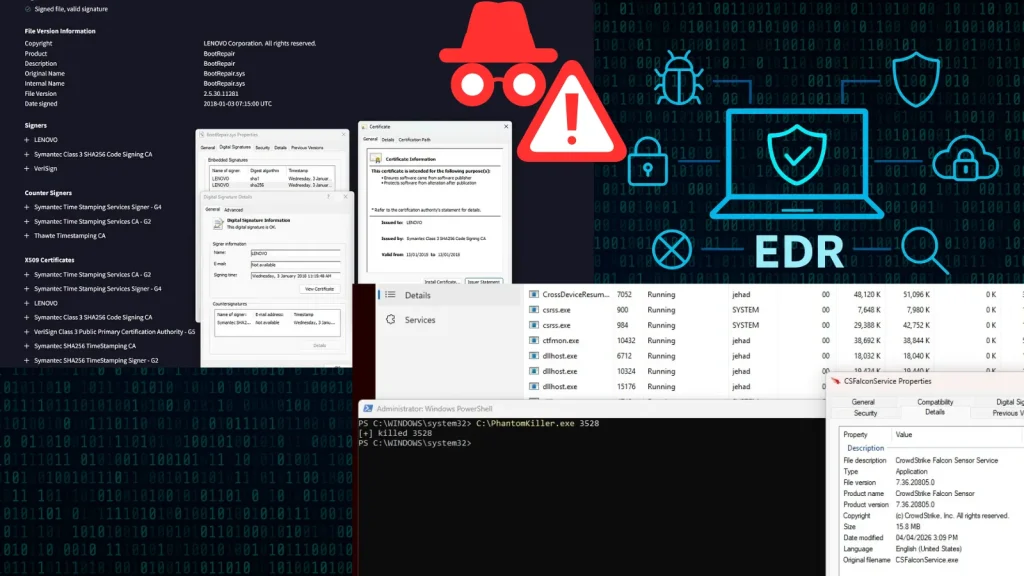
Hackers Can Weaponize Lenovo Driver to Terminate EDR Processes
A disturbing discovery has emerged from the cybersecurity landscape: threat actors can now weaponize a legitimately signed Lenovo driver to terminate critical Endpoint Detection and Response (EDR) processes. This revelation underscores a significant vulnerability in enterprise security, highlighting the persistent danger of Bring Your Own Vulnerable Driver (BYOVD) attacks. For IT professionals, security analysts, and developers, understanding this vector is paramount to fortifying defenses against sophisticated adversaries.
The BYOVD Threat: Weaponizing Lenovo’s BootRepair.sys
Security researcher Jehad Abudagga meticulously analyzed a Lenovo driver, specifically BootRepair.sys, which is an integral component of the Lenovo PC Manager utility. Abudagga’s research unveiled a critical flaw: this driver, despite being legitimately signed by Lenovo, can be abused to systematically terminate security processes. The implications are profound, as a signed driver inherently bypasses many operating system security checks designed to prevent the execution of malicious code.
The core of the issue lies in the trust placed on legitimately signed drivers. Once an attacker gains initial access, they can load a vulnerable, yet trusted, driver. This grants them elevated privileges, allowing them to manipulate or disable security software that would otherwise detect and prevent their activities. In this specific case, the BootRepair.sys driver provides a pathway for attackers to kill EDR processes, effectively blinding security teams and allowing for unhindered malicious operations.
How Attackers Exploit Signed Drivers to Bypass EDR
The BYOVD attack vector is particularly insidious because it leverages a trusted entity – a vendor-signed driver – against the very systems it’s meant to protect. Here’s a breakdown of the typical attack chain:
- Initial Access: Attackers first gain a foothold on a target system through various means, such as spear-phishing, exploiting known vulnerabilities in other software, or social engineering.
- Privilege Escalation (Optional but Common): While not always strictly necessary for BYOVD if the attacker can already load kernel-mode drivers, often attackers seek to escalate privileges to ensure they can install and load the vulnerable driver.
- Loading the Vulnerable Driver: The attacker then loads the compromised or vulnerable legitimate driver, in this case, the Lenovo BootRepair.sys. Because it’s signed, the operating system trusts it.
- Exploiting Driver Functionality: With the loaded driver, the attacker interfaces with its legitimate, but abusable, functionalities. In this scenario, the driver provides a mechanism (likely an exposed IOCTL or similar interface) that allows for process termination, including those belonging to EDR solutions.
- EDR Disablement: The EDR agent, now deprived of its monitoring and enforcement capabilities, becomes ineffective. This creates a window of opportunity for further malicious activities, such as data exfiltration, lateral movement, or ransomware deployment, without triggering alerts.
Remediation Actions and Mitigations
Addressing the BYOVD threat, especially when legitimate drivers are involved, requires a multi-layered approach. Organizations must prioritize proactive measures and maintain vigilance.
- Kernel Driver Blocking: Implement Windows Defender Application Control (WDAC) policies or similar host-based intrusion prevention systems to block known vulnerable drivers, even if they are legitimately signed. Microsoft maintains a recommended driver blocklist that organizations should leverage and regularly update. Ensure the specific offending driver (BootRepair.sys) and any future identified vulnerable drivers are added to your blocklist.
- Endpoint Detection and Response (EDR) Enhancements: While attackers aim to terminate EDR, modern EDR solutions are continuously evolving to detect such attempts. Ensure your EDR is configured for maximum protection, including behavioral analysis to detect anomalous process termination, even if the terminating process is unexpected.
- Regular Patch Management: Keep all software, including device drivers, operating systems, and security solutions, up to date. While this vulnerability is in a signed driver, vendors often release updated versions or guidance to mitigate known exploits.
- Principle of Least Privilege: Enforce the principle of least privilege for all users and applications. Restrict the ability to load kernel-mode drivers to only authorized administrators or system processes.
- Monitoring for Unusual Driver Activity: Implement robust logging and monitoring for driver installations and loading events. Look for drivers being loaded from unusual locations or by low-privilege processes. Integrity monitoring of system kernel modules can also be beneficial.
- Security Awareness Training: Educate users about the dangers of downloading and installing unverified software or drivers, as initial access often precedes BYOVD attacks.
Tools for Detection and Mitigation
Effectively combating BYOVD attacks requires the right tools and strategies. Here are some categories of tools that can assist:
| Tool Category | Purpose | Examples/Key Features |
|---|---|---|
| Application Control/WHQL/DSD Enforcers | Control which drivers and applications can run on endpoints. Prevent the loading of known vulnerable drivers. | Windows Defender Application Control (WDAC): Native OS control for driver blocking and application whitelisting. Third-Party Application Whitelisting Solutions: Offer granular control over executable permissions. |
| Endpoint Detection and Response (EDR) | Detect and respond to malicious activities, including attempts to disable security software or load unauthorized drivers. | Leading EDR Solutions (CrowdStrike Falcon, SentinelOne, Microsoft Defender for Endpoint): Offer behavioral analysis, threat intelligence, and remediation capabilities. |
| Vulnerability Management Platforms | Identify out-of-date drivers and software that might contain known vulnerabilities. | Tenable.io, Qualys, Rapid7 InsightVM: Scan for vulnerabilities and help prioritize patching efforts. |
| System Monitoring & SIEM | Collect and analyze logs for suspicious driver loading, process termination, or privilege escalation attempts. | Splunk, Elastic SIEM, Microsoft Azure Sentinel: Centralized log management and security event correlation. |
Conclusion: Strengthening Defenses Against Evolving Threats
The ability of hackers to weaponize a legitimately signed Lenovo driver to terminate EDR processes is a stark reminder of the sophisticated and evolving nature of cyber threats. BYOVD attacks exploit the very trust mechanisms designed to secure our systems, turning trusted components into vectors for compromise. By understanding this threat, implementing robust remediation actions, and leveraging appropriate security tools, organizations can significantly enhance their resilience against such advanced techniques. Constant vigilance, continuous patching, and a proactive security posture are no longer optional but essential for safeguarding digital assets in today’s threat landscape.




