
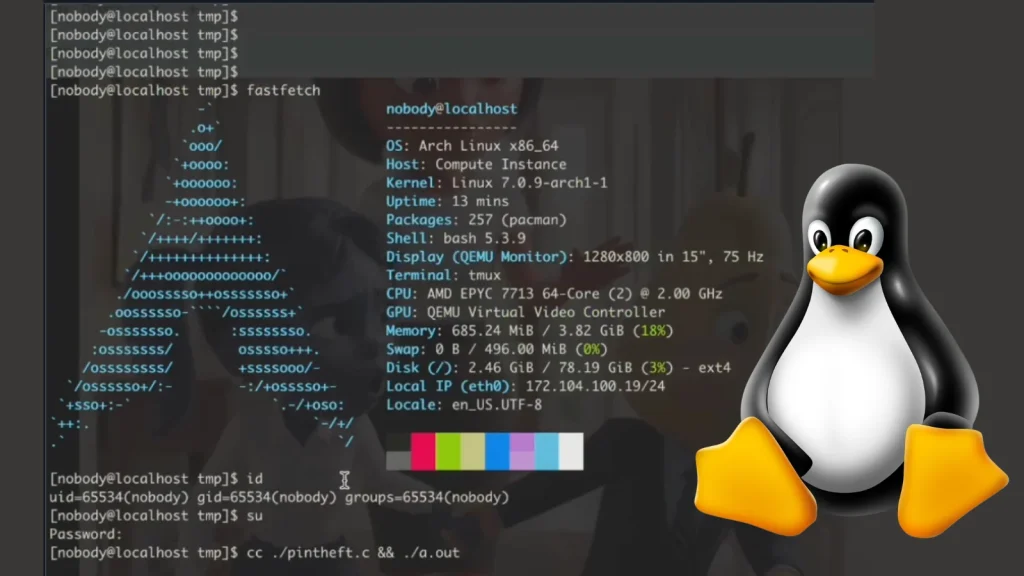
PinTheft Linux Vulnerability Let Attackers Gain Root Access – PoC Released
PinTheft Linux Vulnerability: When Local Access Becomes Root Access
In the evolving landscape of cybersecurity, local privilege escalation (LPE) vulnerabilities remain a critical concern for system administrators and security professionals. A new LPE flaw, dubbed “PinTheft,” has recently been brought to light, demonstrating how readily local attackers can gain unfettered root access on vulnerable Linux systems. This discovery, coupled with the release of a proof-of-concept (PoC) exploit, underscores the urgency of understanding and patching this significant security risk.
Understanding the PinTheft Vulnerability
Discovered by Aaron Esau of the V12 security team, the PinTheft vulnerability leverages a specific flaw within the Linux kernel: an RDS zerocopy double-free bug. The Remote Direct Memory Access (RDMA) functionality in Linux, specifically the Reliable Datagram Sockets (RDS) protocol, allows for high-performance network communication by bypassing the CPU for direct memory access between devices. The “zerocopy” mechanism within RDS is designed to optimize this process by eliminating unnecessary data copies.
However, the existence of a “double-free” bug in this context is highly problematic. A double-free vulnerability occurs when a program attempts to free the same block of memory twice. This can lead to memory corruption, which an attacker can then manipulate to execute arbitrary code, ultimately leading to privilege escalation. In the case of PinTheft, a local attacker can exploit this memory corruption within the RDS zerocopy mechanism to elevate their privileges to root, gaining complete control over the compromised system.
Proof-of-Concept Release and Its Implications
The release of a functional Proof-of-Concept (PoC) exploit significantly escalates the threat posed by PinTheft. While the technical details suggest a complex exploitation chain, the availability of a PoC lowers the barrier for potential attackers. This means that even less sophisticated threat actors can leverage pre-built tools to exploit this vulnerability, making it a more immediate and widespread danger.
The researchers, having seen a kernel patch become available, opted to release their PoC, a common practice in the security community. This action serves a dual purpose: it informs the wider Linux community about the severity of the flaw and encourages rapid patching, while also allowing security teams to test their systems against known exploits.
Recognizing the Risk: Are You Affected?
Given the nature of LPE vulnerabilities, any Linux system that has local user access could be at risk if it incorporates the vulnerable kernel versions. While specific kernel versions are often detailed in the official CVE record, it’s crucial for system administrators to be proactive. The vulnerability is tied to the RDS zerocopy implementation, so systems utilizing or capable of utilizing this functionality should be scrutinized.
The official CVE for this vulnerability is CVE-2023-32233. System administrators should consult this CVE record for the most accurate and up-to-date information regarding affected kernel versions and detailed technical explanations.
Remediation Actions: Protecting Your Linux Systems
Addressing the PinTheft vulnerability requires immediate attention. The following actions are critical for mitigating risk:
- Apply Kernel Patches Immediately: The most crucial step is to apply the available kernel patches. Linux distribution maintainers have likely released updates addressing CVE-2023-32233. Regularly updating your kernel is paramount.
- Reduce Local Attack Surface: Minimize the number of users with local access to your Linux systems. Implement strong access control policies and enforce the principle of least privilege.
- Monitor System Logs: Implement robust logging and monitoring for suspicious activity, especially related to privilege escalation attempts or abnormal memory usage.
- Implement Intrusion Detection/Prevention Systems (IDPS): Deploying IDPS solutions can help detect and potentially prevent exploitation attempts by identifying known attack patterns or anomalous behavior.
- Regular Security Audits: Conduct periodic security audits and vulnerability assessments to identify and address potential weaknesses before they can be exploited.
Tools for Detection and Mitigation
While direct detection of the PinTheft vulnerability prior to a patch often requires specialized kernel analysis, general security practices and tools remain invaluable.
| Tool Name | Purpose | Link |
|---|---|---|
| Kernel Upgrade Tools (e.g., apt, yum, dnf) | Updating the Linux kernel to patched versions. | Refer to your distribution’s documentation. |
| Vulnerability Scanners (e.g., OpenVAS, Nessus) | Identifying unpatched systems and other vulnerabilities. | OpenVAS / Nessus |
| Intrusion Detection Systems (e.g., Snort, Suricata) | Monitoring network traffic for exploitation attempts. | Snort / Suricata |
| Security Information and Event Management (SIEM) | Centralized logging and anomaly detection. | (Various commercial and open-source options) |
Key Takeaways for Linux System Security
The PinTheft Linux vulnerability, rooted in an RDS zerocopy double-free bug (CVE-2023-32233), serves as a potent reminder of the persistent threat posed by local privilege escalation. The rapid release of a PoC exploit after the availability of a kernel patch underscores the urgency of proactive security measures. System administrators must prioritize immediate kernel updates to mitigate this vulnerability. Furthermore, a layered security approach encompassing robust access controls, diligent monitoring, and regular security audits remains essential for maintaining the integrity and security of Linux environments against both known and emerging threats.




