
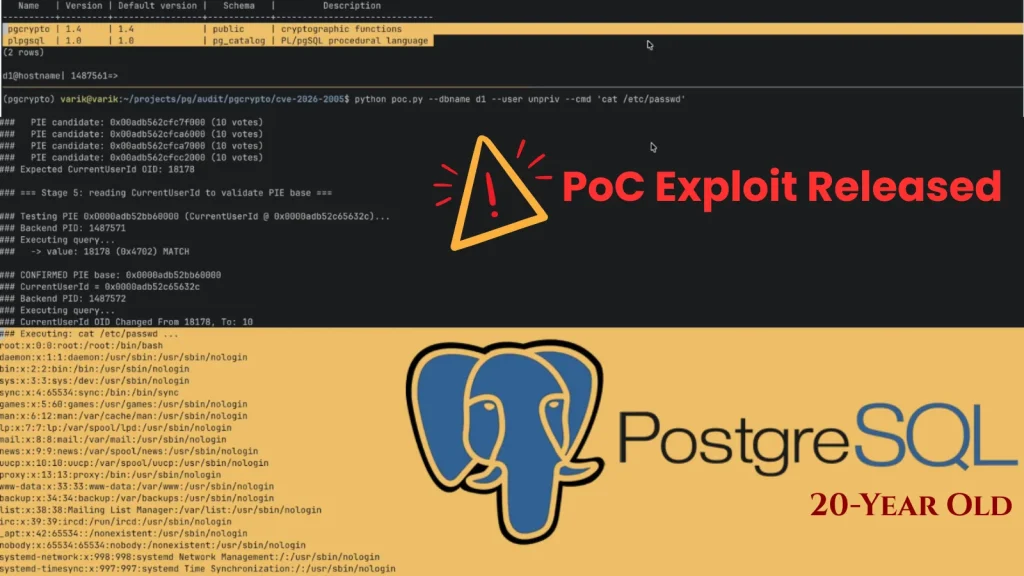
PoC Exploit Released for 20-Year Old PostgreSQL RCE Vulnerability
The Ghost in the Machine: 20-Year Old PostgreSQL RCE Vulnerability Awakens with Public Exploit
Databases are the lifeblood of modern applications, and PostgreSQL stands as a cornerstone for countless organizations. Yet, even the most robust systems harbor hidden dangers. A recent development has sent ripples through the cybersecurity community: the public release of a proof-of-concept (PoC) exploit for a two-decade-old CVE-2026-2005, a critical Remote Code Execution (RCE) vulnerability affecting PostgreSQL’s pgcrypto extension. This isn’t just another vulnerability; it’s a stark reminder that even ancient code can pose contemporary threats, especially when it concerns fundamental memory handling within widely deployed database systems.
Unpacking CVE-2026-2005: A Deep Dive into the pgcrypto RCE
The core of CVE-2026-2005 lies within PostgreSQL’s popular pgcrypto extension, specifically in its handling of PGP session key parsing. This particular flaw stems from legacy code, nearly 20 years old, hinting at the pervasive challenge of maintaining security across vast and evolving codebases. Memory handling issues have long been a notorious source of vulnerabilities, often leading to buffer overflows, use-after-free errors, and, in severe cases like this, RCE. An RCE vulnerability allows an attacker to execute arbitrary code on the affected server, granting them nearly complete control. For a database system like PostgreSQL, this could lead to data exfiltration, modification, deletion, or even the deployment of further malicious payloads, compromising the integrity and confidentiality of critical information.
The Ramifications of a Public PoC
The public release of a PoC exploit drastically escalates the threat posed by CVE-2026-2005. Before a public exploit, exploiting such a vulnerability might require significant expertise and effort. However, with a PoC readily available, the barrier to entry for malicious actors is significantly lowered. Script kiddies and less-skilled attackers can now leverage pre-built tools to exploit vulnerable PostgreSQL instances. This situation necessitates immediate attention from database administrators and security teams. The widespread use of PostgreSQL, coupled with the age of the vulnerable code, suggests that a significant number of installations globally could be at risk if not properly patched or mitigated.
Remediation Actions: Securing Your PostgreSQL Instances
Addressing CVE-2026-2005 requires immediate and proactive measures. Here’s actionable advice for protecting your PostgreSQL deployments:
- Patch Immediately: The most crucial step is to update your PostgreSQL instances to the latest stable versions. Vendors typically release patches promptly for critical RCE vulnerabilities. Consult the official PostgreSQL documentation and your distribution’s update channels for the relevant security patches.
- Review
pgcryptoUsage: If your applications utilize thepgcryptoextension, particularly for PGP-related operations, conduct a thorough review to understand its exposure. While patching is paramount, understanding your attack surface is always beneficial. - Principle of Least Privilege: Ensure that your PostgreSQL users and applications operate with the absolute minimum necessary privileges. This limits the potential damage an attacker can inflict even if they manage to compromise the database.
- Network Segmentation and Firewalls: Isolate your database servers within your network. Implement robust firewall rules to restrict access to PostgreSQL ports (default is 5432) only from trusted hosts and necessary application servers.
- Regular Security Audits and Penetration Testing: Conduct regular security audits and penetration tests on your infrastructure, including your PostgreSQL databases, to identify and remediate vulnerabilities before they can be exploited.
Tools for Detection and Mitigation
Leveraging the right tools can significantly enhance your ability to detect and mitigate such vulnerabilities:
| Tool Name | Purpose | Link |
|---|---|---|
| Nessus | Vulnerability scanning for identifying unpatched systems and misconfigurations. | https://www.tenable.com/products/nessus |
| OpenVAS | Open-source vulnerability scanner, effective for network and application-level checks. | https://www.openvas.org/ |
| Greenbone Security Manager | Enterprise-grade vulnerability management solution built on OpenVAS. | https://www.greenbone.net/en/community-edition/ |
| Trivy | Container and Kubernetes vulnerability scanner, useful if PostgreSQL runs in containers. | https://aquasec.com/cloud-native-security-resources/trivy/ |
| PostgreSQL Logs | Monitoring database logs for unusual activity or failed connection attempts. | https://www.postgresql.org/docs/current/runtime-config-logging.html |
Lessons Learned: The Enduring Challenge of Legacy Code and Memory Safety
The emergence of a public exploit for CVE-2026-2005 serves as a potent reminder of several enduring cybersecurity principles. First, legacy code, even seemingly benign components, can harbor critical vulnerabilities for decades. Second, memory handling bugs remain a top concern, consistently leading to severe security flaws. Finally, the availability of a public PoC fundamentally changes the risk landscape, demanding an accelerated response from defenders. Prioritize patching, enforce strong security hygiene, and continuously monitor your systems to protect against these persistent threats.




