
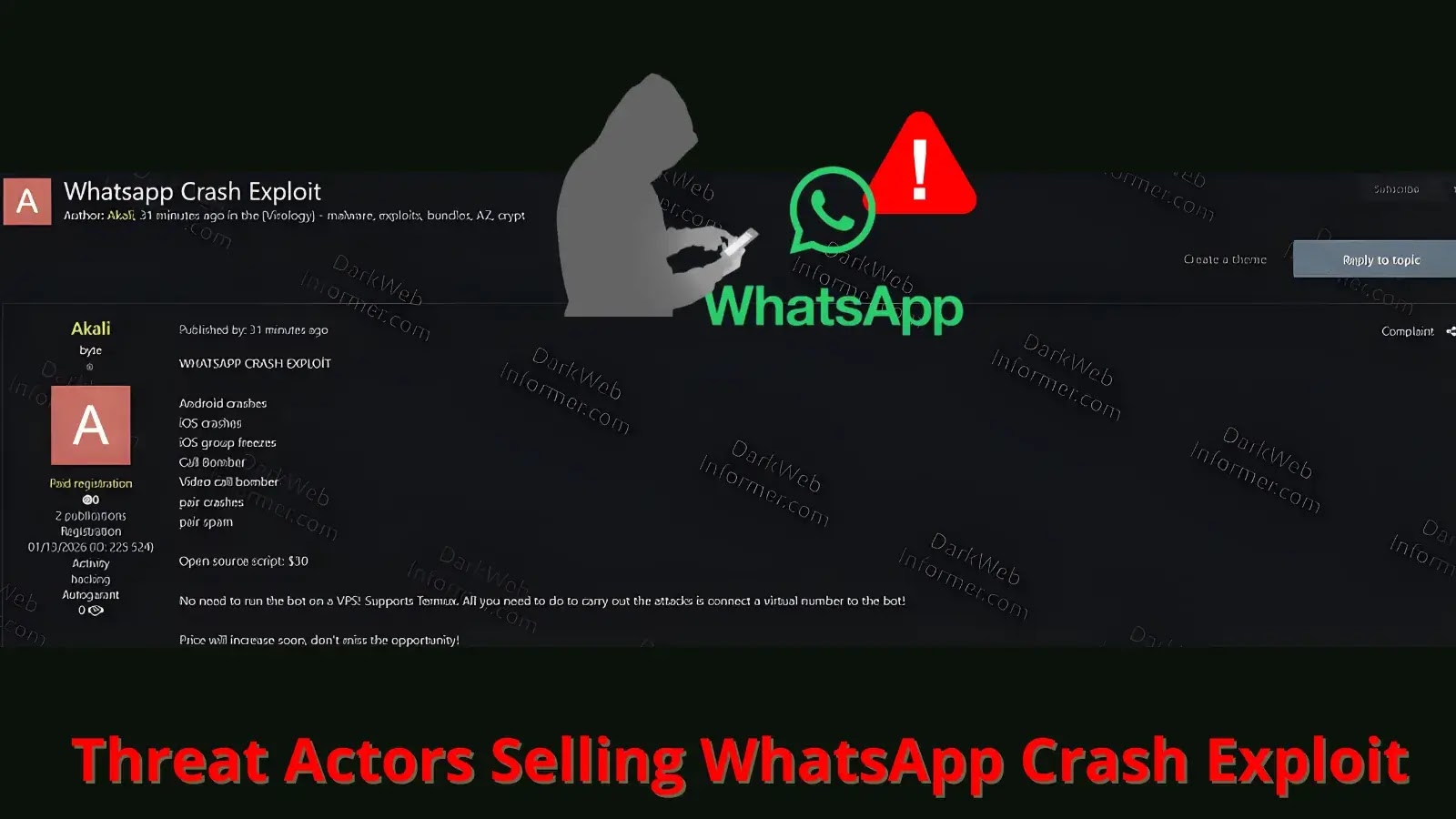
Threat Actors Allegedly Selling WhatsApp Crash Exploit on Hacking Forums
A disturbing development has emerged from the clandestine corners of underground hacking forums: threat actors are allegedly peddling a potent exploit capable of crashing WhatsApp across multiple operating systems. This isn’t merely a nuisance; it represents a significant risk to user experience, data integrity, and the overall reliability of a platform relied upon by billions worldwide. Our analysis delves into this emerging threat and outlines critical remediation strategies.
The WhatsApp Crash Exploit: Anatomy of a Digital Disruptor
Threat intelligence platforms have identified a concerning trend: the active solicitation of a script designed specifically to induce a denial-of-service (DoS) condition on WhatsApp. This malicious code, reportedly available for purchase on hacking forums, targets vulnerabilities that, when exploited, force the application to cease function. While the exact technical specifics of the exploit remain under wraps, its advertised capability to affect users across diverse operating systems—including Android, iOS, and potentially desktop clients—underscores a broad attack surface.
The motivation behind such an exploit sale can vary. It could be for:
- Financial Extortion: Threat actors might use this to coerce individuals or even businesses.
- Harassment and Sabotage: Disrupting communications for targeted individuals or groups.
- Proof of Concept: Demonstrating capabilities to potential clients for other, more sophisticated attacks.
The alleged availability of this WhatsApp crash exploit on hacking forums signifies a concerning shift from theoretical vulnerabilities to readily deployable attack tools. Such exploits lower the barrier to entry for malicious activity, allowing less technically skilled individuals to inflict disruption.
Understanding the Impact: Beyond a Simple Crash
While a “crash” might seem like a minor inconvenience, the implications of a widely available WhatsApp vulnerability allowing for remote application termination are far-reaching:
- Communication Disruption: For individuals, this means interrupted conversations, lost productivity, and in critical scenarios, inability to communicate during emergencies.
- Business Interruption: Many businesses rely on WhatsApp for internal and external communications. A widespread exploit could cripple operational workflows.
- Data Loss/Corruption (Potential): While primarily a DoS, certain crash scenarios can lead to temporary data inaccessibility or, in rare cases, data corruption if not handled gracefully by the application.
- Trust Erosion: Repeated crashes or performance issues undermine user confidence in the platform’s security and reliability.
The exact CVE associated with this specific exploit has not yet been publicly disclosed or confirmed by official channels. However, the nature of these attacks often aligns with categories like CWE-399 (Resource Management Errors) or CWE-400 (Uncontrolled Resource Consumption), which can lead to DoS conditions.
Remediation Actions: Fortifying Your WhatsApp Security
As cybersecurity professionals, our role is to anticipate and mitigate threats. While the official patch from Meta (WhatsApp’s parent company) is the ultimate solution, proactive steps can significantly reduce risk:
- Keep WhatsApp Updated: Always ensure your WhatsApp application is running the latest version. Developers frequently release patches for newly discovered vulnerabilities. Enable automatic updates if possible.
- Operating System Updates: Maintain current security patches for your device’s operating system (Android, iOS). Exploits often chain vulnerabilities, where an app-specific flaw is leveraged alongside an OS weakness.
- Be Wary of Unknown Contacts: Exercise caution when receiving messages or calls from unknown numbers. Malicious scripts might be delivered through specially crafted messages. Avoid opening suspicious links or files.
- Regular Backups: Ensure your WhatsApp chats are regularly backed up to cloud services (Google Drive, iCloud). This safeguards your data against potential loss, even if an application crash becomes severe.
- Monitor Threat Intelligence: Stay informed through reputable cybersecurity news sources (like Cybersecurity News) and threat intelligence platforms for official announcements from WhatsApp or Meta regarding this or similar vulnerabilities.
Detection and Mitigation Tools
While direct detection of this specific “crash exploit” client-side might be challenging without precise signatures, general security hygiene and threat intelligence tools are crucial.
| Tool Name | Purpose | Link |
|---|---|---|
| Mobile Device Management (MDM) Solutions | Enforce security policies, manage app updates, and monitor device health for corporate users. | Search MDM Solutions |
| Endpoint Detection & Response (EDR) | Monitor and detect suspicious activity on endpoints, including application anomalies and potential exploit execution. | Search EDR Solutions |
| Threat Intelligence Platforms | Provide real-time intelligence on emerging threats, including exploit sales and vulnerability disclosures. | Search Threat Intelligence Platforms |
| Regular OS & App Update Policies | Proactive update management is the primary defense against known vulnerabilities. | N/A (Organizational Policy) |
Conclusion: Vigilance is Key in the Face of Evolving Threats
The alleged sale of a WhatsApp crash exploit on hacking forums serves as a stark reminder of the persistent and evolving landscape of cyber threats. Malicious actors are continuously probing popular applications for weaknesses, turning vulnerabilities into lucrative opportunities. For users and security professionals alike, adherence to best practices—keeping software updated, practicing caution with unknown communications, and staying informed—is paramount. As this situation develops, official advisories from Meta will be critical in understanding the full scope of the threat and implementing definitive countermeasures. Until then, proactive security measures remain our strongest defense against application disruptions and other malicious activities.




