
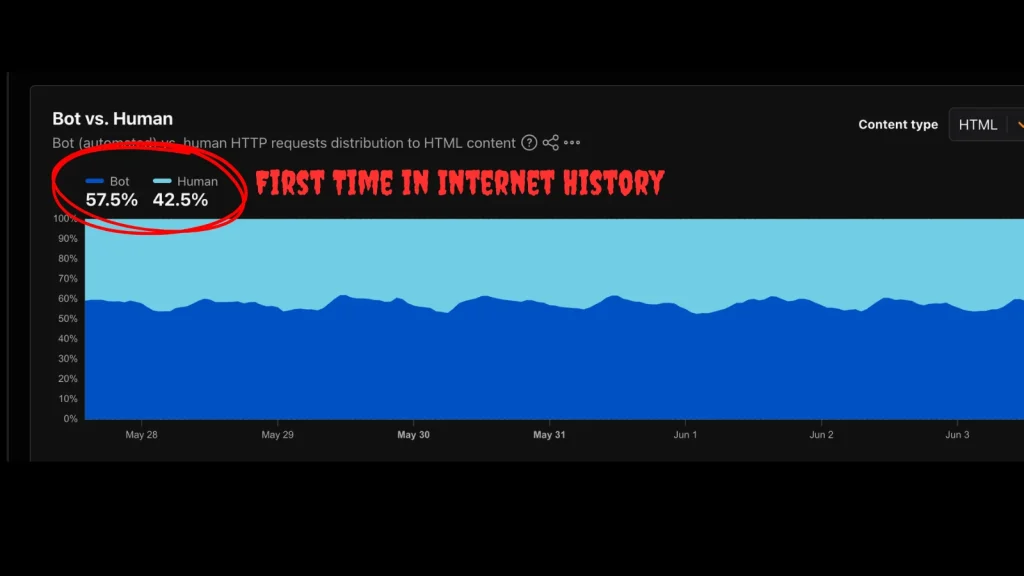
Bots Surpass Humans in Global Web Traffic for the First Time in Internet History
The internet, once primarily a stage for human interaction, has reached a critical inflection point. For the first time in its history, automated bots now generate more global web traffic than human users. This isn’t just a marginal shift; it’s a significant and accelerating trend that demands immediate attention from cybersecurity professionals, IT leaders, and anyone managing online infrastructure. The implications are profound, ranging from skewed analytics and operational inefficiencies to sophisticated cyber threats.
The Bot Takeover: A New Digital Reality
Recent data from Cloudflare Radar, as reported by Cybersecurity News, reveals a stark reality: bots now account for an astounding 57.5% of all HTTP requests to HTML pages globally. This surpasses human-generated traffic, indicating a fundamental change in the composition of internet activity. This isn’t a gradual creep; industry leaders acknowledge this acceleration is happening faster than previously anticipated, setting a new baseline for how we understand and secure the digital landscape.
Understanding the Diverse World of Bots
Not all bots are inherently malicious, but the sheer volume magnifies the potential for harm. To effectively navigate this bot-dominated internet, it’s crucial to differentiate between their various types and purposes:
- Good Bots: These include search engine crawlers (like Googlebot), legitimate API bots, monitoring services, and site scrapers used for good-faith data collection. They are essential for indexing content, ensuring website functionality, and providing valuable insights.
- Bad Bots: The rise in overall bot traffic inevitably means an increase in malicious automated activity. This category encompasses a wide array of threats, including spambots, credential stuffing bots, DDoS attack bots, content scrapers for illicit purposes, and sophisticated bots designed for phishing or fraud.
Implications Across the Digital Spectrum
The dominance of bot traffic has far-reaching consequences:
- Data Distortion: Website analytics become less reliable when more than half of the traffic isn’t human. This skews marketing metrics, user behavior analysis, and resource planning.
- Operational Overhead: Servers and network infrastructure must contend with a significantly higher load, much of which may be non-productive or even harmful. This can lead to increased operational costs and degraded service for legitimate users.
- Enhanced Cyber Threats: The scale of bot traffic provides a vast canvas for attackers. Automated attacks, such as CVE-2023-38890 (impacting Fortinet products with potential DDoS implications) or CVE-2023-34362 (critical MOVEit Transfer vulnerability often exploited by automated scripts), become more challenging to detect and mitigate when obscured by a sea of other bot activity.
- Fraud and Abuse: Bots facilitate account takeovers, fraudulent purchases, inventory hoarding, and spam campaigns at unprecedented scales.
Remediation Actions and Strategic Defense
Given this new reality, organizations must re-evaluate their bot management strategies. A reactive approach is no longer sufficient; proactive and intelligent bot defense is paramount.
- Implement Advanced Bot Management Solutions: Invest in specialized bot management platforms that leverage AI and machine learning to differentiate between legitimate and malicious bot traffic. These solutions often go beyond simple CAPTCHAs, analyzing behavioral patterns and reputation scores.
- Rate Limiting and Throttling: Apply strategic rate limits to API endpoints and critical website sections to prevent abuse without impacting legitimate users.
- Behavioral Analytics: Monitor user behavior for anomalous patterns indicative of bot activity, such as unusually fast navigation, repeated requests from the same IP, or rapid form submissions.
- Regular Security Audits: Conduct frequent security audits and penetration testing to identify potential vulnerabilities that bots could exploit.
- Web Application Firewalls (WAFs): A robust WAF acts as a crucial first line of defense, filtering out common bot attack vectors and protecting against known web application vulnerabilities like SQL injection or cross-site scripting.
- IP Reputation Services: Utilize services that track and block traffic from known malicious IP addresses and botnet origins.
- Educate and Train: Ensure development and operations teams understand the evolving bot landscape and best practices for building bot-resilient applications.
The Path Forward: Adapting to a Bot-Centric Internet
The internet’s shift to bot dominance is not merely a statistical anomaly; it is a fundamental redefinition of the digital environment. Organizations operating online can no longer afford to treat bot traffic as a secondary concern. Adapting to this new bot-centric internet requires a comprehensive cybersecurity strategy that integrates advanced bot management, continuous monitoring, and a proactive posture against automated threats. Understanding this shift is the first step toward securing our digital future.




