
Hackers Abuse GitHub Actions to Backdoor AsyncAPI npm Packages With Miasma RAT
The digital supply chain, a cornerstone of modern software development, has once again been exploited, exposing the vulnerabilities inherent in interconnected systems. A recent and alarming incident saw threat actors compromise trusted AsyncAPI npm packages, injecting the insidious Miasma Remote Access Trojan (RAT) into developer ecosystems. This sophisticated attack highlights the growing risk associated with open-source dependencies and automated build processes, particularly when malicious actors leverage legitimate infrastructure like GitHub Actions. Developers and security professionals alike must understand the mechanics of such attacks to fortify their defenses against these evolving threats.
The Anatomy of the Attack: GitHub Actions as an Infiltration Vector
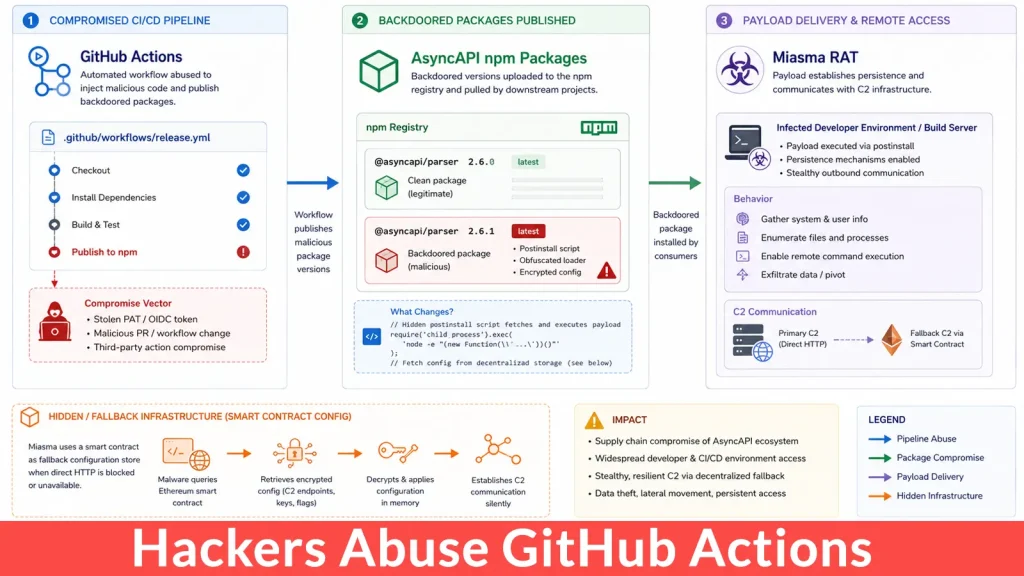
In this particular supply chain compromise, the attackers meticulously orchestrated their assault by exploiting the release process of AsyncAPI npm packages. The core of their strategy involved abusing GitHub Actions, a powerful automation tool widely used for continuous integration and continuous deployment (CI/CD). By compromising the project’s release pipeline, they gained the ability to publish malicious code directly into the official npm namespace.
The attackers leveraged a compromised release process, effectively making the malicious versions indistinguishable from legitimate updates in the eyes of automated systems and unsuspecting developers. This method bypasses traditional security checks that might flag entirely new or suspicious packages, as the distribution channel itself was compromised. The affected packages, with a staggering combined reach of approximately 2.9 million weekly downloads, demonstrate the massive potential impact of such a breach. While the exact number of compromised systems is still being determined, the high download volume underscores the critical need for vigilance in open-source software consumption.
Miasma RAT: The Payload and Its Impact
The ultimate payload delivered through this supply chain attack was the Miasma Remote Access Trojan (RAT). Miasma RAT is a well-known malicious tool designed to grant unauthorized remote access and control over infected systems. Once deployed, it can perform a range of nefarious activities, including:
- Data Exfiltration: Stealing sensitive information such as source code, API keys, credentials, and configuration files.
- System Manipulation: Executing arbitrary commands, modifying system settings, and installing additional malware.
- Lateral Movement: Spreading to other systems within the network, potentially compromising entire development or production environments.
- Persistence: Establishing a backdoor to maintain access even after system reboots.
The consequences of Miasma RAT infiltrating developer systems or automated build environments are severe. Compromised developer machines can lead to intellectual property theft, corporate espionage, and further supply chain attacks by injecting malicious code into other projects. Similarly, a compromised build environment can result in malicious code being compiled into production applications, impacting end-users and the reputation of the affected organization.
Remediation Actions and Proactive Defense
Addressing this type of supply chain attack requires immediate remediation and a proactive stance on security. Organizations and individual developers must implement robust strategies to mitigate similar risks in the future.
- Immediately Update Affected Packages: If you are using AsyncAPI
npmpackages, identify and update to the latest, clean versions as soon as they are made available by the maintainers. Always verify the integrity of packages from official sources. - Audit GitHub Actions Workflows: Regularly review and audit all GitHub Actions workflows for suspicious changes, unauthorized access, or unusual activity. Implement strict access controls and principle of least privilege for all GitHub accounts and associated tokens.
- Implement Multi-Factor Authentication (MFA): Enable MFA for all GitHub accounts,
npmaccounts, and any other critical development infrastructure. This significantly reduces the risk of account compromise. - Supply Chain Security Tools: Utilize software supply chain security tools to scan for known vulnerabilities and malicious packages. These tools can help identify anomalies and suspicious dependencies within your projects.
- Dependency Verification: Employ mechanisms to verify the integrity and authenticity of open-source dependencies. This includes checking cryptographic signatures, comparing package hashes, and monitoring for sudden version changes without clear justification.
- Network Segmentation and Endpoint Detection and Response (EDR): Implement network segmentation to limit the blast radius of potential compromises. Deploy EDR solutions on developer workstations and build servers to detect and respond to suspicious activities indicative of malware like Miasma RAT.
- Security Training: Educate developers on the risks of supply chain attacks, phishing, and proper security hygiene. A well-informed developer community is a powerful line of defense.
Relevant Tools for Detection and Mitigation
| Tool Name | Purpose | Link |
|---|---|---|
| npm audit | Identifies known vulnerabilities in project dependencies. | https://docs.npmjs.com/cli/v9/commands/npm-audit |
| Snyk | Automated security scanning for open-source dependencies and code. | https://snyk.io/ |
| OWASP Dependency-Check | Identifies project dependencies and checks for known vulnerabilities. | https://owasp.org/www-project-dependency-check/ |
| GitHub Advanced Security | Provides code scanning, secret scanning, and dependency review within GitHub. | https://docs.github.com/en/code-security/github-advanced-security/about-github-advanced-security |
| Sonatype Nexus Lifecycle | Automates open-source governance and provides risk assessment. | https://www.sonatype.com/products/nexus-platform/nexus-lifecycle |
Key Takeaways
This incident serves as a stark reminder of the persistent and evolving threat of supply chain attacks. The abuse of legitimate platforms like GitHub Actions to distribute sophisticated malware such as Miasma RAT underscores the need for continuous vigilance. Organizations must prioritize the security of their development pipelines, secure third-party dependencies, and educate their teams on the critical importance of cybersecurity. Proactive measures, including robust access controls, multi-factor authentication, regular security audits, and the strategic deployment of security tools, are essential to protect against these increasingly common and impactful attacks.




