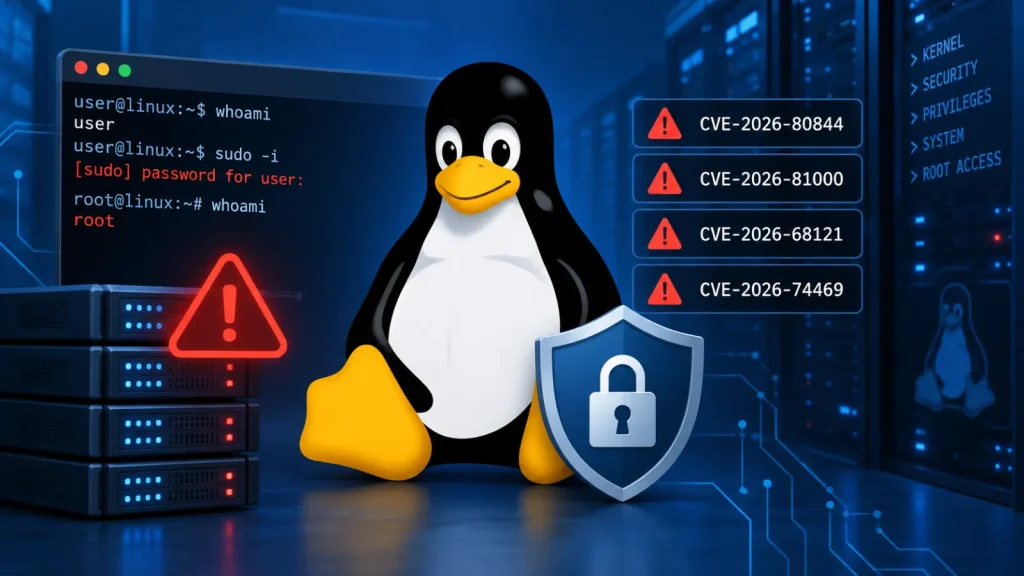
Linux Kernel Hit by Four Privilege Escalation Flaws Enabling Root Access
Linux Kernel Under Attack: Four New Privilege Escalation Flaws Uncovered
The security landscape for Linux systems has once again been rattled, with the recent disclosure of four critical privilege escalation vulnerabilities within the Linux kernel. These flaws, collectively allowing local attackers to achieve root access, highlight the ongoing challenge of maintaining robust security in foundational operating system components. As a cybersecurity analyst, understanding these vulnerabilities, their impact, and the necessary remediation steps is paramount for protecting vital infrastructure.
These newly identified weaknesses, dubbed DirtyAH6, TUNderflow, PPPoEject, and DiagSpill, are rooted in long-standing networking code. Their discovery underscores the complexity of modern kernel development and the persistent need for meticulous security auditing. Upstream fixes have thankfully been released, but the window of exposure for unpatched systems remains a significant concern for IT professionals and developers alike.
Understanding the Four Privilege Escalation Vulnerabilities
The four distinct vulnerabilities each present a path for local privilege escalation, ultimately enabling attackers to gain complete control over affected Linux systems. While they share the common goal of root access, their underlying mechanisms differ.
- DirtyAH6 (CVE-2026-80844): This vulnerability impacts the IPv6 subsystem. More specifically, it resides within code related to Address Header processing, hence the “AH6” in its name. Exploitation of DirtyAH6 allows for kernel memory corruption, leading to privilege escalation. You can find more details on the official CVE database: CVE-2026-80844.
- TUNderflow (CVE-2026-81000): Targeting the TUN/TAP device driver, TUNderflow exploits a flaw that could lead to an integer overflow. Such an overflow can be leveraged to corrupt kernel memory, granting elevated privileges to a local attacker. For further information, refer to: CVE-2026-81000.
- PPPoEject (CVE-2026-68121): This vulnerability affects the Point-to-Point Protocol over Ethernet (PPPoE) implementation within the kernel. Exploiting PPPoEject allows for memory corruption and subsequent privilege escalation. Details are available at: CVE-2026-68121.
- DiagSpill (CVE-2026-74469): DiagSpill is found in the Linux kernel’s diagnostic sockets (Netlink). This flaw can be used to leak sensitive kernel memory information or corrupt it, ultimately enabling privilege escalation. More information can be found at: CVE-2026-74469.
The common thread among these vulnerabilities is their ability to enable kernel memory corruption. This is a critical class of vulnerability, as it allows attackers to manipulate the fundamental operations of the operating system, bypassing security controls and gaining root access.
Impact on Linux Systems and Organizations
The potential impact of these privilege escalation flaws is significant. A local attacker, perhaps a malicious user with limited access or malware that has already gained a foothold on a system, could exploit these vulnerabilities to:
- Gain full root access to the affected Linux machine.
- Install rootkits or other persistent malware.
- Modify system configurations, potentially disabling security measures.
- Access, modify, or delete sensitive data stored on the system.
- Use the compromised system as a launchpad for further attacks within the network.
For organizations, this translates to heightened risk for data breaches, system compromise, and operational disruption. Servers, workstations, and embedded devices running vulnerable Linux kernel versions are all at risk.
Remediation Actions
Mitigating the risk posed by DirtyAH6, TUNderflow, PPPoEject, and DiagSpill requires prompt and decisive action. The following steps are crucial for protecting your Linux environments:
- Kernel Updates: The most critical step is to apply the latest kernel updates provided by your Linux distribution vendor. These updates contain the upstream fixes for these vulnerabilities. Regularly checking for and installing security patches should be a standard operational procedure.
- System Hardening: Implement and maintain strong system hardening practices. This includes limiting unnecessary services, employing the principle of least privilege for user accounts, and configuring robust firewall rules.
- Intrusion Detection/Prevention Systems (IDS/IPS): Deploy and configure IDS/IPS solutions to monitor for suspicious activity that might indicate an attempted exploitation or post-exploitation behavior. While these flaws are local, initial access often precedes privilege escalation.
- Security Audits and Scans: Conduct regular security audits and vulnerability scans of your Linux systems. These can help identify unpatched systems or misconfigurations that could expose your environment to risk.
- Endpoint Detection and Response (EDR): Utilize EDR solutions to gain deeper visibility into system processes and detect anomalous behavior that could signal compromise, even if the initial exploit is local.
Tools for Detection and Mitigation
Leveraging appropriate tools is essential for a comprehensive security posture. Here’s a table of relevant tools that can assist in detecting vulnerabilities, scanning for them, and generally bolstering your Linux security.
| Tool Name | Purpose | Link |
|---|---|---|
| CVE.mitre.org | Official CVE database for vulnerability details. | https://cve.mitre.org |
| Nessus | Vulnerability scanner for identifying unpatched systems and configurations. | https://www.tenable.com/products/nessus |
| OpenVAS / Greenbone Vulnerability Management | Open-source vulnerability scanner. | https://www.greenbone.net |
| Lynis | Security auditing tool for Unix-like systems. | https://cisofy.com/lynis/ |
| KernelCare | Live kernel patching without reboots (for some distributions). | https://www.kernelcare.com |
Maintaining Robust Linux Security
The discovery of DirtyAH6, TUNderflow, PPPoEject, and DiagSpill serves as a stark reminder that even the most mature and widely scrutinized software, like the Linux kernel, can harbor critical vulnerabilities. Proactive patching, rigorous security auditing, and the implementation of defense-in-depth strategies are not merely best practices but fundamental requirements for safeguarding digital assets. Staying informed about new threats and acting swiftly to mitigate them is the bedrock of effective cybersecurity.