
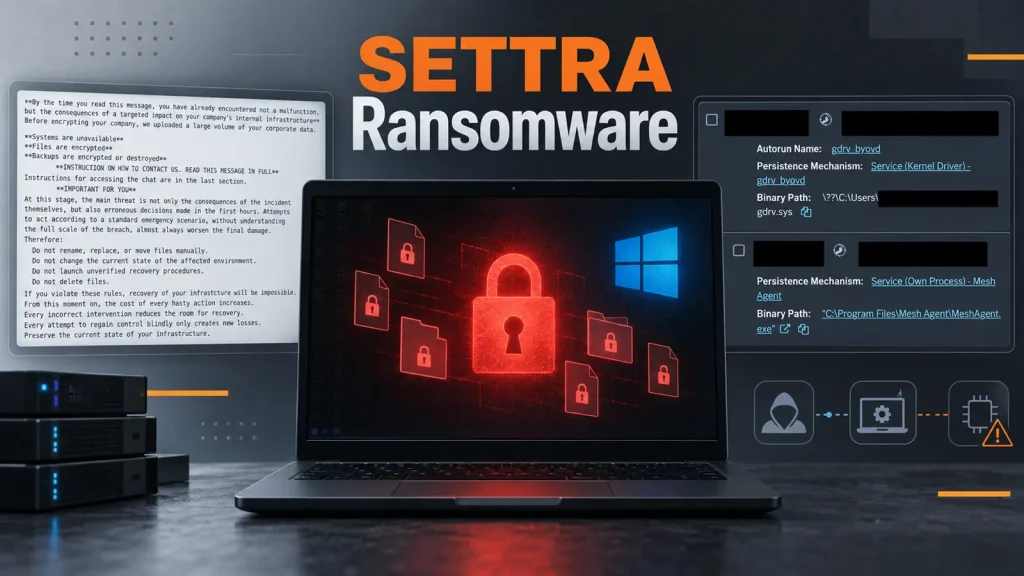
New SETTRA Ransomware Uses MeshAgent RMM and BYOVD to Encrypt Windows Systems
A new and alarming ransomware operation, dubbed Settra, has been identified, posing a significant threat to Windows networks. Recent investigations have directly linked Settra to at least two distinct intrusions, each characterized by its sophisticated methods, including the abuse of remote-management software and novel recovery-blocking techniques. This emerging threat not only encrypts critical files and leaves behind pervasive ransom notes but also actively works to impede both incident investigation and data restoration efforts, amplifying the impact on affected organizations.
The attackers behind Settra ransomware demonstrate a clear understanding of network vulnerabilities and operational security, leveraging specific tools and techniques to maximize their destructive potential. Understanding their modus operandi is crucial for bolstering defensive strategies.
Settra Ransomware’s Attack Vectors and Modus Operandi
Initial reports indicate that the Settra ransomware operators are gaining unauthorized access through several well-established attack vectors. While specific initial compromise methods can vary, a consistent theme involves the abuse of legitimate tools and vulnerabilities to establish a foothold and escalate privileges.
Leveraging MeshAgent RMM for Initial Access
One of the most notable aspects of Settra’s attacks is its use of MeshAgent Remote Monitoring and Management (RMM) software. MeshAgent, a legitimate tool designed for IT administrators to manage and support remote systems, is being weaponized by the Settra group. Attackers likely compromise credentials or exploit misconfigurations to gain control of MeshAgent instances already present in a network or deploy it themselves to establish persistent access. This allows them to execute commands, transfer files, and ultimately deploy the ransomware payload with elevated privileges, bypassing traditional security controls that might flag unknown executables.
BYOVD – Bringing Your Own Vulnerable Driver
Further escalating their malicious capabilities, Settra ransomware is employing a Bring Your Own Vulnerable Driver (BYOVD) technique. This sophisticated approach involves the attackers introducing a legitimate, but vulnerable, device driver into the compromised system. Once loaded, this driver can be exploited to achieve kernel-level privileges. Such high-level access allows the ransomware to disable security software, bypass operating system defenses, and perform actions that would otherwise be impossible from user-mode, making detection and remediation significantly more challenging. This technique underscores a growing trend among ransomware operators to exploit trust in signed drivers.
Encryption and Post-Encryption Tactics
Upon gaining the necessary privileges, Settra initiates its encryption routine, targeting a wide array of file types crucial for business operations. Victims are then presented with ransom notes detailing demands for payment, typically in cryptocurrency, to decrypt their files. Beyond simple encryption, Settra operators are implementing tactics to hinder recovery efforts. This includes deleting shadow copies, disabling backup services, and potentially corrupting system recovery partitions, thereby complicating an organization’s ability to restore data from backups. This makes the investigative process significantly more complex, forcing organizations to dedicate more resources to incident response.
Remediation Actions and Proactive Defenses
Defending against advanced threats like Settra requires a multi-layered security strategy focusing on prevention, detection, and rapid response. Organizations must prioritize robust security hygiene and advanced threat detection capabilities.
- Patch Management: Regularly update all operating systems, applications, and network devices to patch known vulnerabilities. This is critical for preventing BYOVD attacks and exploitation of other software flaws.
- Strong Authentication: Implement multi-factor authentication (MFA) across all accounts, especially for remote access, RMM tools, and privileged accounts, to prevent credential theft and abuse.
- Endpoint Detection and Response (EDR): Deploy EDR solutions to monitor endpoints for suspicious activities, including the loading of unusual drivers, unauthorized RMM tool usage, and unusual file encryption patterns.
- Network Segmentation: Segment networks to limit lateral movement. If an attacker breaches one segment, the impact on the entire network is minimized.
- Principle of Least Privilege: Enforce the principle of least privilege for all users and services, ensuring they only have access to resources absolutely necessary for their function.
- RMM Tool Security: Secure and monitor all RMM tools. Change default credentials, restrict access to authorized personnel and IP ranges, and audit their logs regularly for anomalous activity.
- Regular Backups: Maintain isolated, air-gapped, and immutable backups of critical data. Test restoration processes regularly to ensure data integrity and recoverability.
- Security Awareness Training: Educate employees about phishing, social engineering, and the importance of strong passwords to reduce the risk of initial compromise.
- Driver Whitelisting/Blacklisting: Implement policies to control which drivers can be loaded on systems. Consider tools that enforce driver whitelisting to prevent malicious or vulnerable drivers from being introduced.
Relevant Tools for Detection and Mitigation
Implementing the right security tools is paramount for effectively combating ransomware threats like Settra. The following table outlines tools that can aid in detection, scanning, and mitigation efforts:
| Tool Name | Purpose | Link |
|---|---|---|
| Microsoft Defender for Endpoint | Advanced endpoint detection and response (EDR) capabilities, behavior-based anomaly detection. | Microsoft Defender for Endpoint |
| CrowdStrike Falcon Insight | Cloud-native EDR and next-gen antivirus for real-time protection against advanced threats. | CrowdStrike Falcon Insight |
| Varonis Data Security Platform | Monitors data access, identifies unusual behavior, and helps protect sensitive files. | Varonis Data Security Platform |
| Nessus Professional | Comprehensive vulnerability scanning and assessment to identify weak points in infrastructure. | Nessus Professional |
| Sysinternals Suite (especially Process Monitor) | Advanced utilities for monitoring, troubleshooting, and diagnosing Windows systems, useful for detecting suspicious driver loads. | Sysinternals Suite |
The Evolving Ransomware Landscape
The emergence of Settra ransomware highlights the continuous evolution of cyber threats. Adversaries are constantly refining their techniques, moving beyond simple phishing attacks to incorporate sophisticated methods like BYOVD and the abuse of legitimate RMM tools. This strategic shift underscores the critical need for organizations to move beyond reactive security measures and adopt a proactive, adaptive defense posture. Continuous monitoring, robust incident response plans, and a deep understanding of current threat intelligence are indispensable in safeguarding digital assets against these increasingly complex and destructive attacks.




